

Decluttering Mental Health Tips. Physical clutter can drain your energy and leave your brain spinning with constant decisions. For professionals juggling work and life, the stress and anxiety triggered by clutter are more than a minor annoyance, affecting focus, mood, and overall well-being. By understanding your unique emotional responses and tapping into tech-driven solutions like AI-powered tools, you can reclaim mental clarity and create an organized space that actually supports your productivity.
Table of Contents
- Step 1: Assess Your Emotional Triggers Around Clutter
- Step 2: Set Clear Decluttering Goals and Priorities
- Step 3: Leverage AI Tools to Simplify Decisions
- Step 4: Gamify Small Wins for Lasting Motivation
- Step 5: Verify Progress and Adjust Habits Regularly
Quick Summary
| Key Point | Explanation |
|---|---|
| 1. Understand Your Emotional Triggers | Reflect on how clutter affects you emotionally to identify specific triggers that impact your decluttering process. |
| 2. Set Specific Decluttering Goals | Define clear, measurable goals focused on areas that will relieve stress, enhancing motivation to declutter. |
| 3. Use AI Tools for Decision-Making | Implement AI to analyze items quickly, reducing mental fatigue and simplifying your decision-making process. |
| 4. Gamify the Decluttering Process | Introduce a points system for small wins to maintain motivation and make the decluttering experience more enjoyable. |
| 5. Regularly Review Progress and Adjust | Schedule consistent check-ins to assess your decluttering journey and adapt strategies as life changes. |
Step 1: Assess Your Emotional Triggers Around Clutter
Before you tackle a single item, you need to understand what clutter does to you emotionally. This step is about getting honest with yourself about your feelings toward the mess around you. Not all clutter stresses people equally, and not everyone reacts the same way. Your emotional relationship with clutter is unique, shaped by past experiences, current life circumstances, and how your brain processes decision-making. Once you identify your specific triggers, you can approach decluttering in a way that actually reduces stress instead of creating more anxiety.
Start by sitting with the clutter for a few minutes. Go into a cluttered room or area and simply observe. What emotions surface? Do you feel overwhelmed, guilty, anxious, or ashamed? Research shows that emotional reactions to clutter vary significantly among individuals, and understanding these triggers is the foundation for meaningful change. Some people feel paralyzed by decision fatigue. Others experience a wave of anxiety about the monetary value of items they haven’t used. Still others feel guilt about unfinished projects or gifts they never appreciated. Write down three to five emotions that come up when you look at your clutter. Be as specific as possible. Instead of writing “stressed,” try “anxious about making the wrong decision” or “ashamed that others might see this mess.” These detailed descriptions will guide how you approach each decluttering session.
Next, trace back where these emotions come from. Did a parent criticize you for messiness? Do you hold onto items because giving them away feels like failure? Is your clutter linked to past financial insecurity, making it hard to let go of anything usable? The connection between perceived clutter and emotional well-being is deep, often rooted in how we grew up and what we learned about possessions. Spend time journaling about this. You don’t need to solve anything yet, just understand the pattern. Once you see why certain items trigger you, you can turn that awareness into action when you feel paralyzed. Awareness is the first real step toward breaking the cycle.
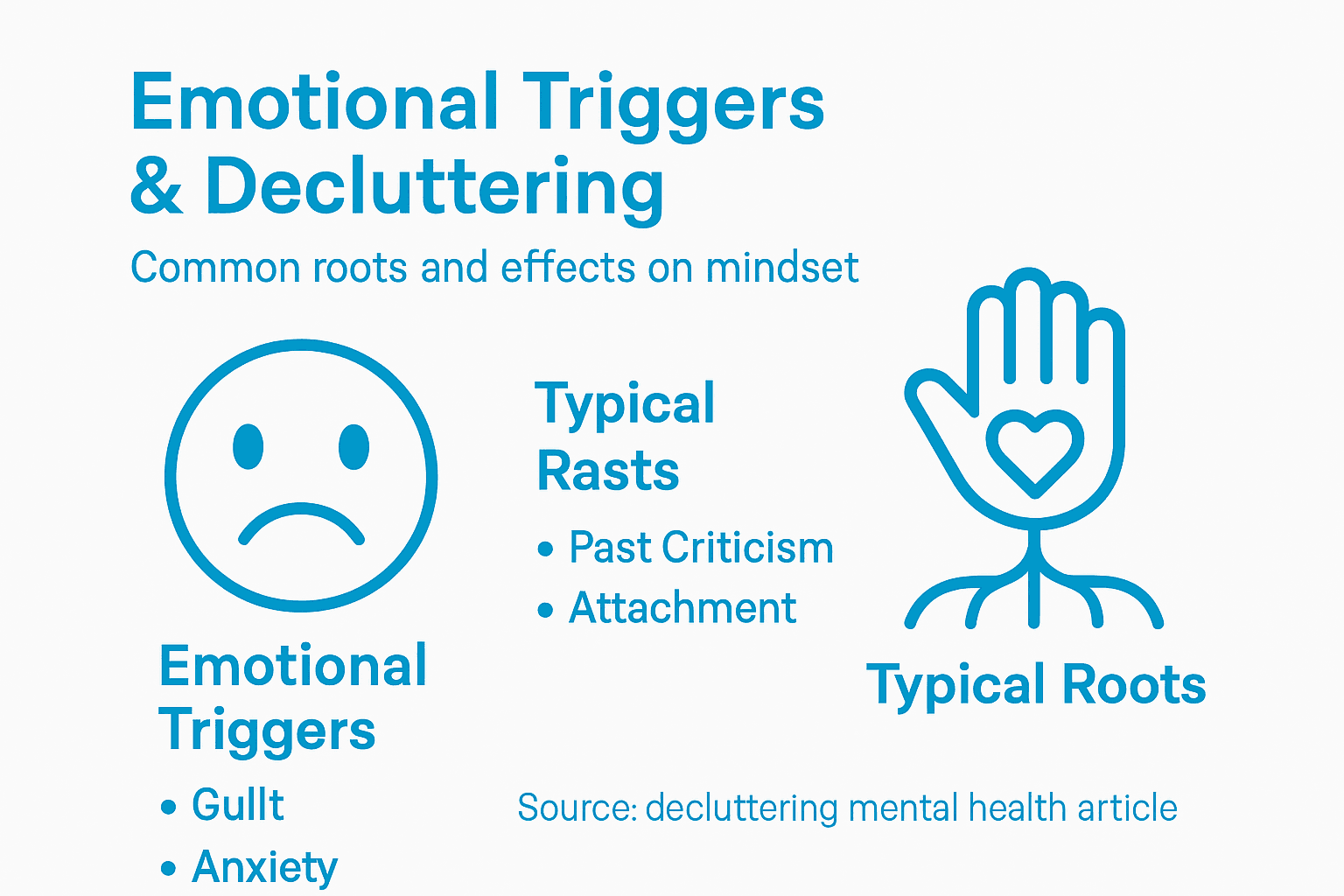
Here’s a brief comparison of common emotional triggers around clutter and their potential roots:
| Emotional Trigger | Possible Root Cause | Example Impact |
|---|---|---|
| Anxiety about decisions | Past criticism or pressure | Fear of letting go of items |
| Guilt over unused items | Financial insecurity | Holding onto excess belongings |
| Shame about mess | Fear of judgment | Avoiding inviting others over |
| Overwhelm | Decision fatigue | Difficulty starting decluttering |
| Sentimental attachment | Family history or memories | Reluctance to part with keepsakes |
Pro tip: Take a photo of your cluttered space and look at it when you’re feeling calm and clear-headed. This creates distance between the emotional reaction and the rational assessment, making it easier to identify patterns without feeling overwhelmed.
Step 2: Set Clear Decluttering Goals and Priorities
Now that you understand your emotional triggers, it’s time to set specific goals that will guide your decluttering work. Without clear objectives, you’ll drift from room to room, starting projects you never finish, which only adds to the overwhelm. Your goals need to be meaningful and connected to reducing stress in your life, not just checking boxes.
Start by identifying which spaces or items will bring you the most relief. Think about your daily life. Is your bedroom a sanctuary or a source of anxiety? Does your home office make it hard to focus? Are you spending time searching for things because everything is scattered? Setting priorities based on what improves well-being is critical to decluttering success. Pick one area that, when cleared, would genuinely change how you feel when you walk into that space. For busy professionals, this often means starting with a workspace or the entryway where you drop everything at the end of the day. Once you’ve identified that priority area, make your goal specific and measurable. Instead of saying “declutter my bedroom,” try “sort through and organize my closet, keeping only clothes I’ve worn in the past year.” The more concrete your goal, the easier it becomes to actually finish it and feel the mental reward that comes with completion.

Now break your main goal into smaller milestones. SMART goals (Specific, Measurable, Achievable, Relevant, Time-bound) help you stay focused and motivated throughout the process. For example, if your goal is to organize your home office in two weeks, your milestones might look like this: clear your desk by day three, sort through papers and files by day seven, and organize remaining items by day fourteen. This prevents the paralysis that comes from staring at a massive project. Small, manageable objectives keep your motivation high and your stress levels down. Write these goals somewhere visible so you can track progress, and be honest about your timeline. Rushing through decluttering just to finish defeats the purpose. When you approach this mindfully, you’re not just organizing your space, you’re rewiring how you make decisions about what you keep.
Pro tip: Choose your first goal based on the space you use most frequently, not the messiest room. Quick wins in high-traffic areas boost motivation faster than tackling the basement no one sees.
Step 3: Leverage AI Tools to Simplify Decisions
This is where technology becomes your greatest ally. By now you understand your emotional triggers and have clear goals, but you still face the hardest part: making countless micro-decisions about each item. Should you keep it, donate it, sell it, or trash it? That decision fatigue is what stops most people cold. AI-powered tools can eliminate the mental burden by analyzing your items and suggesting the best outcome based on condition, value, and usage patterns. Instead of agonizing over every single object, you hand the analysis to technology and focus on execution.
Start by identifying what information matters for your decisions. Think about the criteria you actually use when evaluating an item: Is it in good condition? Have I used it recently? Is it worth money? Could someone else benefit from it? AI tools are transforming how people simplify decisions by automating analysis and suggesting personalized support, which directly reduces the cognitive load that makes decluttering feel impossible. When you use an AI-powered decluttering platform, you provide basic information about each item, and the system handles the heavy lifting. For busy professionals juggling work, family, and endless obligations, this approach cuts decluttering time significantly. You move through your space more quickly because you’re not stuck in analysis paralysis over whether that bread maker from 2019 might someday be useful. The AI provides a clear recommendation, and you make the final call. This collaborative approach combines human judgment with machine efficiency.
As you work through your priority area, notice how much mental energy returns to you. The stress of making decisions alone disappears when you have a tool suggesting logical, personalized outcomes. AI-powered tools reduce cognitive overload by analyzing emotional states and simplifying mental health management, principles that directly apply to decluttering tasks. You stop second-guessing yourself because the recommendations are based on consistent, objective criteria rather than mood-dependent thinking. Track which decisions feel easier once you have AI support, and use those insights to understand how decision fatigue has been holding you back.
Below is a summary table of how AI-powered decluttering tools impact the process for busy professionals:
| Tool Feature | Decluttering Benefit | Business Impact |
|---|---|---|
| Automatic item analysis | Rapid, consistent decisions | Saves hours of manual sorting |
| Personalized suggestions | Reduces decision fatigue | Lowers mental stress |
| Progress tracking | Visual organization feedback | Boosts user motivation |
| Predictive recommendations | Prioritizes valuable tasks | Focuses effort where needed |
Pro tip: Start with categories where decisions feel hardest, not easiest. Let the AI handle your clothes, kitchen items, or books first, since those often trigger the most decision paralysis, and save the emotionally easier categories for when you want a confidence boost.
Step 4: Gamify Small Wins for Lasting Motivation
Decuttering is a marathon, not a sprint. By now you’ve identified your emotional triggers, set clear goals, and leveraged AI to simplify decisions. But here’s the challenge: staying motivated when the work feels endless. This is where gamification transforms the entire experience. Instead of viewing decluttering as a tedious chore, you turn it into a system where every small victory counts. Points, streaks, badges, and progress tracking shift your brain from dreading the work to actively seeking the next win.
Start by defining what counts as a win in your system. A win might be sorting through one shelf, making decisions on ten items, or completing a full category like your kitchen utensils. The key is making wins small enough that you can achieve them regularly but meaningful enough to feel satisfying. Gamification enhances motivation by tapping into psychological mechanisms such as reward recognition and progress tracking, which directly applies to sustaining engagement in decluttering work. When you earn points or unlock a badge after clearing a shelf, your brain releases dopamine, the same reward chemical that makes you want to play video games for hours. This isn’t manipulation, it’s behavioral science working in your favor. Track your progress visually. Some people use a physical checklist they mark off. Others use an app that shows their point accumulation or streak count. The visual representation of progress creates momentum that carries you through sessions when motivation naturally dips. Celebrate these small wins immediately. Don’t wait until your entire closet is done. After completing one category, pause and acknowledge the achievement.
As you continue with your decluttering work, notice how gamification prevents the emotional crash that usually happens midway through a project. Gamification boosts motivation and engagement by rewarding small achievements, which fosters lasting engagement over time. You’re building positive associations with the work itself. Every decision you make adds to your streak. Every category you finish unlocks a new achievement. This cumulative reward system keeps you coming back, not because you feel obligated, but because you want to maintain your streak or reach the next milestone. The decluttering process shifts from something you dread into something you anticipate.
Pro tip: Set rewards tied to your milestones that have nothing to do with buying things. After reaching 500 points, treat yourself to an hour of guilt-free relaxation, a favorite meal, or time doing something you love, reinforcing that decluttering effort deserves celebration.
Step 5: Verify Progress and Adjust Habits Regularly
You’ve made it this far, which means you’ve already broken through the paralysis that stops most people. Now comes the part that separates temporary progress from lasting transformation: reviewing what’s working and adjusting what isn’t. Progress isn’t a straight line. Life shifts, priorities change, and habits that worked brilliantly three months ago might need tweaking now. Regular verification keeps your decluttering momentum alive and prevents you from sliding back into old patterns.
Set a weekly or biweekly review session. Spend fifteen minutes looking at your progress toward your goals. Are you maintaining the spaces you’ve already cleared? Are you still making decisions using the AI tool, or have you slipped back into endless deliberation? Check your gamification metrics. Has your point accumulation slowed? Is your streak still active? These numbers tell a story about your habits. Tracking progress and making habit adjustments regularly ensures routines stay relevant and achievable, which sustains behavior change and reduces overwhelm. If you notice your motivation dropping, don’t judge yourself. Instead, ask what’s changed. Are you busier this month? Did a particular category prove harder than expected? Is the reward system no longer exciting? Once you identify the friction point, you can address it directly. Maybe you need to lower your weekly goals during a busy work season. Perhaps you need a different type of reward. Or you might realize that a particular category needs to be broken down into smaller chunks. The system works only when it reflects your actual life.
Also track your emotional state alongside your progress. Notice which cleared spaces genuinely improve your mental health and which don’t matter as much as you thought. Establishing daily routines with regular review and flexibility to adjust habits supports mental health by recognizing progress through consistent small behaviors. This feedback loop is gold. Some people feel dramatically calmer after organizing their bedroom. Others find that clearing their home office actually transforms their work focus and productivity. Understanding your personal triggers helps you prioritize future decluttering efforts toward changes that matter most to you. Build flexibility into your system so you can adapt without abandoning the process entirely.
Pro tip: Schedule your review session for the same day and time each week, treating it like a non negotiable appointment with yourself. Consistency in checking progress prevents small backslides from becoming major derailments.
Transform Stress Into Success With Personalized Decluttering Support
The article highlights how emotional triggers and decision fatigue create a mental block that makes decluttering overwhelming and stressful. If you find yourself feeling anxious about making the wrong choices or paralyzed by too many decisions, you are not alone. The goal is to regain control over your space without adding to your stress. That is where Mindset & Emotional Support – Declutter Now meets cutting-edge AI technology to simplify your process and rebuild your confidence one decision at a time.
Explore how DeclutterNow.ai combines behavioral science with AI-powered analysis and gamification to remove decision paralysis and reward your progress. Don’t let clutter dictate your mental well-being. Visit DeclutterNow.ai today to experience a stress-free, motivating way to clear your space and calm your mind. Take the first step toward lasting change and make overwhelm a thing of the past.
Frequently Asked Questions
How can I identify my emotional triggers related to clutter?
Understanding your emotional triggers begins with self-reflection. Take a moment to sit in your cluttered space and observe your feelings—note specific emotions like anxiety or guilt. Write down three to five emotions that arise, then consider their possible origins to gain insights into your relationship with clutter.
What steps should I take to set clear decluttering goals?
Start by identifying which areas in your home cause the most stress or distraction. Create specific, measurable goals, such as “organize my closet by the end of this week,” and break those goals down into smaller milestones to keep you motivated and focused.
How can AI tools help in the decluttering process?
AI tools simplify decision-making by analyzing items and suggesting whether to keep, donate, or discard them based on their condition and your usage patterns. Utilize these tools to reduce decision fatigue and speed up your decluttering process, allowing you to make faster progress on your goals.
What are effective ways to gamify my decluttering efforts?
Define small wins for your decluttering activities, such as sorting five items or completing one shelf. Track these achievements visually, and reward yourself with meaningful and non-material incentives to maintain motivation and create a positive association with the decluttering process.
How often should I review my decluttering progress?
Schedule a review session weekly or biweekly to assess your progress and adjust your goals as necessary. Spend about 15 minutes reflecting on what has worked and what hasn’t to ensure you stay on track and adapt your approach to meet your evolving needs.
What should I do if I feel overwhelmed during the decluttering process?
If you start to feel overwhelmed, take a break and revisit your emotional triggers to understand why you feel this way. Break your decluttering tasks into smaller, manageable chunks to lower anxiety, focusing on one category or space at a time to maintain progress without added stress.
Recommended
- You Are Not Your Clutter: A Guided Meditation to Clear Your Mind and Your Space – Declutter Now
- How to Organize Your Home Room by Room Without Overwhelm
- How to Get Rid of Clutter When You Feel Paralyzed
- How to Stop Being a Hoarder and Reclaim Your Space
Decluttering Mental Health Tips