
Let me guess what happened this morning.
You walked past that pile on the counter—the one that’s been growing for weeks—and felt that familiar surge of guilt mixed with exhaustion. You thought, “I really should deal with that today.” Then immediately: “But where would I even start?” And finally: “I’ll do it this weekend.”
Except you said the same thing last weekend. And the weekend before that.
Here’s what I need you to understand: You are not lazy. You are not a failure. You are not broken.
You’re overwhelmed. And overwhelm has a solution.
The Connection Nobody Talks About
For years, I tried to fix my cluttered home by… well, by trying to fix my cluttered home. I’d read organizing books. I’d buy storage containers. I’d set aside entire Sundays to “finally deal with it.”
And I’d get nowhere.
Because I was treating the symptom, not the cause.
The truth is this: Your cluttered space and your overwhelmed mind aren’t two separate problems. They’re two sides of the same coin, feeding each other in an exhausting cycle.
When your space is chaotic, your mind feels chaotic.
When your mind is chaotic, you can’t organize your space.
But here’s the beautiful part: You can interrupt this cycle from either side.
Most people try to fix it by cleaning first. But what if we started with the mind instead?
Why This Meditation Is Different
This isn’t another “just be positive!” meditation that ignores reality.
This is a practice designed specifically for the overwhelm that comes when you:
- Have too many decisions to make
- Feel guilty about the mess but frozen to fix it
- Know what you should do but can’t make yourself do it
- Feel like your space is closing in on you
- Carry mental weight that shows up as physical clutter
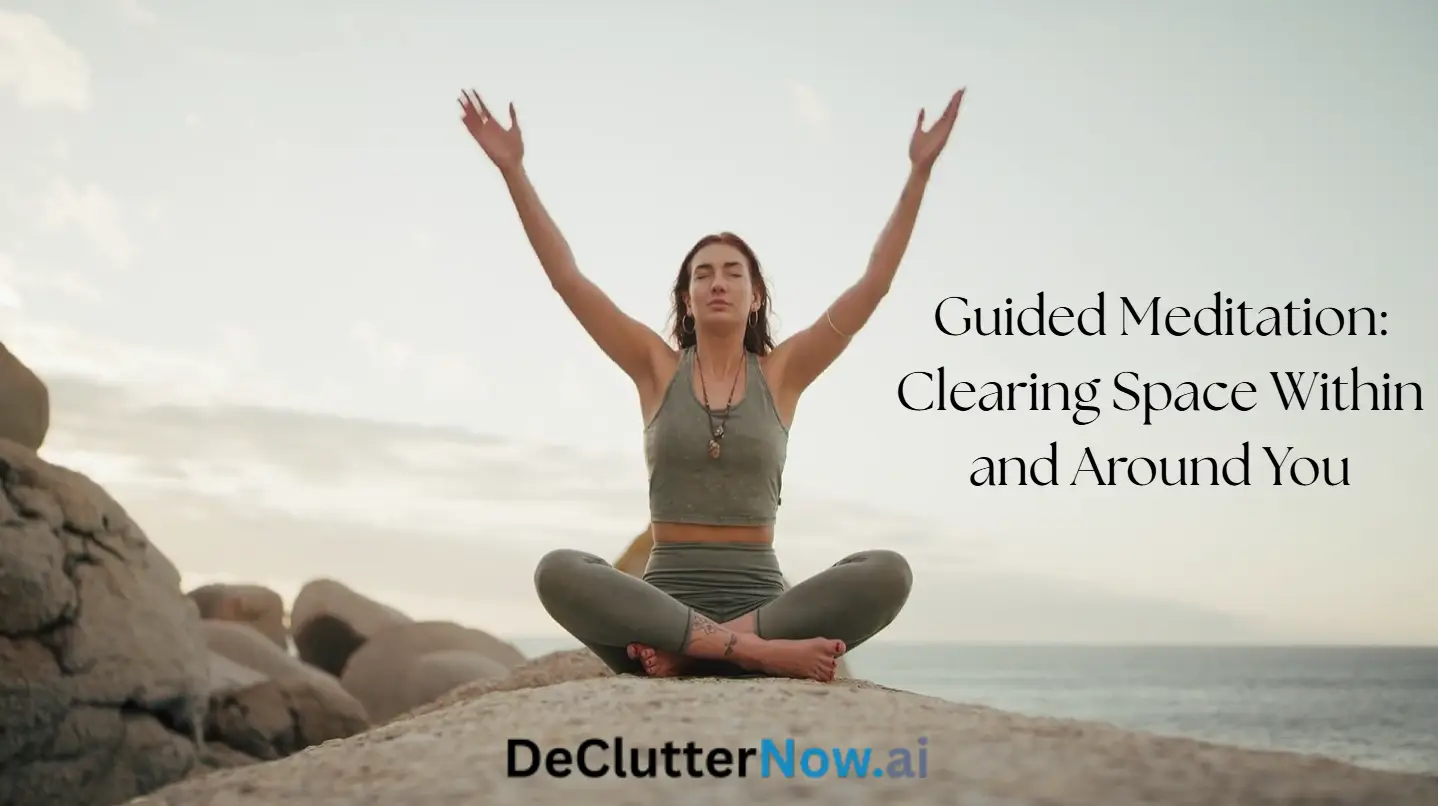
What you’ll experience in this 5-minute meditation:
 Validation first – Because toxic positivity doesn’t help Gentle breathing practices – To create mental space Visualization exercises – That connect mind and physical space Realistic affirmations – Not “manifesting” nonsense, just truth A bridge to action – So you finish feeling ready, not just relaxed
The Science Behind It (Yes, There’s Science)
Research shows that physical clutter directly impacts cognitive function. A Princeton University study found that physical clutter competes for your attention, reducing performance and increasing stress.
But here’s what’s fascinating: The reverse is also true.
Studies on mindfulness meditation show that it reduces decision fatigue, improves executive function, and increases our capacity to take action on tasks we’ve been avoiding.
Translation: Clear the mind, and the space becomes easier to clear.
This meditation leverages both insights. We’re not just relaxing—we’re strategically creating the mental capacity you need to make decisions about your physical space.
What Happens After You Watch
Many people report that after this meditation, they naturally want to take one small action:
Sarah (from the comments):
“I did this meditation, then immediately cleared my kitchen counter. First time in MONTHS it’s been empty. I actually cried.”
Michael:
“I’ve been avoiding this one drawer for literally two years. After the meditation, I just… opened it. Sorted it. Done. Why was I so scared of a drawer?”
Jessica:
“I didn’t clean anything after, but I felt lighter. Like I finally had permission to NOT do everything at once. That actually helped more than forcing myself would have.”
The meditation doesn’t force you to clean. It gives you the mental space needed to want to—and to know where to begin.
How to Use This Meditation
For Maximum Impact:
BEFORE you watch:
- Find a comfortable spot (doesn’t have to be perfect)
- Turn off notifications
- Have headphones if possible
- Don’t worry about sitting perfectly—comfort matters more
DURING the meditation:
- Close your eyes or soften your gaze
- Don’t judge yourself if your mind wanders (it will—that’s normal)
- Let yourself feel whatever comes up
- There’s no “wrong” way to do this
AFTER you finish:
- Sit for 30 seconds before jumping up
- Notice how your body feels
- Look around your space with fresh eyes
- If you feel moved to take one small action, do it
- If not, that’s okay too—the work happened internally
The One-Item Practice (Try This After the Meditation)
If you want to bridge this meditation into physical action, try this simple practice:
Step 1: After the meditation, choose ONE item that’s been weighing on you
Step 2: Ask yourself: “Do I need this? Do I use this? Do I love this?”
Step 3: Make ONE decision: Keep, Donate, Sell, or Trash
Step 4: Take action TODAY (even if it’s just putting it in a “donate” bag)
That’s it. One item. One decision. One action.
You don’t need to declutter your entire house. You just need to prove to yourself that you can make a decision. That you’re not actually frozen—you’re just carrying too much mental weight.
This meditation helps you set that weight down.
The Affirmations (Read These When You Need Them)
Sometimes you need these words before you’re ready to do the full meditation. Save this section and come back to it:
 “Overwhelm is not my enemy—it’s a signal.”
Translation: You’re not broken. Your system is just overloaded.
“I don’t need to do everything; I just need to do one thing.”
Translation: Permission to start small granted.
“Empty space is not emptiness—it’s possibility.”
Translation: Letting go creates room for what matters.
“Every item I release makes room for what matters.”
Translation: Subtraction is a valid strategy.
“My space reflects my mind; my mind reflects my space.”
Translation: They heal together.
“I am allowed to start small.”
Translation: Small IS enough.
“Progress doesn’t have to be perfect.”
Translation: Done is better than perfect.
When Mental Overwhelm Needs More Than Meditation
Let’s be real: Sometimes the overwhelm is bigger than a meditation can address.
If you’re experiencing:
- Severe anxiety that interferes with daily life
- Depression that makes even small tasks feel impossible
- Trauma responses to your clutter
- Hoarding behaviors that you can’t control
Please reach out to a licensed mental health professional. There’s no shame in needing more support. Meditation is a tool, not a cure-all.
This practice is designed for general overwhelm and decision fatigue—the kind most of us experience when life gets too full. For clinical conditions, please seek appropriate treatment.
Why I Created This (My Story)
I’ll be honest with you: I created this meditation because I needed it myself.
A few years ago, my house had become… well, embarrassing. Not hoarder-level, but definitely “please don’t come over” level. Boxes I hadn’t unpacked. Piles I walked around. Drawers I was afraid to open.
And every day, I’d feel this low-grade shame. This constant mental buzz of “You should really deal with that.”
I tried everything:
- Hired an organizer (felt judged)
- Bought organizing books (never finished them)
- Scheduled “declutter days” (found excuses to avoid them)
- Guilt-tripped myself constantly (made it worse)
Nothing worked because I was trying to force myself to do something my mind wasn’t ready for.
Then I learned about the mind-space connection. I realized I needed to clear my mental clutter before I could tackle my physical clutter.
So I created this practice—for me first, then for others like me.
And it worked. Not overnight. Not perfectly. But gradually, I started to:
- Make decisions about items without overthinking
- Clear surfaces without feeling overwhelmed
- Open those drawers I’d been avoiding
- Actually maintain the spaces I cleared
The secret wasn’t willpower. It was creating mental space first.
What to Do With Your Freed Space (After You Create It)
Once you’ve started clearing—both mentally and physically—people often ask: “Now what? What do I do with this empty space?”
Here’s what I’ve learned:
DON’T immediately fill it. Let it breathe. Get used to the feeling of openness. Your instinct might be to fill it with something “better,” but resist that for a while.
DO protect it. Once you’ve cleared a surface, counter, or drawer, establish a rule: This space stays clear. It’s your anchor point—proof that you can maintain clarity.
DON’T feel guilty about empty space. We’re so conditioned to maximize every inch that empty space feels wasteful. It’s not. Empty space is functional. It’s breathing room for your life.
DO use it intentionally. If you’re going to put something there, make it something that genuinely serves you or brings you joy. Not just “stuff that needs to go somewhere.”
The DeclutterNow Connection (How We Can Help)
After hundreds of people told me this meditation helped them, I kept hearing the same question:
“Okay, I feel ready now. But what do I actually DO with all this stuff?”
That’s why I built DeclutterNow.ai.
It’s designed for exactly this moment—when you’ve created mental space through meditation and you’re ready to take action, but you need help with:
Decision-making – AI analyzes your items and suggests what to do Gamification – Earn points for progress (because your brain loves rewards) Tracking – See how much space you’ve actually freed (it’s more than you think) Selling support – Direct integration with eBay, Mercari, Poshmark No judgment – Just practical help, one item at a time
Think of it like this:
- This meditation = Creates mental space to make decisions
- DeclutterNow = Helps you make those decisions efficiently
They work beautifully together.
Try DeclutterNow free for 14 days →
Frequently Asked Questions
Q: How often should I do this meditation?
A: As often as you need it. Some people do it:
- Daily (as part of a morning routine)
- Before decluttering sessions (to prepare mentally)
- When feeling overwhelmed (as an emotional reset)
- Weekly (as maintenance)
There’s no wrong frequency. Listen to what you need.
Q: What if I fall asleep during it?
A: That means you needed rest more than meditation! Your body is smart. If you keep falling asleep, try:
- Doing it earlier in the day
- Sitting up instead of lying down
- Opening your eyes slightly instead of fully closing them
Or just accept that sometimes you need a 13-minute nap, and that’s okay too.
Q: I did the meditation but still can’t make myself clean. Am I doing it wrong?
A: No. There’s no “wrong.” This meditation creates the capacity to take action, but it doesn’t force it. Sometimes you need:
- Multiple sessions before you’re ready
- Professional support (therapy, ADHD treatment, etc.)
- Help from others (friends, organizers, apps like DeclutterNow)
- Simply more time to process
The meditation worked if you feel even slightly lighter afterward. Action can come later.
Q: Can I do this meditation while actually organizing?
A: Not really—it requires you to be still and focused. BUT you can:
- Do it BEFORE organizing (to prepare mentally)
- Take meditation breaks DURING organizing (if overwhelmed)
- Revisit the affirmations while you work
Think of the meditation as the warmup, not the workout itself.
Q: What if the clutter isn’t mine? (Roommate, partner, family)
A: Ah, the hardest situation. This meditation helps YOU process YOUR feelings about the situation. It can:
- Reduce your reactive stress
- Help you communicate needs more clearly
- Create boundaries around shared spaces
- Accept what you can’t control
But it won’t magically make others clean up. For that, you need conversations, boundaries, and sometimes professional mediation.
The Truth About Clutter (That Nobody Wants to Say)
Here’s what I’ve learned after years of working with overwhelmed people:
Your clutter is not your real problem.
Your clutter is a symptom of:
- Not enough time
- Not enough energy
- Not enough support
- Too many decisions
- Too many responsibilities
- Not enough processing capacity
And in a world that demands MORE MORE MORE from you constantly, of course your space becomes cluttered. Of course your mind feels full.
You are not failing at life because you have clutter. You’re simply human in a system that demands too much.
This meditation doesn’t fix the system. But it gives you a tool to manage your nervous system’s response to it. And that’s a start.
Your Next Steps (Choose Your Own Adventure)
If you’re feeling ready to take action:
- Watch the meditation above
- Choose ONE small space (a drawer, a surface, a corner)
- Try the One-Item Practice
- Use DeclutterNow to help with decisions
If you’re not ready for action yet:
- Watch the meditation above
- Save this post for later
- Give yourself permission to just rest today
- Know that readiness will come
If you want more support:
- Subscribe to our YouTube channel for more meditations
- Join our email list for weekly encouragement
- Try DeclutterNow free for 14 days
- Follow us on Instagram for daily reminders
Final Thoughts: You Are Not Your Clutter
If you take nothing else from this post, remember this:
You are not your clutter.
You are not the pile on your counter.
You are not the boxes in your garage.
You are not the overwhelm in your mind.
You are the space beneath it all—calm, capable, and waiting patiently to be rediscovered.
And you don’t have to rediscover it all at once.
One breath.
One item.
One moment at a time.