
A method of organization is a structured way to sort through your stuff to finally make progress and make life run a little smoother. From my own experience, the best methods are simple, repeatable, and take the guesswork out of decisions. The goal isn’t instant perfection; it’s building momentum.
Why Finding Your Method of Organization Can Feel Impossible
If you've ever stared at boxes that haven't moved in years, you know the feeling. It's not because you're lazy or unmotivated. The real issue is something I call "clutter paralysis"—that feeling of being so overwhelmed it stops you before you even start.
Think about it: every single item in that pile represents a decision. Keep it? Toss it? Sell it? Donate it? When you’re facing hundreds, or even thousands, of these little choices, your brain does what any overloaded computer would do: it freezes.
This mental drain has a name: decision fatigue. It's the reason why generic, one-size-fits-all advice just doesn't work. Being told to "get organized" is like being told to "climb a mountain" with no map or gear. It completely ignores the very real psychological wall standing in your way.
It's Not Laziness – It's Decision Fatigue
That feeling of being paralyzed isn't a character flaw. It’s a completely normal human response to a monumental task. Every object carries its own weight—be it emotional, financial, or just practical—and the combined load is just plain exhausting. This is why so many of us get caught in a frustrating loop:
- You feel stuck looking at the clutter, which kills your motivation.
- You try to start, but the sheer number of choices is paralyzing.
- You give up, feeling even more defeated than when you began.
The breakthrough happens when you stop blaming yourself and start tackling the real enemy: decision fatigue. It’s not about finding the "perfect" system; it's about finding a system that makes the first decision feel easy.
Shifting from Perfection to Progress
To finally break free from clutter paralysis, you have to change the objective. Forget about achieving a perfectly organized home overnight. The real goal is to simply make progress, one small step at a time. This starts by picking a method of organization that helps you build momentum.
Instead of starting with the hardest, most sentimental items, a smarter approach focuses on quick wins. For a deeper dive into getting past this common roadblock, check out our detailed guide on how to declutter my home.
By starting with the easiest decisions—like obvious trash—you get a small but powerful hit of dopamine. Psychology shows this creates a positive feedback loop that makes the next decision feel a little bit easier, and the one after that, easier still. Understanding this mental block is the first real step toward turning overwhelm into action.
Finding Your Decluttering Groove: A Guide to Popular Organization Methods
Choosing the right way to organize your home is a lot like finding the right workout routine. What works amazingly for your friend might feel totally wrong for you. The secret isn't forcing yourself into a system that feels unnatural; it's about understanding the philosophies behind a few proven methods so you can pick the right tool for the job.
Let's be real—not every system is designed for someone who's already feeling drained and stuck. Some methods demand a lot of emotional energy right from the get-go, which is a total non-starter when you're already overwhelmed. So, let's break down some of the biggest names in decluttering and see which one might actually help you move forward.
The KonMari Method
Made famous by Marie Kondo, this method of organization revolves around one deceptively simple question: "Does this spark joy?" The idea is to tackle your stuff by category—not by room. You gather every single piece of clothing you own, for instance, into one giant pile. Then, you physically hold each item and decide if it gives you that spark.
- Who it's for: This is great for people who have a strong emotional attachment to their belongings and are ready for a deep, almost spiritual, decluttering journey. It's best if you aren't in a rush and have the mental bandwidth for mindful, reflective decisions.
- The Challenge: If you're already struggling with decision fatigue, the abstract idea of "sparking joy" can be more paralyzing than helpful. We don't start with "does this spark joy?"—we start with "is this actually trash?" for a reason.
The Four-Box Method
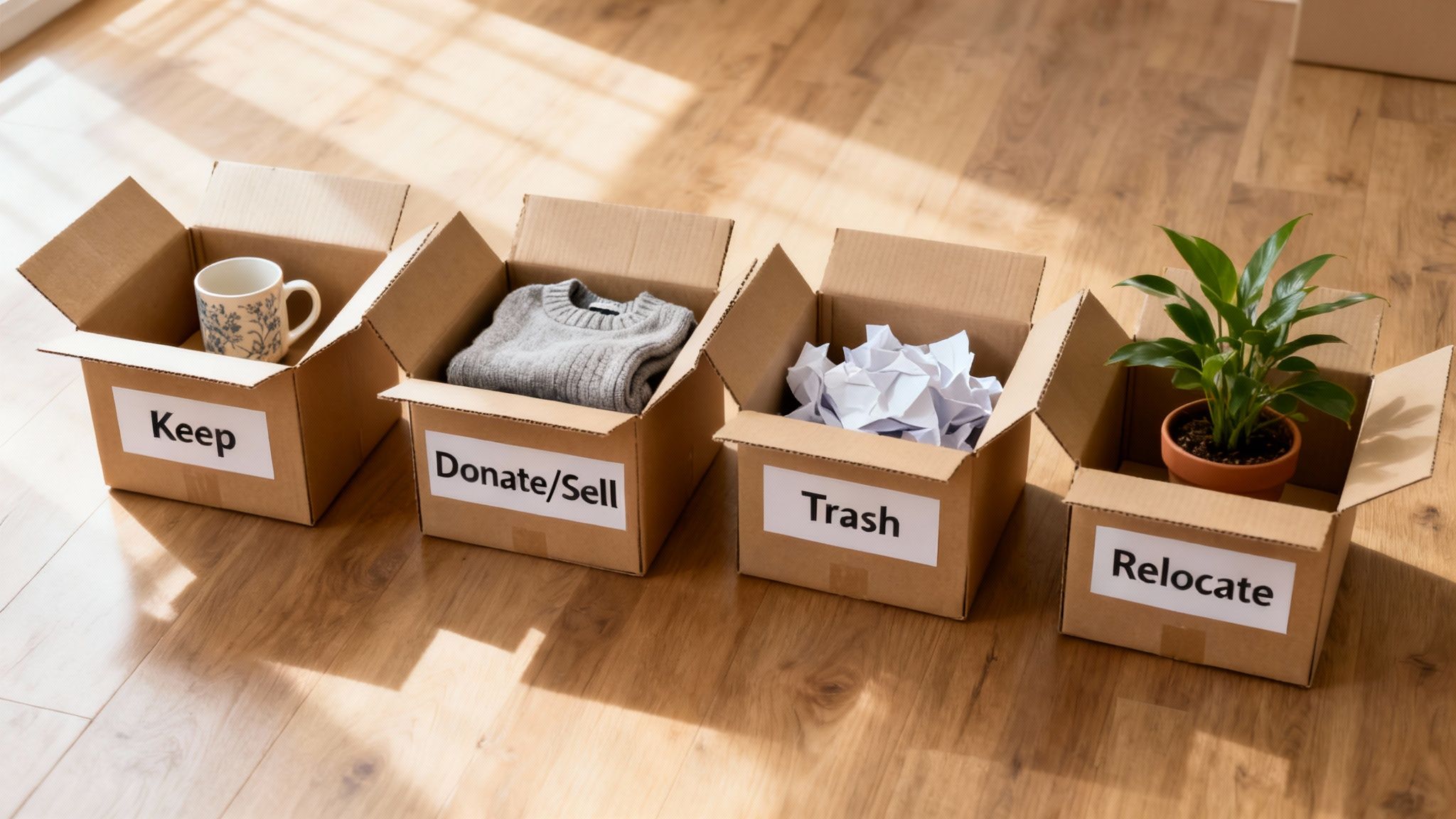
This is a refreshingly direct and logical system. You just need four boxes (or designated piles) labeled: Keep, Donate/Sell, Trash, and Relocate. As you pick up an item, you have to sort it into one of those four categories. No second-guessing, just a simple, repeatable action.
- Who it's for: This method is a lifesaver for anyone feeling overwhelmed, stuck in that "clutter paralysis," or dealing with executive function challenges. Its sheer simplicity cuts through the mental fog and helps you build momentum with quick wins.
- The Advantage: It's a direct assault on decision fatigue. By stripping away abstract questions and replacing them with a straightforward sorting task, it makes progress feel possible. This no-nonsense approach is exactly why it’s the backbone of the DeClutter Now app.
The flowchart below shows the two very different paths clutter can take—one that keeps you stuck and another that builds real momentum.
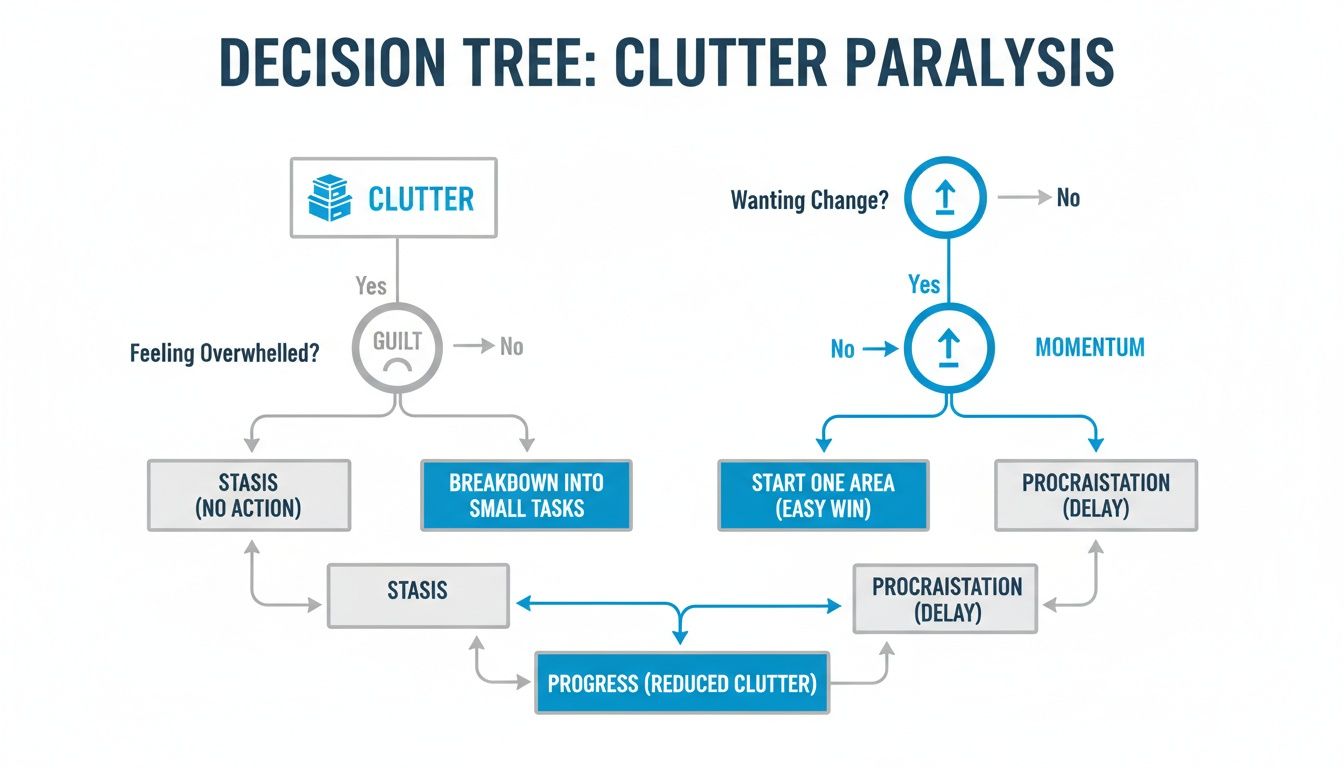
As you can see, having a simple, structured process is the key to breaking that cycle of paralysis and creating a clear path forward.
Swedish Death Cleaning
Don't let the name scare you! This method is actually a deeply thoughtful and practical way to organize your life with an eye on the future. The core idea is to gradually pare down your possessions so you don't leave a massive burden for your loved ones down the line. It forces you to think about the legacy of your things.
- Who it's for: It's especially useful for older adults, people who are downsizing, or anyone who wants to take a more mindful, legacy-oriented approach to their home.
- The Mindset: It brilliantly reframes decluttering. Instead of a chore, it becomes an act of love and consideration for the people you care about, which can be an incredibly powerful motivator.
Quick Comparison of Popular Organization Methods
To make it even clearer, here’s a side-by-side look at how these strategies stack up. Think of this as your cheat sheet for picking the approach that best fits your personality and current situation.
| Method of Organization | Core Principle | Best For | Potential Challenge |
|---|---|---|---|
| KonMari | Keep only what "sparks joy." | People ready for a deep, emotional decluttering journey. | The "joy" concept can feel too abstract and paralyzing for some. |
| The Four-Box Method | Sort every item into one of four logical categories: Keep, Trash, Donate, Relocate. | Anyone feeling overwhelmed or experiencing decision fatigue. | Can feel less profound; might not address the root of clutter habits. |
| Swedish Death Cleaning | Declutter now so others don't have to later. | Older adults, those downsizing, or anyone motivated by legacy. | The long-term focus may lack the urgency needed to start immediately. |
Each method offers a unique lens through which to view your belongings. There's no single "best" one—only the one that resonates most with you right now.
At the end of the day, the best method of organization is the one you will actually do. It’s all about picking a system that lowers the barrier to entry and helps you turn that "I'm stuck" feeling into that first, crucial step forward.
The "Trash First" Method: A Practical Way to Start
Ever look at a cluttered room and just feel… stuck? That wave of overwhelm is real, and it’s exactly why our "Trash First" approach, built on the Four-Box Method, is such a game-changer. It’s a straightforward, practical system that gets you started without bogging you down in complicated rules or deep philosophical questions.
This approach is all about taking action. Instead of getting paralyzed by abstract ideas, you get right to the point with a simple, physical sorting process. All you need are four containers—cardboard boxes, laundry baskets, or even just designated corners of the room.
Breaking Down the Four Boxes
Each box has a single, clear job. This is key, because it forces you to make a firm decision for every single item you touch. That's how you turn a mountain of clutter into a series of manageable, quick wins.
Here’s what goes where:
- Trash: This is your easy-win box. Start here! Toss out the obvious junk—broken gadgets, old mail, expired food, worn-out socks. This is the core of the "Trash First" methodology. Getting rid of trash first gives you an immediate sense of progress and builds momentum.
- Donate/Sell: For all the perfectly good stuff you just don't need anymore. That sweater you haven't worn in years, the extra set of coffee mugs, the books you've already read—if someone else can use it, it goes in here.
- Keep: This one’s for the items you actually use, genuinely love, and have a designated spot for. The goal is to be honest, but don’t torture yourself over every decision. If it’s a definite keeper, in it goes.
- Relocate: This might be the most important box of all. It’s for all the things that belong in your home, just not in this room. Think stray coffee cups that need to go back to the kitchen or the kids' toys that have migrated into the living room. This box keeps you from getting sidetracked running all over the house.
Why This Method Works
The "Trash First" method is so effective because it’s built on momentum. When you start with the "Trash" box, you’re picking the path of least resistance on purpose. Every item you throw away is a small victory—a quick win that makes the next, slightly harder decision feel more manageable. For more tips on building this kind of momentum, check out our guide on how to declutter quickly.
This process isn't about achieving a perfectly organized home overnight. It's about breaking through that "clutter paralysis" and making real, visible progress, one box at a time. By focusing on simple, physical sorting, you give your brain a clear roadmap to reclaim your space without all the emotional heavy lifting.
How Historical Efficiency Shapes Modern Decluttering
The drive to get organized isn't new. It's a century-old quest for efficiency that started not in our homes, but on the factory floor. That feeling of being totally stuck, staring at a room full of clutter, is the same kind of chaos that industrial pioneers fought to control. When you see that connection, you realize that a systematic approach to decluttering isn't about chasing some impossible standard of perfection—it's about applying time-tested principles to a very modern problem.
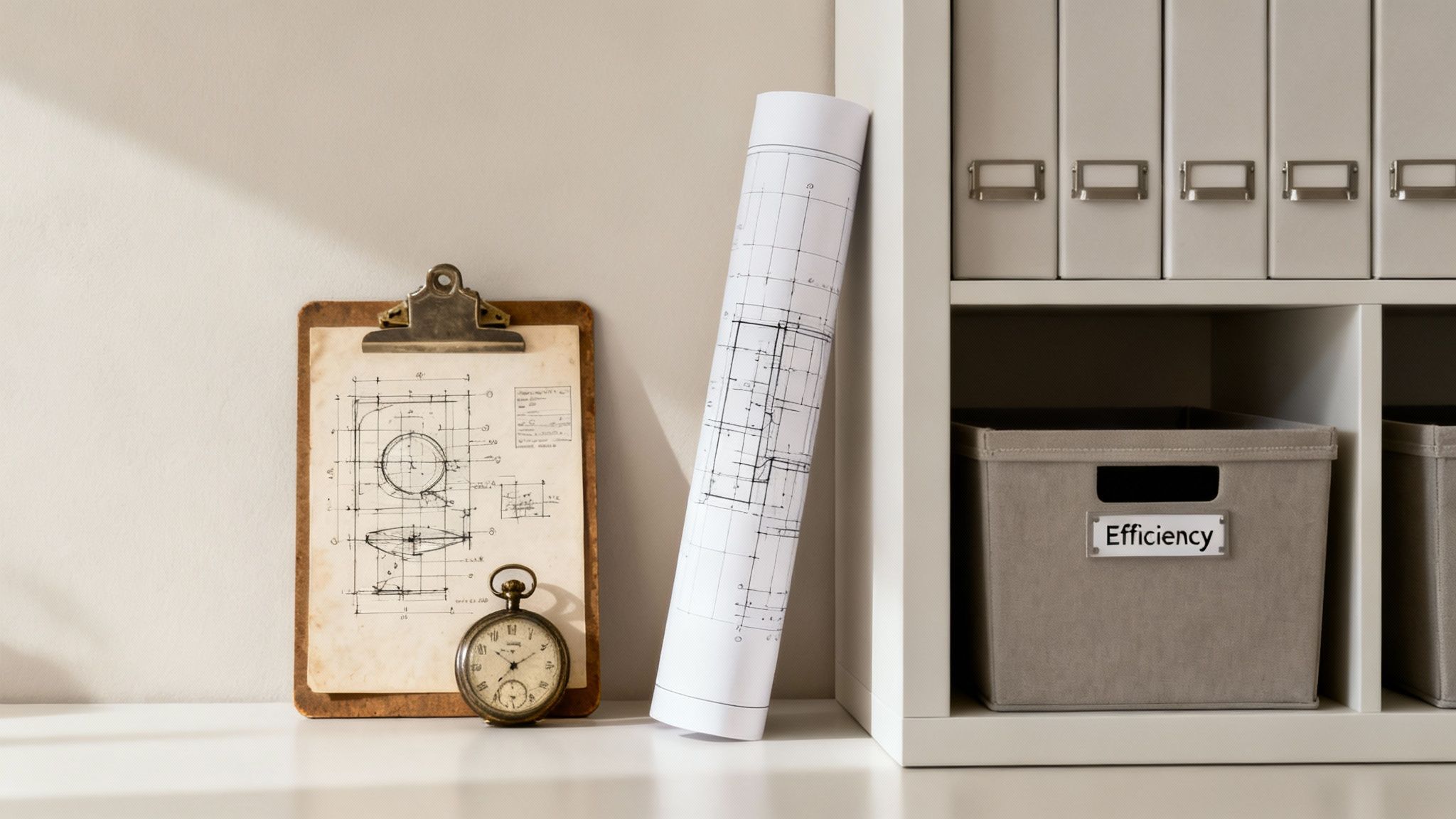
The link here is more direct than you might think. Back in the early 1900s, an efficiency expert named Frederick Winslow Taylor changed factory work forever. He noticed that complex, overwhelming jobs were burning workers out and slowing everything down. His solution? Break those huge tasks into simple, measurable, and repeatable steps. This simple idea boosted productivity like nothing before. You can learn more about how Taylor’s early data analysis transformed workplaces long before we had fancy software.
From the Assembly Line to Your Living Room
So what does a guy from the 1900s have to do with those boxes sitting for years in the garage? Everything. Taylor's big insight was that the secret to tackling an intimidating project is to break it down into small, manageable actions. That’s how you overcome paralysis and actually start making progress.
This is the exact same psychology-backed logic that powers the best decluttering methods today. Instead of seeing your entire home as one massive, soul-crushing project, a smart method of organization gives you a simple, repeatable system to follow.
When you choose a method like "Trash First," you’re using the same strategy that transformed entire industries: start with the smallest, most obvious task to build momentum. It’s a direct descendant of Taylor’s systematic thinking, just applied to your personal space.
Why This Historical Context Matters
There's something really encouraging about knowing these ideas have been battle-tested for over 100 years. It proves that feeling overwhelmed isn’t a personal failing; it’s a universal problem solved by a structured process, not just willpower.
The tools have certainly changed—we've swapped stopwatches for AI-powered apps—but the core strategy is identical:
- Break It Down: Don't try to organize a whole room at once. Just pick up one single item.
- Create a System: Use a simple, repeatable process like the Four-Box Method for every single thing you touch.
- Measure Progress: Focus on quick wins, like filling one trash bag. These little victories build unstoppable momentum.
When you adopt this classic efficiency mindset, you stop seeing a mountain of clutter. Instead, you start seeing a series of small, achievable steps. It’s a proven method of organization that has always been about turning chaos into clarity, one decision at a time.
How AI Can Supercharge Your Chosen Method
No matter which organization method you choose—whether you’re a fan of our "Trash First" approach or you've created your own system—the biggest challenge is always the same. It's getting started and, just as importantly, keeping that momentum going. This is where a smart tool like an AI assistant comes in, helping to break through decision fatigue.
Think about it. You pick up some random thing from a box that’s been sitting there for years. Instead of getting stuck in a mental loop trying to figure out what to do with it, you just snap a photo. In a second, our AI can analyze it and give you a simple suggestion based on the Four-Box Method: "This looks like a good fit for the 'Donate/Sell' box." Just like that, the initial roadblock is gone.
Turning Decisions into Dopamine
What’s really happening here is rooted in psychology. Every time you make one of those quick, AI-assisted decisions, your brain releases a small bit of dopamine—the chemical linked to reward and motivation. This is how you start building a real sense of momentum, one quick win at a time.
DeclutterNow leans into this by turning the entire process into a genuinely rewarding experience with gamification features designed to keep you on track:
- Points and Streaks: You earn points for every item you sort. When you keep it up for a few days in a row, you build a streak. This makes decluttering feel less like a draining chore and more like a game you’re winning.
- Progress Tracking: Seeing a visual tracker of how many items you’ve cleared gives you tangible proof that your hard work is actually paying off. This is how you finally make progress.
DeclutterNow isn't another strict system you have to follow perfectly. It's a flexible, intelligent tool that makes any organization method you choose faster and more motivating by getting rid of the friction that decision-making creates.
From Chore to Cash
Let’s be honest, the "Donate/Sell" box is often a huge momentum killer. It quickly turns into another pile of "I'll get to it later" tasks that can sit around for months. An integrated AI assistant can flip this box from a burden into an immediate and rewarding action.
For instance, when the app flags an item as something you could sell, it can instantly whip up a solid title, description, and even a suggested price for an eBay listing. A task that used to involve 20 minutes of research and writing now takes about two minutes. You just snap a few more pictures and hit "publish." This turns a potential chore into a quick win, which just reinforces that positive cycle of progress. You can read more about how this technology is changing decluttering in our guide on why AI decluttering is a topic on everyone's mind.
By helping you push through that initial paralysis and making every step after that easier and more rewarding, AI acts like your personal decluttering coach. It ensures you not only get started but actually have the motivation you need to see it through to the end.
Your Questions About Decluttering Answered
Even the best-laid plans hit snags. That’s perfectly normal. Below, we walk through the most common roadblocks and share down-to-earth tips that remind you: progress beats perfection every time.
What Is The Best Method Of Organization If I Have ADHD?
When executive function feels like an uphill battle, the key is cutting out extra choices and getting fast wins. The Four-Box Method is a great place to start. It’s a simple, visual approach that points you straight at the “trash” box first—an easy dopamine boost that helps you build momentum.
A tool like DeclutterNow can be a powerful ally here. Our AI breaks through decision fatigue, and gamified streaks turn small tasks into quick wins. This psychology-backed decluttering is the secret sauce.
How Do I Get My Family On Board With A New Organization Method?
Change rarely sticks if it’s imposed. Instead, bring everyone into the conversation by focusing on shared gains: calmer mornings, more open space, less stress.
Research from Rensis Likert in the 1960s found that teams who set their own goals outperform those told what to do. You can read more about how collaborative goal-setting improves results.
Try this simple roadmap:
- Discuss the “Why”: Highlight benefits like quicker routines and fewer arguments.
- Choose a System Together: Lay out options—such as the Four-Box Method—and pick one that feels right.
- Track Progress as a Team: Use an app to turn tidying into a group challenge, complete with shared milestones and celebrations.
I’ve Tried Organizing Before And Always Quit—How Do I Stick With It?
Quitting usually means the task felt overwhelming. The trick? Shrink your definition of success until it’s almost laughable.
Start with something tiny: clear one drawer or fill one small trash bag. These quick wins build momentum. Tracking your efforts—say with simple before-and-after photos—makes progress real.
And remember: missing a day isn’t failure, it’s just part of being human. When you slip, reset with another small task. Momentum, not perfection, creates lasting change.
Ready to turn clutter paralysis into progress? DeclutterNow uses psychology-backed, AI-powered tools to help you build momentum, one easy decision at a time. Try DeClutter Now free →