
How to start an organizing business. Have you ever walked into a friend’s chaotic kitchen and felt an overwhelming urge to start sorting their pantry? If you have, you get it. That natural talent for creating order isn’t just about being neat—it’s the seed of a thriving business that can genuinely help people.
This isn’t just about tidying up. It’s about building a real company that helps people escape the “clutter paralysis” that keeps them stuck. You’re not just organizing spaces; you’re guiding someone from “I don’t even know where to start” to a place of clarity and control, helping them finally make progress on those boxes that have been sitting for years.
And the demand is real. Starting an organizing business means tapping into a global market valued at around $8.2 billion in 2023. It’s projected to hit $12.9 billion by 2032. Why? Because life gets busy, our homes get full, and people are overwhelmed by decisions. You can dig into the numbers in this full professional organizer market report.
Your Blueprint for a Profitable Organizing Business
So, how do you turn that passion into a paying profession? It all comes down to a solid plan. While every organizer’s journey is a bit different, the foundational steps are surprisingly consistent. You need to figure out who you want to help, what specific problems you’ll solve, and how you’ll package your solutions.
This simple flow is really all it takes to get the ball rolling. It’s about moving from your core idea to defining your services and then, finally, getting in front of the right people.
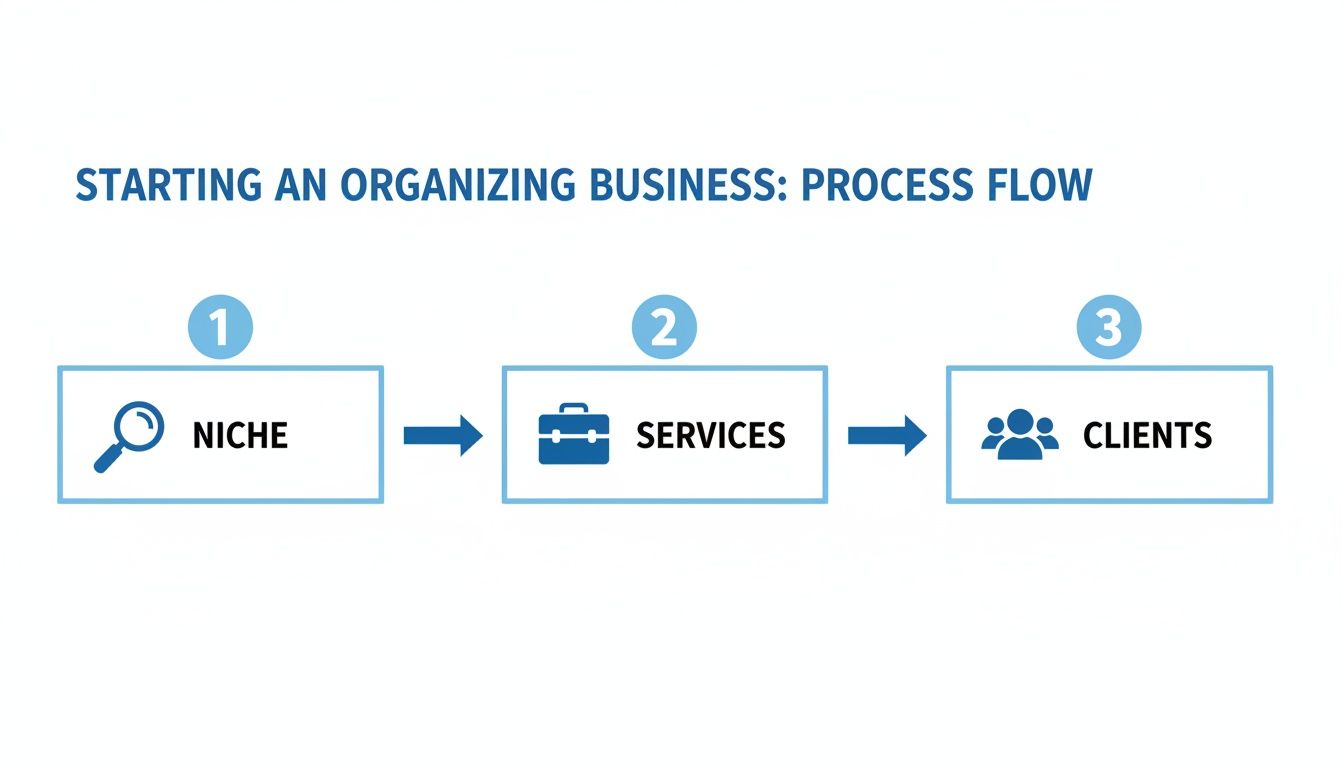
The key takeaway here is focus. You can’t be everything to everyone. The most successful organizers are the go-to experts for a specific type of client.
From Tidying Talent to a Real Career
I get it. You might feel excited about the work but completely overwhelmed by the “business” part. I’ve been there, too, staring down a to-do list that includes everything from legal paperwork to marketing. It can feel like a mountain, causing the same kind of paralysis your future clients feel.
The most impactful organizers don’t just clean spaces; they help clients break through the decision fatigue that keeps them stuck. Your business is the vehicle for that transformation.
This guide is your direct, no-fluff blueprint. We’re going to walk through exactly what you need to do to launch with confidence. Here’s a quick look at where we’re headed:
- Pinpointing Your Ideal Clients: Will you be the hero for busy families drowning in toys? The trusted guide for seniors downsizing? Or the secret weapon for entrepreneurs setting up a hyper-efficient home office?
- Crafting Irresistible Service Packages: It’s time to think beyond a simple hourly rate. We’ll look at how to create value-packed offers that solve specific, painful problems for your clients.
- Building a Sustainable Business Model: From getting your business registered to landing your first paying client, we’ll cover the practical steps that turn your organizing skills into a profitable career.
To give you a bird’s-eye view, here’s a high-level roadmap of the journey ahead. Think of this as your “you are here” map for building your business from the ground up.
Organizing Business Quick Launch Roadmap
| Phase | Key Actions | Primary Goal |
|---|---|---|
| 1. Foundation | Identify your ideal client (niche), research competitors, and define your unique value proposition. | To establish a clear, focused business identity that stands out in the market. |
| 2. Services & Pricing | Develop service packages, set your pricing structure, and outline your core offerings. | To create compelling, profitable offers that solve specific client problems. |
| 3. Legal & Financial | Register your business name, set up a business bank account, and get proper insurance. | To build a legitimate and protected business entity from day one. |
| 4. Operations | Choose your tools (like DeClutter Now), create client workflows, and draft your contract. | To create a smooth, professional client experience that is efficient and scalable. |
| 5. Marketing & Launch | Build a simple website, set up social media profiles, and start networking to find clients. | To attract and sign your first paying clients and officially launch your business. |
Following this roadmap ensures you cover all your bases, moving from a great idea to a fully functioning and profitable organizing business. Let’s get started.
Finding Your Niche and Crafting Your Services
Trying to be the perfect organizer for everyone is a fast track to burnout. I’ve seen it happen. The most successful professionals I know didn’t cast a wide net; they became the go-to expert for a very specific group of people struggling with a very particular challenge. This is where you find your footing and build a business that genuinely connects.
So, who do you actually want to help? Think about it. Do you feel a pull toward guiding families through the daily chaos of toys and school papers? Or maybe you have a knack for helping entrepreneurs design ultra-efficient home offices that fuel their productivity. Your niche is that sweet spot where your skills, your passion, and a real market need all come together.

Uncovering High-Demand Organizing Niches
Choosing a specialty is a game-changer. It focuses your marketing, sharpens your skills, and lets you speak directly to a client’s pain points. Instead of vaguely saying, “I organize homes,” you can confidently say, “I help parents of young children create calm, functional playrooms.” See the difference? It’s powerful.
Here are a few in-demand areas where people are actively looking for an expert:
- Families with Young Children: These clients are often overwhelmed by a constant tide of toys, outgrown clothes, and school gear. They need practical, sustainable systems that the whole family can actually maintain.
- Seniors Downsizing: This is a compassionate, often emotionally charged niche. You’ll be helping clients sort through a lifetime of memories, making tough decisions about what to keep, donate, or pass on to loved ones.
- Clients with ADHD/Executive Function Needs: This specialty is all about creating visual, intuitive systems that work with a client’s brain, not against it. It demands empathy, patience, and a solid understanding of how to break through decision fatigue.
- Home Office & Entrepreneurs: With so many people working from home, the need for productive, clutter-free workspaces is bigger than ever. You’ll help clients optimize both their physical desk and their digital files.
The goal isn’t just to find a profitable niche, but to find the one that actually energizes you. Your genuine enthusiasm for solving a specific type of clutter problem will be your single greatest marketing asset.
From Hourly Rates to Value-Driven Packages
Once you’ve got your niche in mind, it’s time to build service packages that clients are excited to buy. The old-school hourly rate model can sometimes work against you. It often makes clients watch the clock, focusing on the cost instead of the incredible outcome you’re delivering.
Let’s shift your thinking to value-based packages. You’re not just selling your time; you’re selling a transformation. This small change in mindset positions you as a problem-solver and makes it so much easier for clients to say “yes.” They understand the result they’re paying for.
A great package bundles your time, expertise, and the final result into one clear, upfront price. This manages expectations from the start and ensures you’re paid for the outcome, not just the hours it takes.
For example, a client might hesitate at a $75 per hour rate for an undefined number of hours. But that same client will gladly invest $750 in a “Pantry Transformation Package” that promises a fully decluttered, organized, and labeled pantry with a custom shopping system—all done in a single day.
To give you a clearer picture, I’ve put together this table showing how different niche needs can be translated into compelling service packages.
High-Demand Niches and the Problems They Solve
This table breaks down some high-growth organizing niches and the specific pain points they address, helping you choose a specialty that clicks with you and the market.
| Niche Specialty | Target Audience | Primary Pain Point Solved | Potential Service Package |
|---|---|---|---|
| Closet Systems | Busy Professionals | “I have a closet full of clothes but nothing to wear.” They face decision fatigue every morning. | The Wardrobe Refresh: A 4-hour session to declutter, categorize, and organize a closet for effortless daily dressing. Clients looking to maximize wardrobe space find this especially valuable. |
| Moving & Relocation | Homeowners & Renters | The overwhelming stress of sorting, packing, and unpacking an entire home under a tight deadline. | The Pre-Move Purge: A package of sessions dedicated to decluttering before the move, saving clients money on moving costs and time on unpacking. |
| Digital Organization | Creative Freelancers | Digital chaos—disorganized files, a cluttered desktop, and an overflowing inbox—stifles creativity and productivity. | The Digital Detox: A virtual service to organize cloud storage, create a logical file structure, and set up an email management system. |
| New Parent Prep | Expecting Parents | Anxiety about preparing the home for a new baby, from setting up the nursery to organizing essential supplies. | The Nursery Nesting Package: A comprehensive service to design and organize the nursery, set up a diaper changing station, and create systems for baby clothes and gear. |
By specializing and packaging your services this way, you shift from being a general helper to being seen as a strategic partner. This focus is absolutely foundational to starting an organizing business that lets you attract the right clients, charge what you’re worth, and build a stellar reputation as the go-to expert in your field.
Getting Your Business Ducks in a Row: Legal & Financial Setup
Alright, let’s tackle the not-so-glamorous but absolutely critical side of your new venture: the legal and financial stuff. Getting this sorted out from the get-go means you can operate with confidence and look like the pro you are. It’s less exciting than creating a color-coded closet, I know, but these steps protect both you and your clients. You don’t need a law degree—just a few smart decisions to build a solid foundation.

First up, you need a business name. Think of something that feels right for your niche, is memorable, and—most importantly—is easy for people to find online. Once you’ve landed on the perfect name, it’s time to decide how to structure your business.
Choosing Your Business Structure
This choice really boils down to how you handle taxes and liability. For most new organizers, there are two straightforward paths to consider.
- Sole Proprietorship: This is the default and the simplest way to get started. Legally, you and your business are one and the same. It’s a breeze to set up, but the downside is that your personal assets aren’t separated from your business debts.
- Limited Liability Company (LLC): An LLC puts a legal wall between your personal life and your business. This is a huge deal—it protects your home, your car, and your savings if something goes wrong. It takes a bit more paperwork and a fee to register, but that peace of mind is priceless for many.
Protecting Yourself and Your Clients
Once your business is an official entity, you need to get the right protections in place. This isn’t just about covering your own back; it shows clients you’re a serious, trustworthy professional.
General liability insurance is non-negotiable. This is what protects you if you accidentally damage a client’s property. Imagine you’re installing a shelf system and it slips, breaking a priceless vase. Insurance handles that. It’s surprisingly affordable—often just a few hundred dollars a year—and it’s a tiny price for massive security.
A solid client agreement is just as crucial. A good contract is your best friend for managing expectations and avoiding misunderstandings down the road. It doesn’t have to be 20 pages of legalese, but it should clearly lay out:
- The scope of work and exactly what services you’ll provide
- Your rates and when you expect to be paid
- A clear cancellation policy
- A confidentiality clause (this is key for building client trust)
Think of your contract as a communication tool, not just a legal document. It gets you and your client on the same page before you even open the first box, establishing trust right from the start.
Setting Up Your Finances for Success
Last but not least, let’s talk money. Developing good financial habits now will save you from a world of hurt, especially when tax season rolls around. The single most important thing you can do is open a separate business bank account.
Seriously, do not skip this step. Mixing your personal and business spending is a surefire recipe for a bookkeeping nightmare. A dedicated account keeps your income and expenses crystal clear, making it easy to see how profitable you are and simplifying tax prep.
From there, pick a simple way to track everything. You could use accounting software like QuickBooks or even just a well-organized spreadsheet. The tool doesn’t matter as much as the habit. Track every dollar in and every dollar out. This financial clarity is what turns a passion for organizing into a genuinely profitable career.
Marketing Your Business and Getting Your First Clients
You could be the most talented organizer on the planet, but if potential clients don’t know you exist, that talent stays hidden. This is where authentic marketing comes in—not the pushy, salesy kind, but the genuine kind that attracts people who desperately need your help. We’re going to skip the generic advice and focus on practical strategies that actually work for a new organizing business.
Your marketing isn’t about shouting from the rooftops. It’s about showing up where your ideal client is already feeling overwhelmed and offering a clear, empathetic solution. It all starts with creating a simple, professional online presence that speaks directly to their pain points.
Building Your Digital Storefront
Think of your website as your digital home base. It doesn’t need to be complicated or expensive, but it must do one thing exceptionally well: make a potential client feel understood. When someone lands on your site, they should immediately think, “This person gets me.”
Use language that mirrors their internal struggles. Talk about the “boxes sitting for years” or the feeling of being “paralyzed by decisions.” Frame your services not as “tidying up,” but as the pathway from chaos to calm.
A basic, effective website needs just a few key pages:
- A clear headline: Something like, “Helping Busy Families in Austin Reclaim Their Space and Peace of Mind.”
- An “About Me” page: Share your personal story. I started my decluttering journey because I felt paralyzed by my own clutter for years. Authenticity is how you build trust.
- A “Services” page: Detail your packages, but always focus on the transformational outcomes.
- A portfolio: This is where you showcase your work with compelling visuals.
- A simple contact form: Make it incredibly easy for them to take the next step.
The Undeniable Power of Visual Proof
Nothing sells your service better than a dramatic before-and-after photo. These images are pure gold. They provide instant, undeniable proof of the transformation you deliver and cut through the noise to show, rather than tell, what’s possible.
Instagram and Pinterest are your best friends here. They are visual platforms where people are actively looking for inspiration to improve their homes. Consistently sharing high-quality photos of your work establishes your credibility and builds a following of potential clients.
For those just starting their own journey, you can also share helpful content. Check out our guide on decluttering tips for beginners for ideas on the kind of advice that resonates.
A powerful before-and-after shot does more than just showcase your skills; it gives a potential client hope. It allows them to visualize their own space transformed, turning a vague desire for order into a tangible goal.
Creating a Powerful Referral Network
Honestly, some of your best clients won’t come from a Google search. They’ll come from trusted professionals who are already working with your ideal audience. Building a referral network is one of the most effective ways to generate a steady stream of high-quality leads.
Think about who else serves your clients right before they realize they need an organizer.
- Real Estate Agents: Their clients are often moving or staging a home for sale—prime time for decluttering.
- Family Therapists: They may have clients whose mental health is being crushed by a chaotic home environment.
- Move Managers & Senior Living Advisors: These pros work directly with individuals who are downsizing.
Reach out, introduce yourself, and explain how your services can make their jobs easier and provide immense value to their clients. A strong professional network can easily become your most reliable marketing channel.
Turning Happy Clients into Your Best Marketers
Finally, never underestimate the power of a heartfelt testimonial. A glowing review from a past client is more persuasive than any marketing copy you could ever write. It’s social proof that you deliver on your promises.
Make asking for a review a standard part of your offboarding process. Once a project is complete and your client is thrilled with the result, simply ask if they’d be willing to share their experience. Guide them with specific questions like, “What was the biggest change you noticed after we worked together?” or “How did the process make you feel?”
This approach captures the emotional impact of your work, which is what truly resonates with people drowning in the stress of clutter.
The professional organizer industry is growing fast, with a market size projected to jump from $11.08 billion in 2023 to $28.46 billion by 2031. A key driver of this growth is the power of digital proof—studies show that 65% of consumers are more likely to hire a professional after seeing their content online. You can discover more insights about the professional organizer market and see how testimonials fit into this trend. These authentic stories from happy clients will become the cornerstone of your marketing, doing the selling for you.
Modern Tools and Workflows for Organizers
Working smarter, not harder, is the real secret to a profitable organizing business. Your true value isn’t just folding sweaters perfectly; it’s guiding clients through the paralyzing decisions that keep them stuck. This is where modern tools become your superpower, letting you amplify your impact and deliver a seamless experience from start to finish.
This goes way beyond simple scheduling software. The right technology can actually empower your clients to make progress even when you’re not in the room, turning small, independent wins into major momentum for your project.
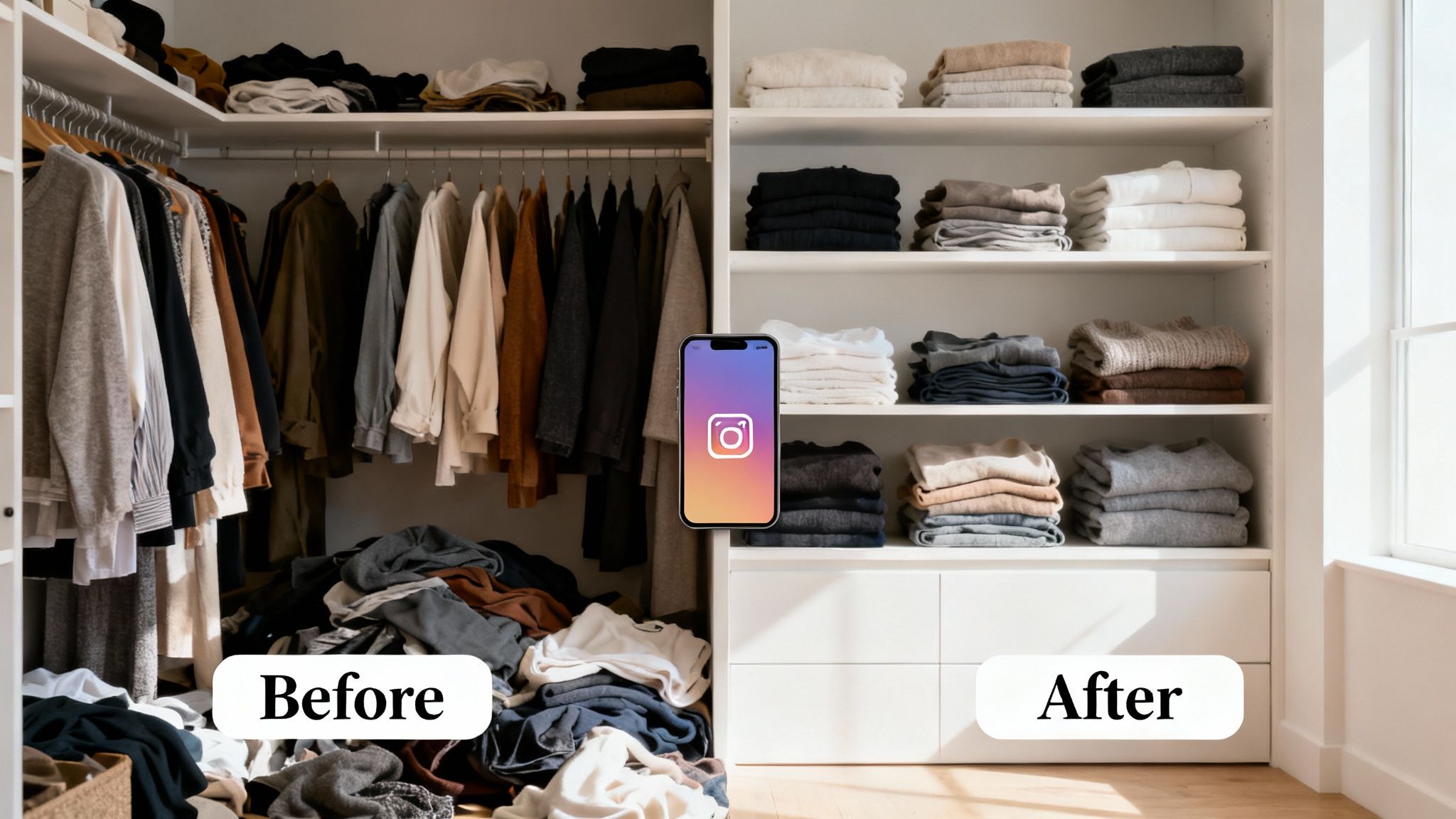
This kind of visual transformation is exactly what clients are dreaming of. The right tools can help bridge the gap between their current reality and this future goal.
Empowering Clients Between Sessions
One of the biggest hurdles clients face is keeping up the momentum between your visits. That same decision fatigue that led them to hire you in the first place can easily creep back in when they’re on their own. This is the perfect opportunity to introduce them to a supportive tool like DeClutter Now.
Think about giving your client “homework” that feels less like a chore and more like a game. With an app like this, they can snap photos of items, and its AI helps them make quick, confident decisions. It’s all built on the “Trash First” methodology—a psychology-backed trick that starts with the easiest choices (actual trash) to build confidence and momentum. It’s different from just asking “Does this spark joy?”; it starts with a much simpler question.
When your clients can tackle small piles of clutter on their own time, your sessions together become far more strategic. You can spend your hours working on the bigger-picture systems and emotionally charged items, knowing they’ve already cleared out the low-hanging fruit. This approach pairs perfectly with the strategies in our guide on how to organize a cluttered home.
The best organizers don’t just create systems; they equip their clients with the tools and confidence to maintain them. By introducing technology, you extend your support far beyond the hours they pay for, providing an incredible amount of extra value.
This shift isn’t just a good idea; it’s where the industry is heading. As lifestyles get busier, the demand for organizing is booming. We’ve seen virtual services jump 40% since 2020, and by 2023, 45% of organizing firms were already offering online consultations. Apps that use AI to coach clients through decisions are tapping into a market projected to grow from USD 10.45 billion in 2024 to USD 25.86 billion by 2030.
Building Your Essential Tech Stack
You don’t need a dozen complicated programs to run an efficient business, but a core set of tools will save you countless hours and headaches. A solid foundation from day one makes scaling up so much easier.
Your toolkit should cover a few key areas:
- Client Management: A simple CRM (Customer Relationship Management) system is a lifesaver for tracking leads, client details, and project notes. Many organizers have great success with tools like HoneyBook or Dubsado.
- Scheduling: Put an end to the back-and-forth emails. An automated scheduler like Calendly or Acuity Scheduling lets potential clients book consultations right from your website based on your live availability.
- Project & Task Management: To keep client projects from getting chaotic, a tool like Trello or Asana is invaluable. You can create a dedicated board for each client to outline the plan, assign tasks, and track progress.
- Billing & Invoicing: Professionalism matters. Software like QuickBooks or FreshBooks makes it easy to send polished invoices, track payments, and get a clear picture of your finances.
By embracing these tools, you’re not just organizing homes—you’re building a modern, scalable business that positions you as an efficient expert who delivers lasting results.
Common Questions About Starting an Organizing Business
Jumping into a new business always brings up a lot of questions. Getting straight answers is the best way to quiet that inner voice of doubt and start taking real, confident steps forward.
Let’s tackle some of the biggest questions I hear from aspiring organizers. My goal here is to give you the clarity you need to get moving.
How Much Does It Cost to Start an Organizing Business?
The great news is that a professional organizing business has surprisingly low startup costs, especially compared to other service businesses. You don’t need a huge bank loan to get this off the ground.
Your main initial investments will break down like this:
- Business Registration: Depending on your state and whether you go for a Sole Proprietorship or an LLC, this can be anywhere from $50 to $500.
- Liability Insurance: This is non-negotiable. It protects you and your clients. Plan for about $300 to $600 for a solid annual policy.
- A Basic Website: You can create a professional-looking site for $200 to $1,000 using beginner-friendly platforms.
Honestly, many organizers get their business up and running for well under $2,000. The trick is to start lean. Reinvest what you make from your first few clients right back into the business to fuel your growth.
Do I Need a Certification to Be a Professional Organizer?
The short answer is no, a certification isn’t legally required to call yourself a professional organizer. But the real answer is a bit more nuanced.
Think of a certification as a powerful trust signal. When a potential client sees that you’ve earned a credential from an organization like the National Association of Productivity and Organizing Professionals (NAPO), it immediately builds credibility. It shows them you’re serious about your craft and have invested in your skills. It can absolutely help you stand out when you’re just starting.
What if a Client Resists Getting Rid of Their Things?
Welcome to one of the most common—and human—parts of the job. When a client digs their heels in, it’s almost never about the actual stuff. It’s about emotional attachment, fear of making a mistake, or just plain old “clutter paralysis” from having to make too many decisions. Remember, it’s not laziness—it’s decision fatigue.
Your job isn’t to be a dictator who forces them to throw things away. It’s to be a compassionate guide who empowers them to make their own choices.
The key is to build momentum with quick wins. I often use a psychology-backed approach like the “Trash First” method. We start with the easiest decisions first: expired food from the pantry, junk mail, a broken lamp. These small victories create a dopamine hit that fuels motivation to keep going.
Asking gentle, open-ended questions also works wonders. Instead of “Do you want to keep this?”, try “Tell me the story behind this item,” or “How does keeping this support the life you want to live now?” This simple shift changes the focus from loss to empowerment.
Feeling overwhelmed by decluttering decisions is completely normal—both for you and your future clients. DeClutter Now was designed to turn that paralysis into progress with simple, guided actions.
Try DeClutter Now free and see how AI can help you build momentum →