
The secret to breaking through decision paralysis isn't a grand, sweeping gesture. It's the exact opposite. You have to start with the smallest, easiest decisions to build momentum, rather than trying to conquer the entire mountain at once. This strategy breaks that awful cycle of overwhelm by giving you a few quick wins, which actually tricks your brain into wanting to continue.
Why You’re Not Lazy—You’re Paralyzed by Clutter
See those boxes that have been sitting for years in your garage? What about that stack of papers you swear you'll get to "someday"? Their continued existence has nothing to do with you being lazy. That feeling of being totally frozen when you look at a mess is a real thing called decision paralysis. It's a traffic jam in your brain caused by cognitive overload, not a character flaw.
As the founder of DeclutterNow.ai, I get it. I had 15 boxes from a move that sat unopened for three whole years. Every single time I glanced at them, my brain just… quit. I felt paralyzed, and traditional methods just didn't work for me.
This mental shutdown happens when you're hit with too many choices all at once. Think about it: every single item in a cluttered room triggers a cascade of tiny, draining decisions:
- Do I even want this?
- If I keep it, where on earth will it live?
- Should I donate it? Sell it? Just trash it?
- But what if I need it one day?
Now, multiply that mental checklist by hundreds, or even thousands, of items. Your brain's executive function simply gets worn out. This isn't just a hunch; it's a well-documented response to information overload. A major 2023 study from Oracle actually found that 72% of people admitted that data overload stopped them from making any decision at all. If you're curious, you can explore a breakdown of the study's findings about decision-making.
The Big Flaw in Most Decluttering Advice
This is exactly why most traditional decluttering advice falls flat. It completely ignores the root cause: decision fatigue. You're told to dive in with big, emotionally heavy questions like, "Does this spark joy?" While the sentiment is nice, it forces you to do deep, soul-searching work for every single item.
When you're already drowning in overwhelm, that's like asking someone stuck in quicksand to start training for a marathon. It's not laziness—it's decision fatigue.
The real problem isn't a lack of desire for a tidy space. It's the sheer mental horsepower required to make one decision after another. Your decision-making battery is just completely drained.
That’s why we need a different approach, one grounded in how our brains actually work. Instead of starting with the hardest, most abstract questions, we're going to start with the absolute simplest ones. This is how you turn clutter paralysis into progress.
Build Momentum with Simple Cognitive Decluttering Tricks
Okay, so we know why our brains get stuck. That’s a great first step. But the real game-changer is learning how to overcome decision paralysis with strategies you can use right in the thick of it. The secret isn't some massive, superhuman burst of energy. It's about using small, psychology-backed mind hacks to get the ball rolling.
These little cognitive tricks are all about creating quick wins. They give you that satisfying dopamine hit that makes you actually want to keep going.

The best part? You can start using these methods right now. No special tools, no complicated systems. They’re designed to bypass that overwhelmed part of your brain and engage the part that loves to check something off the list.
Embrace the Two-Minute Rule
One of my all-time favorite ways to bust through inertia is the Two-Minute Rule. The idea is brilliantly simple: if you see something that will take less than two minutes to handle, do it immediately. Don't put it on a list. Don't save it for later. Just get it done.
This could be tossing junk mail the second you walk in the door, putting a single dish straight into the dishwasher instead of the sink, or wiping a small spill off the counter. Each tiny action is a completed decision. It’s a quick win that proves to your brain that you can make progress. It's an incredibly effective way to build momentum, turning a series of tiny, easy "yeses" into a powerful current of action.
These quick wins aren't just about tidying up. They’re about retraining your brain. Each completed micro-task sends a signal that you are in control, chipping away at that feeling of being overwhelmed and making the next decision feel just a little bit easier.
Create Your Own Default Rules
Decision fatigue is a major energy vampire. It happens when you have to make the same basic choices over and over again. You can reclaim that precious mental energy by creating Default Rules—essentially, pre-made decisions for common clutter scenarios. This puts your choices on autopilot.
Think of these as your personal decluttering standard operating procedures. Here are a few examples to get you started:
- Expired Food: If it's past the date, it's trash. No debating, no "is it still okay?"—it just goes.
- Duplicate Gadgets: If you find two can openers, the older or less-functional one is automatically donated. No hesitation.
- Unworn Clothes: Anything that hasn't been worn in over a year goes straight into a donation bag.
- Pens That Don't Work: The moment you discover a pen is out of ink, it goes directly into the trash can.
Rules like these completely remove the "what if…?" from the equation. The decision is already made for you, freeing up your cognitive bandwidth to tackle the tougher items later.
Shrink the Problem with Micro-Decisions
When staring at a cluttered room feels like looking up at an unclimbable mountain, you have to shrink your focus. The strategy here is making Micro-Decisions, which means breaking a huge, undefined problem ("clean the office") into a laughably small one. Instead of that vague command, tell yourself, "I'm just going to deal with the pens on my desk."
By zeroing in on a single category or a tiny physical space, the task becomes instantly manageable. You’re not deciding about everything; you're just deciding about pens. Once that's done, you've got a success under your belt. That quick win builds the confidence and momentum you need to move on to the sticky notes, then the papers, one micro-decision at a time.
A Psychology-Backed Method That Actually Breaks Paralysis
If quick cognitive tricks are the warm-up, the Trash First methodology is the main event for anyone truly struggling with how to get unstuck. I've seen firsthand how this psychology-backed approach works because it was designed specifically for the overwhelmed mind. It flips traditional decluttering advice on its head—advice that, frankly, often makes the problem much worse.
Most popular methods ask you to start with big, emotionally loaded questions like, "Does this spark joy?" While the intention is good, this question immediately forces you to grapple with memories, future "what-ifs," and guilt over every single item. When you’re already stuck in a state of paralysis, that's a recipe for instant shutdown.
Start with Trash, Build Momentum
The Trash First method works differently. We don't begin with emotionally complex decisions. We start with the easiest decisions first—"is this actually trash?"
There’s no sentimental value attached to an old receipt, an empty shampoo bottle, or an expired coupon from last year. Deciding to toss it requires almost no mental energy. Each piece of trash you get rid of is a quick, painless win.
This isn't just about cleaning up a room; it's about rewiring your brain's response to clutter. You're creating a momentum loop. Each tiny win delivers a small dopamine hit, which fuels the motivation to find the next tiny win.
This process systematically rebuilds your decision-making muscle. You're proving to yourself, one piece of trash at a time, that you can make progress. It's this forward motion that finally breaks through the freeze response tied to decision fatigue. Once the obvious trash is gone, moving on to the "donate" or "keep" piles suddenly feels far more manageable.
For a deeper dive into this, you can learn more about how to make decisions faster in our detailed guide.
This feeling of being stuck is often called analysis paralysis, and it's incredibly common. In fact, productivity experts have found that analysis paralysis can affect as many as 85% of us, turning what should be a simple choice into a complete standstill. It's a massive productivity killer, where having too many options leads to making no choice at all.
If you want to tackle this head-on, it's worth exploring practical methods for how to overcome analysis paralysis. By starting with the easiest possible step—just identifying trash— you bypass the mental roadblocks that keep you frozen and finally start turning clutter paralysis into real, tangible progress.
Two Approaches to Decluttering When Paralyzed
It's helpful to see a direct comparison of why starting with trash is so effective when you're feeling overwhelmed, versus a method that starts with emotional evaluation.
| Factor | Trash First Method (DeclutterNow) | Spark Joy Method (Kondo) |
|---|---|---|
| Starting Point | Objective, low-emotion items (trash, expired goods) | Emotionally-charged items (clothes, books) |
| Mental Energy Required | Very low; decisions are binary (trash/not trash) | Very high; requires introspection and emotional connection |
| Initial Experience | Creates immediate, easy wins and builds momentum | Can trigger guilt, nostalgia, and anxiety, leading to shutdown |
| Best For | Individuals experiencing decision paralysis or overwhelm | Individuals who are mentally ready for deep emotional processing |
| Core Principle | Build momentum, not perfection | Connect with your belongings to curate a joyful environment |
The takeaway is simple: when your brain is already overloaded, you need a system that reduces the cognitive load, not one that adds to it. The Trash First method is designed to get you moving again, one simple decision at a time.
Using AI to Make Decluttering Decisions Effortless
Let's be honest: when your brain feels fried, even simple tricks for how to overcome decision paralysis can feel like climbing a mountain. That’s the perfect moment to let technology step in. Instead of forcing your exhausted mind to make one more choice, an AI companion like DeclutterNow can do the heavy lifting for you.
Think about how easy this could be. You get stuck on an item—that old sweater, a random kitchen gadget, whatever. You just snap a photo of it. Our AI instantly analyzes the image and gives you a clear, objective suggestion based on the Four-Box Method: Keep, Relocate, Donate/Sell, or Trash. AI breaks through decision fatigue by giving you an immediate, actionable starting point.
Your Personal Decision Coach
What about those really tough items that just leave you frozen? For those, our "Help Me Decide" AI coach is like having a non-judgmental friend on call. It gently guides you with clarifying questions about the item's real value, how often you actually use it, and any emotional ties you might have. The point isn't to be perfect; it's to turn that paralyzing feeling of "I don't know what to do!" into small, steady actions.
This kind of objective help is something more and more people are looking for. An eye-opening Oracle study revealed that 64% of people—and a whopping 70% of leaders—would sometimes rather have an AI or robot make decisions for them. It just goes to show how deeply we all want a break from decision fatigue.
This diagram highlights the difference between starting with easy, logical tasks versus emotionally charged ones.
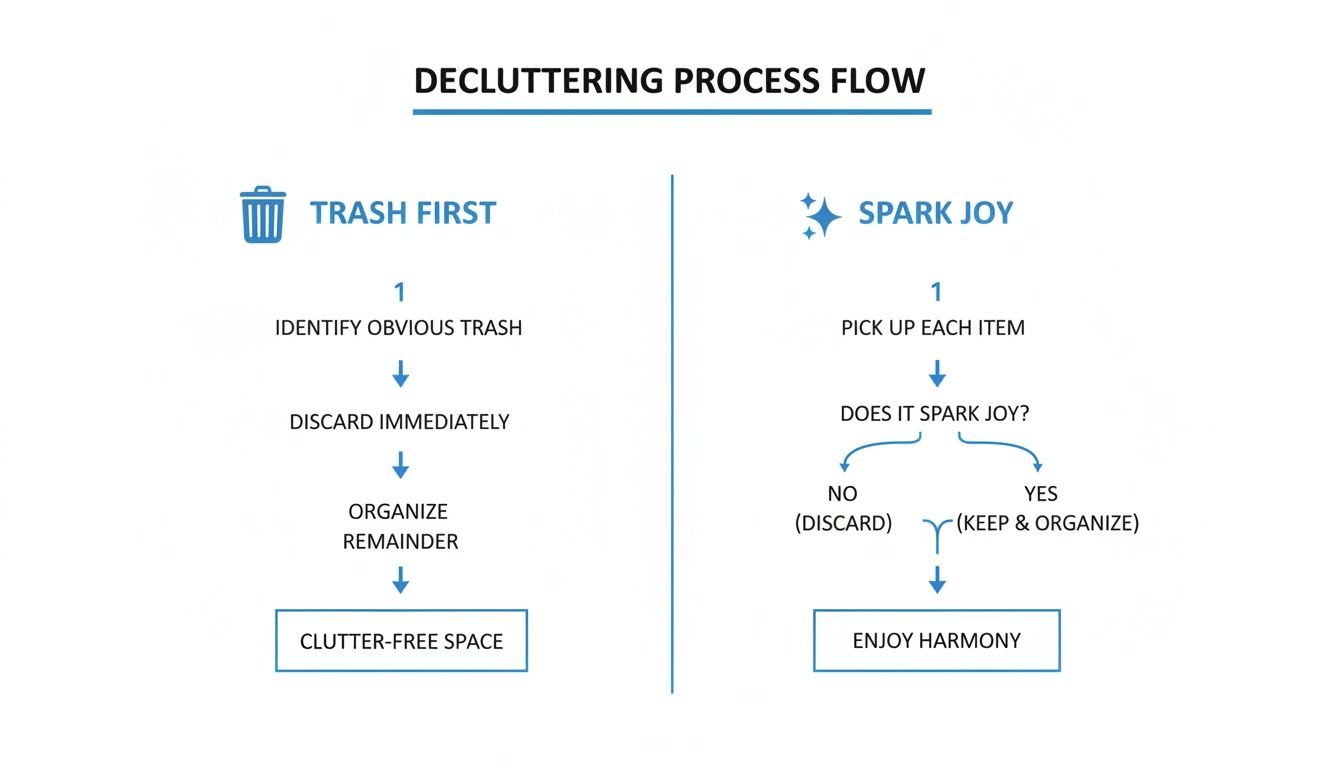
As you can see, the 'Trash First' approach gives you a straightforward way to build momentum, while jumping straight into the 'Spark Joy' method can get complicated fast.
Turning Progress into a Game
To keep you going, DeclutterNow builds in gamified features that work with your brain's natural reward system. You earn points for every single decision you make, which helps you build streaks and unlock new levels. This isn't just a gimmick; it's applied psychology.
Each quick win releases a little bit of dopamine—that "feel-good" chemical—which reinforces the positive habit and makes you want to keep going. You’re not just looking at a messy room anymore; you're earning points and watching a progress bar fill up, making the next decision feel more like a fun challenge than a chore.
And this thinking doesn't just apply to clutter. To streamline information and make faster choices in other parts of your life, you might want to explore AI note-taking tools as well. By pairing smart technology with a little bit of brain science, you finally have a way to push past the paralysis and see real, visible progress.
Your 15-Minute Action Plan to Get Started Today
All these strategies sound good on paper, but the real test is putting them into practice. So let's do that, right now. This isn't some massive, overwhelming project; it's a simple plan you can knock out in less than 15 minutes to score a quick, tangible win against that feeling of being stuck.
Forget about conquering the entire garage or basement. This is about proving to yourself that you can move forward, one small step at a time. The goal is to build a little momentum. That's it.
Pick Your Battlefield
First things first, choose one small, highly visible area. I'm not talking about a junk drawer you can just close and ignore. Pick a spot you see every single day—that cluttered kitchen counter, the top of your nightstand, or the infamous "doom chair" that has become a second closet.
A high-traffic zone like the front entrance is a fantastic choice. If that's your spot, our guide on organizing an entryway has some great ideas. By keeping your focus razor-sharp on a tiny space, the task immediately feels less daunting, and you get to see the rewarding results of your effort right away.
Use the "Trash First" Method
Okay, grab your phone and set a timer for just five minutes. Your only job is to find five pieces of obvious trash in that small area you just picked. Think old receipts, junk mail, empty wrappers, expired food containers—anything that requires zero thought or emotional energy.
You're not deciding what to keep, donate, or sell. This is purely about clearing the dead weight. Once you’ve found five items and tossed them, stop. You're done. That’s a win.
Snap One Photo
Finally, find just one item in that space that makes you pause. You know the one—the gadget you haven't touched in three years, the well-intentioned gift collecting dust. Don't force yourself to decide its fate.
Instead, just open the DeclutterNow app and snap a photo. Let the AI give you a starting point. You don't have to follow its suggestion immediately. The purpose of this step is to practice offloading the mental burden of a tough decision onto a tool designed to help. It's a low-stakes way to see how technology can be your ally.
And that's it. You've just spent 15 minutes turning overwhelm into action. This tiny routine proves that progress doesn't require hours of painful effort—just a few focused, intentional minutes. Remember, momentum is built on small wins, not perfect outcomes. You can absolutely do this.
You’ve Got Questions, We’ve Got Answers
Even with the best game plan, a few persistent questions can surface and grind your progress to a halt. Getting past decision paralysis often comes down to having solid answers for those nagging "what if" scenarios that love to pop up. Let's tackle some of the most common ones head-on.
What if I Throw Away Something I Might Need Later?
This is it. The number one fear that keeps us tethered to our clutter. It’s a powerful thought, but one we can definitely work around. The "Trash First" method is a great starting point because it immediately sidesteps this fear. You’re only dealing with items that have zero potential for future use—think expired coupons, broken electronics, or old junk mail. There's simply no debate to be had.
For everything else, remember that the goal is progress, not perfection. If you’re truly stuck on an item, grab a "maybe box." Put the questionable item inside, tape it shut, and write a date six months from now on the lid. If you haven't even thought about opening that box by the time the date rolls around, you can donate its contents with total confidence.
Honestly, we almost never miss the things we let go of. The mental clarity and physical freedom you get back are almost always worth more than the tiny chance you might need that one specific thing again.
How Is This Different from Other Decluttering Apps?
I get this question a lot. Most organizing apps are just glorified to-do lists. They’re great at telling you what to do, but when you’re already drowning in decision fatigue, another list just adds to the noise. They don't help you with the how—the actual, nitty-gritty process of making a choice.
DeClutter Now was built differently from the ground up, based on the psychology of what actually gets people unstuck.
- We start with the easy wins. Our "Trash First" workflow builds momentum right away, unlike other methods that throw you into the deep end with emotionally charged items.
- We offer real decision support. Instead of just letting you list your stuff, our AI looks at your photos and gives you a concrete, actionable suggestion. It’s like having a coach right there with you, lightening the mental load.
- We make it feel good. We’ve built-in gamification with points and streaks that tap into your brain's natural reward system. It helps turn a dreaded chore into a surprisingly satisfying challenge.
Simply put, we don't just help you organize your tasks. We are a psychology-backed decision support tool that helps you make the thousands of tiny decisions that lead to a clear, calm space.
Can This Method Help if I Have ADHD?
Absolutely. In fact, our entire system was designed with the challenges of executive function in mind. ADHD paralysis is a very real thing—that feeling of complete shutdown when you're overwhelmed by too many choices, tasks, or emotions.
The DeclutterNow approach directly targets those pain points:
- It externalizes the entire process. You don't have to hold all the steps in your head. The app walks you through one small, manageable decision at a time.
- It provides instant gratification. Those quick wins from tossing trash or earning points deliver the little dopamine hits that are so crucial for staying motivated and engaged.
- It cuts down on overthinking. By providing clear, AI-driven suggestions, the app quiets the "analysis paralysis" that can make it feel impossible to even start.
It takes the vague, overwhelming goal of "getting organized" and breaks it down into a series of small, concrete, and rewarding actions.
Ready to stop thinking and start doing? Turn your clutter paralysis into real, visible progress today. With DeclutterNow, you can finally break free from the overwhelm and build the momentum you need.