
How to organize a messy room. Let’s be honest: those boxes that have been sitting for years? The secret to finally tackling a truly cluttered room isn’t about dedicating an entire weekend to a cleaning marathon. It’s about figuring out why it feels so impossible to even start.
I know because I’ve been there. For years, I had boxes from a move that I just couldn’t bring myself to unpack. Every time I looked at them, I felt paralyzed. Traditional methods just didn’t work. The most effective first step I discovered is incredibly simple: grab a trash bag, set a timer for 15 minutes, and just look for obvious trash. That’s it. This “Trash First” methodology builds momentum without forcing you into tough decisions right away, making that first bit of progress feel genuinely achievable.
Why Organizing Your Room Feels Impossible Right Now
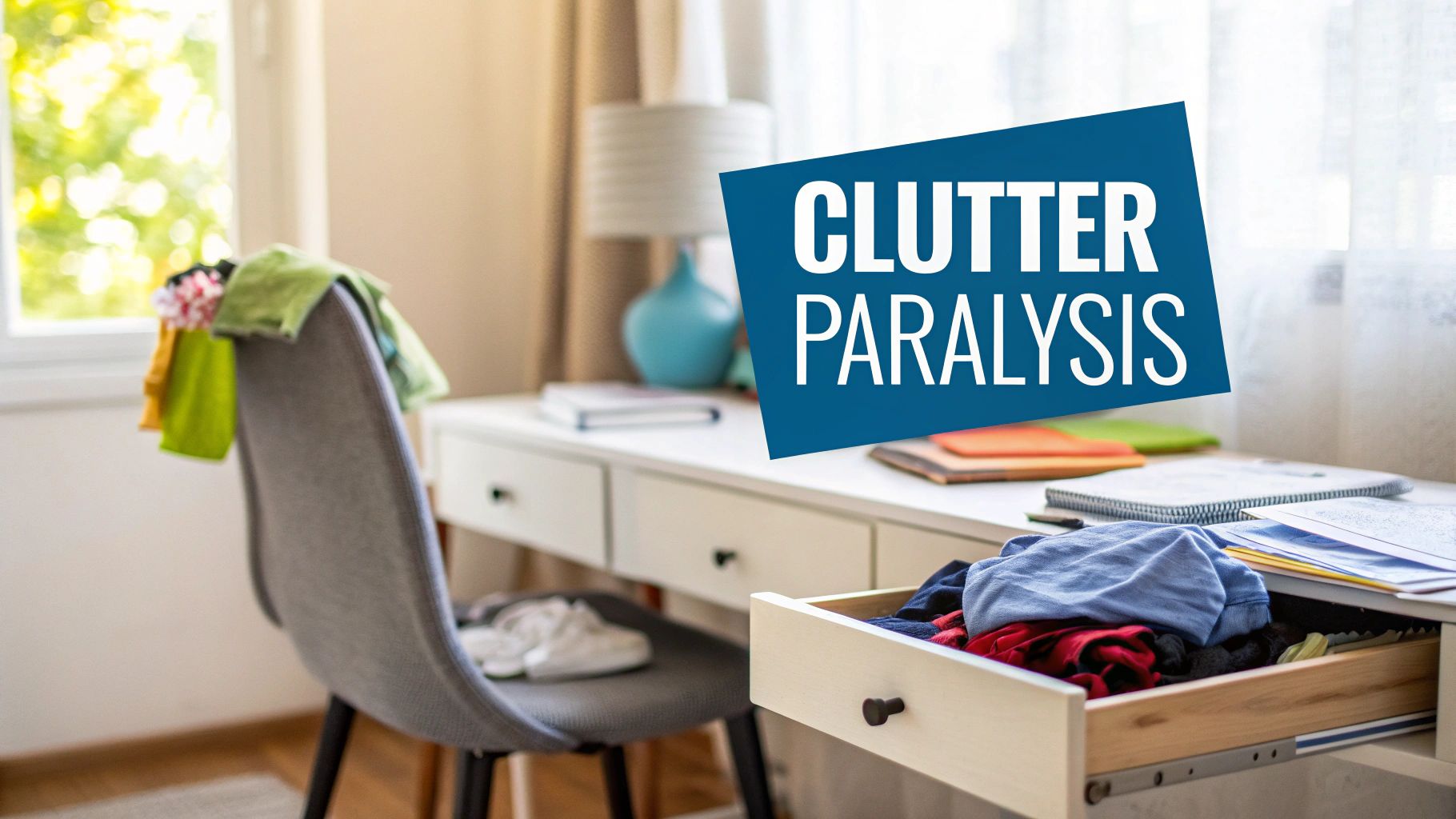
It’s a story I hear all the time. Maybe it’s those moving boxes that never got unpacked, or that one corner of the bedroom that has slowly morphed into a mountain of clothes and long-forgotten purchases. Every time you glance at it, a wave of exhaustion washes over you, and just shutting the door seems so much easier than tackling the problem.
If that sounds familiar, you need to know this isn’t a personal failing. It’s not laziness—it’s decision fatigue. You’re experiencing clutter paralysis, a very real psychological response to being completely overwhelmed. Your brain isn’t being lazy; it’s short-circuiting from being forced to make too many decisions.
The Science Behind Clutter Paralysis
When you look at a room full of stuff, your brain doesn’t just register “a messy space.” It sees hundreds, maybe even thousands, of tiny decisions that need to be made.
- Keep or toss? But what if I need this someday?
- Where does this live? Does it even have a designated spot?
- Should I try to sell this? Is it actually worth the time and effort?
- Is this sentimental? What does it mean if I let this go?
Each one of those questions, no matter how small, chips away at your mental energy. Research from Princeton has shown that all this visual clutter actively competes for your attention, making it harder to focus and spiking levels of cortisol, the stress hormone. Your brain, in an act of self-preservation, essentially shuts down to conserve energy. That’s why you feel stuck.
“The feeling of being paralyzed by your space isn’t a sign of weakness—it’s your brain’s defense mechanism against an overwhelming number of choices. Acknowledging this is the first step toward making progress.”
Why Traditional Organizing Methods Often Fail
Many popular methods ask you to begin with big, emotionally loaded questions like, “Does this spark joy?” While the intention is good, this kind of question can make decision fatigue even worse when you’re already at your limit. We don’t start with ‘does this spark joy?’—we start with ‘is this actually trash?’ Figuring out what brings you joy requires a lot of emotional and mental effort—the exact resources you don’t have when facing down a mountain of clutter.
This is why the weekend “organizing marathon” so often ends in defeat. You start out with high hopes but burn out fast from the sheer volume of decisions, sometimes leaving the room in a worse state and reinforcing that nagging belief that you’re just not an “organized person.”
There’s a much better way. Instead of fighting your brain’s natural response, you can work with it. The key is to reframe the task from “organize everything at once” to “make the absolute easiest decision first.” This psychology-backed approach is all about building momentum, not aiming for perfection right out of the gate.
By separating your mental state from your physical surroundings, you can finally see a clear path forward. To help with this, our guided meditation on how you are not your clutter can be a powerful tool for clearing your mind before you ever touch a thing in your space. The goal is to turn clutter paralysis into progress, one quick win at a time.
Your First 15-Minute Win: Build Momentum, Not Perfection
Let’s be honest: the thought of tackling a cluttered room can be completely paralyzing. The secret to breaking through that feeling isn’t blocking off a whole weekend—it’s proving to yourself, right now, that you can make a real dent. This is your quick-start plan to do just that in only 15 minutes.
We’re going to kick things off with our “Trash First” methodology. Forget making tough decisions about what to keep, donate, or sell. For the next quarter-hour, your single mission is to hunt down and eliminate the easy stuff: the obvious trash.
Why Starting with Trash Actually Works
So many decluttering methods get it backward. They ask you to start with heavy emotional lifting, like deciding if an old t-shirt “sparks joy.” When you’re already feeling overwhelmed, that’s a recipe for shutting down.
We’re not doing that. Instead, we’re asking a much, much simpler question: “Is this garbage?”
This isn’t just about cleaning; it’s a bit of a brain hack. Every old receipt, junk mail flyer, or empty wrapper you toss is a quick, satisfying win. Your brain gets a tiny hit of dopamine—the “good job!” chemical—which builds the motivation and momentum to keep going. It transforms the daunting question of “Where do I even begin?” into a simple, clear mission: “Find the trash.”
You’re not organizing the whole room. You’re just taking out the garbage. Anyone can do that.
Your 15-Minute “Trash First” Game Plan
Ready to finally make progress? The goal here is tangible progress, not perfection.
- Gear Up: All you need is a trash bag (grab the big one—it feels great to fill it) and a timer. Your phone is perfect.
- Set Your Timer for 15 Minutes: This is crucial. Knowing there’s an end in sight makes it so much easier to start.
- Scan and Scoop: Pick one corner and sweep your eyes across the room. Your mission is to spot undisputed trash. Don’t get sidetracked by a book that needs to be shelved or a shirt that needs to be folded. Stay laser-focused.
Think of all the things that are really just trash in disguise: expired coupons, dried-up pens, old shopping lists, hopelessly tangled chargers that stopped working months ago. These things require zero mental energy to deal with. Just toss them.
Did you know the average person can waste over 4.3 hours a week just looking for things or dealing with the fallout from clutter? By simply clearing out the trash, you’re not just tidying up—you’re literally buying back your time and sanity.
What to Do When the Timer Dings
Stop. I mean it.
When that alarm goes off, your work is done for now. Take that trash bag, tie it up, and get it out of the room immediately. Putting it in the bin outside is the physical act that cements your accomplishment.
Now, take a look at the space. It’s not perfect, but it’s visibly better, isn’t it? You just proved you can turn that feeling of overwhelm into real, physical action. That momentum is the most powerful tool you have for what comes next.
Ready to build on this first victory? For more insights on what to do next, check out our complete guide with more decluttering tips for beginners.
How to Sort Without the Stress: The Four-Box Method
You’ve made it through the “Trash First” session, and a little bit of breathing room has appeared. That small win is powerful—it’s the momentum you need to tackle what’s left without falling back into the paralysis trap.
Now, instead of facing a giant, undefined pile of stuff, we’re going to give every single item a clear path forward.
This is where the Four-Box Method comes in. It’s a classic for a reason. This simple, psychology-backed system is all about eliminating those agonizing “what-do-I-do-with-this?” moments. Grab four containers—laundry baskets, cardboard boxes, even sturdy shopping bags will do—and give each one a specific job.
Your Four Sorting Categories
This isn’t just about making four piles on the floor, which can quickly become a new form of clutter. It’s about creating four distinct, actionable streams that keep the process moving and prevent you from getting sidetracked.
Let’s break down what goes where:
- Keep: This is for items you use, love, and that genuinely belong in the room you are organizing. The key here is in this room.
- Relocate: This box is your secret weapon. It’s for anything that has a home somewhere else in your house—the coffee mug that belongs in the kitchen, the kids’ toys that need to go back to the playroom. Just put it in the box and move on; you’ll deal with putting it all away later.
- Donate/Sell: Items that are still in good condition but no longer serve you belong here. This is your opportunity to pass things on to someone who will use them or even make a little cash.
- Trash: You’ve already made a dent here, but you’ll inevitably find more broken things, expired items, or plain old junk as you dig deeper.
This infographic breaks down how to make these decisions quickly during your sorting sessions.
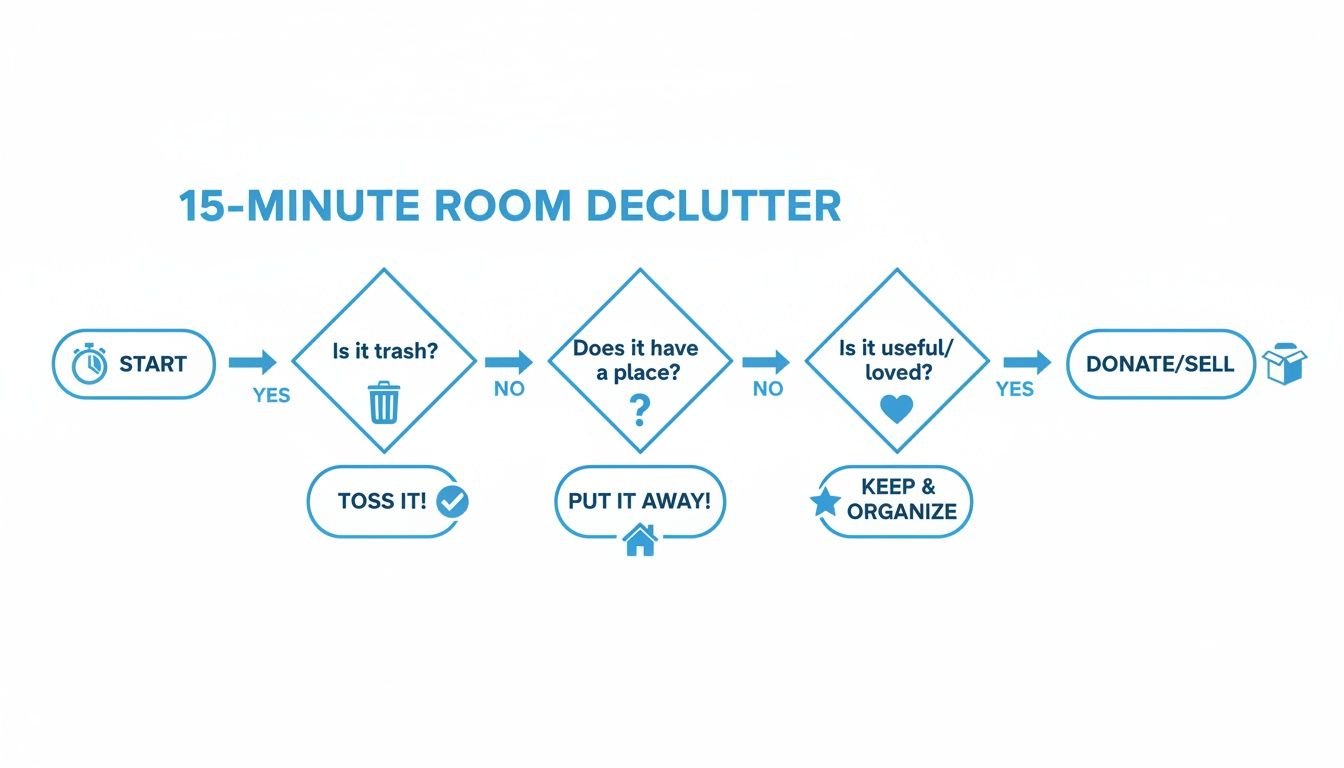
As you can see, the first question is always the easiest: “Is this trash?” Answering that first clears out a surprising amount of stuff without any mental effort at all.
Make Quick, Confident Decisions
The magic of this system is that it limits your choices. Instead of an infinite number of possibilities for each item, you only have four. Pick something up, decide which of the four boxes it belongs to, and place it inside. Don’t overthink it.
Organizational research shows that simple, repeatable systems are what make or break a decluttering session. The Four-Box Method, especially when combined with short, timed bursts of activity, directly addresses the reasons people get stuck. A staggering 70% of people cite feeling overwhelmed as their main barrier, and this method slices right through that feeling.
For a deeper dive, you can explore other decluttering methods that build on these same principles.
To make this even easier, here’s a quick guide to keep you on track.
The Four-Box Method Decision Guide
Use this table to make quick, consistent decisions for every item, eliminating clutter paralysis.
| Box Category | What Goes Inside (With Examples) | Key Question to Ask Yourself |
|---|---|---|
| Keep | Items you use regularly or truly love that belong in this room. (Your favorite sweater, the book on your nightstand, daily-use electronics) | Do I use this? Do I love it? Does it belong here? |
| Relocate | Things that are keepers but live in the wrong room. (Dishes from the kitchen, tools from the garage, mail for the office) | Does this have a home somewhere else in my house? |
| Donate/Sell | Good-condition items you no longer need, want, or use. (Clothes that don’t fit, duplicate kitchen gadgets, unread books) | Could someone else get more use out of this than I am? |
| Trash | Broken, expired, or unusable items. (Old receipts, broken electronics, worn-out clothing, junk mail) | Is this broken, expired, or otherwise unusable? |
Following these simple questions prevents you from getting bogged down in “what if” scenarios and keeps the momentum going strong.
Behavioral studies show a powerful link between our environment and our state of mind. One study found that 83% of people connect a tidy home to improved personal wellbeing and better life outcomes. Using a structured system isn’t just about cleaning; it’s a direct investment in your own peace of mind.
How AI Breaks Through Decision Fatigue
Even with a great system, some decisions are tough. What if you’re unsure if something is valuable? Or if you’re stuck on an item with sentimental value? This is where a tool like DeclutterNow can step in to act as your objective partner.
By simply snapping a photo of an item, the app’s AI can help categorize it for you, suggesting whether it might be a good candidate for the “Sell” pile or if it’s something to keep. It removes the guesswork and a lot of the emotional weight from the decision.
Think of it as having a patient, knowledgeable friend right there with you, helping you move forward without judgment. This kind of support transforms the monumental task of organizing a room into a series of small, manageable, and even rewarding steps.
Targeted Tactics for Your Toughest Clutter Hotspots
Every home has them. Those magnetic zones where clutter just seems to breed. You’ve already got some momentum with the Trash First methodology and have your Four Boxes ready to go. Now, it’s time to take the fight to the most common battlegrounds—the spots where clutter paralysis hits the hardest.
We’re not talking about a generic clean-up plan here. This is about using specific, targeted strategies for the unique challenges of your bedroom, living room, and home office. When you focus on one hotspot at a time, you start to see real, visible progress. That’s the kind of change that truly transforms how you feel and function in your space.
Reclaiming the Bedroom for Rest and Relaxation
Your bedroom is supposed to be your sanctuary, but let’s be honest, it often becomes a storage unit for things that don’t have a home. Piles of clothes, half-read books, and that overflowing bedside table can seriously mess with your ability to unwind. It’s not just in your head; studies show a cluttered bedroom can directly impact sleep quality, making it harder for your brain to switch off.
Let’s start by tackling the two biggest culprits in most bedrooms:
- The ‘Floordrobe’: You know the one. That pile of clothes on a chair or the floor—not dirty enough for the hamper, not clean enough to go back in the closet. Instead of letting it grow, grab your Four Boxes. A quick sort usually reveals that some of it is trash (a lone sock with a hole) or ready for donation (that sweater you haven’t worn in three years). Anything you’re keeping goes straight into the closet or a designated “wear again” basket.
- The Bedside Table Black Hole: This small surface is a magnet for everything from old water glasses and phone chargers to random receipts and lip balm. The fix? Clear it completely. Sort every single item using your Four Boxes and be ruthless. Most of what’s there is probably trash or belongs somewhere else. The goal is to leave only the absolute essentials: a lamp, your current book, and maybe a small dish for jewelry.
A calm physical environment sends a powerful signal to your brain that it’s time to rest. Clearing these surfaces isn’t just about organizing a room; it’s a direct investment in better sleep and a more peaceful state of mind.
By zeroing in on these areas, you’re not just cleaning. You’re actively redesigning your bedroom to serve its primary purpose—rest. This focus makes every decision easier and a lot more impactful.
Creating Calm in the Living Room
The living room is the heart of the home, which means it often turns into a drop zone for everyone and everything. Mail, magazines, tangled cables, and random items that don’t have a home can quickly make the space feel chaotic and stressful.
Here’s how to regain control of your central living space:
- Conquer Surface Clutter First. Always start with the coffee table and end tables. These surfaces are visual anchors, and clearing them gives you an immediate, powerful sense of accomplishment. Gather everything and sort it with your Four Boxes. Old magazines? Donate. Random cables? Test them and trash the broken ones.
- Establish a “Belongs Elsewhere” Bin. The living room is a crossroads, so a dedicated “Relocate” box is non-negotiable here. As you work through a session, just toss anything that belongs in another room into this bin—the kids’ toys, office paperwork, that mug from the kitchen. At the end of your 15 minutes, take five more to return these items to their proper homes.
- Untangle the Tech Mess. That nest of wires behind the TV makes the whole area feel disorganized. Get some simple cable ties or a cable management box to bundle them neatly. It’s a small action that makes a surprisingly huge visual difference.
The secret to a calm living room is simple: everything needs a home. If an item doesn’t have a designated spot, it will always, always end up as surface clutter.
Building a Functional Home Office
For so many of us, the home office is ground zero for clutter paralysis, especially when it comes to paper. Stacks of mail, old documents, and rogue office supplies can make it impossible to focus. A cluttered workspace isn’t just an eyesore; it’s a productivity killer.
Your mission here is to create a space that supports focus, not distraction.
- Attack the Paper Piles. This is where the “Trash First” methodology really shines. Before you even think about sorting, pull out all the obvious junk mail, old flyers, and empty envelopes. This instantly shrinks the pile. Then, use your Four Boxes to sort what’s left. You don’t need a complex system; even a single folder labeled “Action Items” can be a game-changer.
- Audit Your Office Supplies. Be honest: do you really need 27 pens, half of which are dried up? Gather all your pens, paper clips, and sticky notes. Quickly test the pens and toss the duds. Consolidate what’s left into one drawer or organizer. If you have a massive surplus of anything, donate it.
- Reset Your Desk Daily. This is the habit that makes all the difference. At the end of each workday, take just two minutes to put things away. File any new papers, return pens to their holder, and wipe down the surface. This tiny ritual prevents the clutter from ever building back up, ensuring you start each day with a clear space and a clear mind.
How to Turn Unwanted Clutter Into Cash
As you get into the swing of things, you’ll see your “Donate/Sell” box start to fill up. Don’t look at that box as just another chore on your to-do list; it’s an opportunity. Seeing a real reward—actual cash—can be an amazing motivator to keep the decluttering momentum going.
This isn’t about suddenly launching a full-blown reselling business. It’s simply about acknowledging that some of your stuff still has value and turning that value into a nice little bonus for all your hard work. This small shift in perspective can change the entire process from a draining slog into a rewarding treasure hunt.
Quickly Spotting Items With Resale Value
Let’s be real: not everything is worth the hassle of selling, and that’s okay. The goal here is to quickly cherry-pick the items with the best shot at selling so you don’t get bogged down. For everything else, the “Donate” pile is your best friend.
Here’s a quick mental checklist I run through when deciding whether to sell or donate:
- Brand Recognition: Does it have a well-known brand name? Think electronics, designer clothing, or popular home goods. These often hold their value.
- Condition is Key: Items that are new with tags, barely used, or in perfect working order are always the easiest to sell.
- Niche & Collectibles: Do you have vintage toys, obscure electronic parts, or out-of-print books? These often have a dedicated (and passionate) group of buyers.
- Everyday Demand: Things like popular kitchen gadgets, recent tech, or quality tools tend to sell fast because people are always looking for them.
If an item doesn’t really hit these marks, don’t overthink it. Thank it for its service and pop it right into the donate pile. Your time and energy are valuable, too.
The secret to making money from your clutter is to focus on the 20% of items that will bring in 80% of the cash. Don’t burn yourself out trying to sell every last little thing.
Using AI to Make Selling Simple
The biggest roadblock for most people isn’t finding stuff to sell—it’s the tedious task of actually listing it. Taking good photos, writing a compelling description, and figuring out a fair price can feel like a whole separate project. This is where a little modern help can make a world of difference.
Tools like the built-in eBay assistant in the DeclutterNow app are designed to completely eliminate that friction. The process is incredibly simple:
- Snap a Few Photos: Just take clear, well-lit pictures of your item from a few different angles, right from within the app.
- Let AI Handle the Details: Using your photos, the app identifies what you’re selling and generates a great title and a detailed description for you. It automatically pulls in key features and specs, saving you the headache of looking everything up.
- Get Smart Pricing: Based on what similar items have sold for recently, the AI will suggest a competitive price. No more guesswork.
What used to take me 20 minutes of research and typing now takes about two. This turns a dreaded chore into a few quick taps, making it far more likely you’ll actually follow through and get those items listed.
Conquering the Donation Pile for Good
Your “Donate” box is full of things ready for a second life, but for many of us, this is where the process grinds to a halt. Those bags and boxes often end up living in the car trunk for weeks, becoming a new kind of clutter.
To finally get these items out of your house, you need an exit strategy.
- Schedule a Pickup: So many charities offer free home pickups. A quick search for “donation pickup near me” will connect you with local groups. Book it on your calendar just like any other appointment.
- Find a Convenient Drop-Off: Pinpoint a donation center that’s on your way to work or near the grocery store. This makes it a breeze to drop off a bag or two without making a special trip.
- Set a Hard Deadline: I live by the one-week rule. The moment a box is full, I have seven days to get it out of the house. No excuses.
By creating a clear and simple plan for both selling and donating, you truly complete the decluttering cycle. You’ve turned that feeling of being overwhelmed into action, and that action leads to a calmer space, a clearer mind, and maybe even a fatter wallet.
Keeping Your Room Organized for Good: How to Build Lasting Habits
You’ve done the hard work. You fought through the clutter paralysis, sorted your way through piles, and finally carved out a space you can actually breathe in. That’s a huge win. The real challenge, though, is keeping it that way.
This isn’t about aiming for perfection. It’s about building a few small, sustainable habits that prevent the chaos from creeping back. Think of it as turning maintenance into an automatic, almost thoughtless part of your routine—solidifying the calm you worked so hard to create.
Embrace the ‘One-In, One-Out’ Mentality
If you only adopt one new habit, make it this one. The “One-In, One-Out” rule is one of the most powerful tools against future clutter. The idea is simple: every time a new item comes into your room, a similar item has to go.
- Buy a new shirt? One of your old ones gets donated.
- Get a new book? Pass a finished one on to a friend.
- Upgrade your phone charger? That old, frayed one goes straight into e-waste recycling.
This simple practice forces you to be more conscious of what you bring into your home. It keeps your closets and drawers from ever reaching that bursting point again, maintaining a perfect equilibrium. It’s a tiny shift that pays massive dividends over time.
Master the 5-Minute Nightly Tidy
The thought of cleaning every day sounds exhausting, I get it. But we’re not talking about deep cleaning. We’re talking about a quick, five-minute reset before bed.
Set a timer and just focus on a quick sweep. Your only job is to:
- Toss stray clothes into the hamper or hang them up.
- Take that water glass or coffee mug back to the kitchen.
- Wipe down your bedside table.
- Stack any books or papers that are lying around.
This tiny ritual is your best defense against small messes snowballing into overwhelming piles. Waking up to a clear space does wonders for your mindset and reinforces all the great progress you’ve made.
A lot of my clients get stuck on sentimental items they don’t have space for. Here’s a trick: separate the memory from the object. Take a really nice photo of the item and start a digital scrapbook. This lets you honor the memory without sacrificing your physical space.
Navigating Shared Spaces and Other Hurdles
Things get a bit trickier when you share a room or a home. The key here isn’t to get frustrated, but to get clever with communication and shared systems.
I often recommend creating a “landing zone” right by the door. This could be a small table, a specific basket, or a set of hooks. It’s a designated spot for keys, mail, and all that stuff that gets dumped out of pockets, keeping it from migrating onto every flat surface in the room.
For shared closets or drawers, simple dividers can be a game-changer. They create clear, visual boundaries. When everyone knows exactly where their stuff is supposed to live, it becomes so much easier for the whole household to pitch in and maintain order.
Remember, the goal is always progress, not perfection. You’ve already proven you can conquer the overwhelm. These habits are just the tools to help you enjoy the peace and quiet for good.
Ready to turn clutter paralysis into progress? DeclutterNow.ai uses psychology-backed methods and AI to help you build momentum and finally make progress on those spaces that have felt stuck for years.
Try DeclutterNow free → Try DeclutterNow for free