
If you want to make decisions faster, you need a different strategy. I used to think the secret was just trying harder, but I was wrong. The real secret is to shrink the number of choices you face at any given moment and always tackle the easiest ones first.
This simple shift short-circuits the overthinking that keeps you stuck. It’s a powerful way to build momentum, turning that overwhelming feeling of "where do I even start?" into a series of small, confident wins. It’s not about making the perfect choice every time; it’s about making progress.
Why Your Brain Gets Stuck in Clutter Paralysis
Have you ever stood in front of a pile of stuff—maybe one of those boxes that has been sitting there for years—and just felt completely frozen? You have every intention of starting, but your brain just… shuts down. This isn't laziness. It's a very real phenomenon known as "clutter paralysis," and it's a direct result of decision fatigue.

I like to think of our decision-making capacity as a phone battery. You wake up with a full charge, 100%. But every single choice you make throughout the day, no matter how tiny—what to wear, what to eat for breakfast, which email to open first—drains a little bit of that power.
By the time you finally face a mentally demanding task like decluttering, your battery is already running low. When you look at a box with 50 different items and have to ask "Keep, toss, or donate?" for each one, it’s like running 50 different apps at once. Your mental battery plummets, and your brain’s self-preservation instinct kicks in. It shuts down. That's clutter paralysis in a nutshell.
The Science Behind the Struggle
This mental exhaustion is exactly why so many traditional decluttering methods backfire. They push you to make emotionally loaded, complex decisions right out of the gate, which is the last thing your tired brain can handle. For some, an underlying issue like executive dysfunction can make it even harder, as it directly impacts the brain's ability to plan, prioritize, and see tasks through.
The real problem isn't laziness—it's decision fatigue. We burn through our cognitive fuel way too fast. To actually get things done, we have to change the type of decisions we make first.
Instead of fighting against your brain's natural limits, the best approach is to work with them. When you start with the absolute no-brainers (like obvious trash), you bypass the fatigue and start building momentum. This is the key to finally making progress.
This simple strategy saves your precious mental energy for the tougher calls later on, allowing you to finally make decisions faster and turn that feeling of being stuck into real, visible progress.
The Hidden Costs of Indecision in Your Home
Ever notice how those boxes stacked in the garage or the back of a closet aren't just taking up physical space? They're also quietly draining your most valuable resources. Every time you walk past that pile and think, "I'll deal with that later," you're paying a hidden tax—a tax on your time, your energy, and your peace of mind.
This isn't just about a room you don't like looking at. It's about the compounding cost of delayed decisions.

In the business world, there’s a name for this: the 'Slowness Tax.' A survey of company leaders revealed that a staggering 73% of their organizations lose serious revenue every year because of slow decision-making. For a medium-sized business, that can easily add up to millions of dollars lost to simple inaction. When you learn more about how slow decisions impact business performance, the parallels to what's happening at home become crystal clear.
Now, think about your own personal "revenue." This is the time you could be spending with family, the mental energy you could pour into a new hobby, or even just the simple joy of a calm, quiet environment. Every single postponed decision about your stuff chips away at that personal wealth.
Quantifying the Personal Slowness Tax
So, what does this really cost you? Indecision doesn't just put things on hold; it actively works against you in three critical areas.
- Wasted Time: Think about all the minutes you spend each day looking for misplaced keys, a specific shirt, or that one important document. It feels small in the moment, but over a year, this can add up to dozens of hours you will never get back.
- Lost Space: Every square foot of your home has value. Clutter is essentially a freeloader, "renting" that space for free and preventing you from using your home the way you actually want to.
- Mental Drain: Living in a cluttered space constantly sends signals to your brain that your work is never done. This creates a low-grade, persistent stress that saps your focus and, ironically, makes it even harder to make decisions faster.
Indecision in your home works just like debt. The longer you put it off, the more "interest" you pay in the form of stress, lost time, and a home that doesn't support you.
It's a frustrating cycle, isn't it? The more overwhelmed you feel by the clutter, the harder it is to start, and the more the costs add up. But recognizing these hidden costs is the first, most powerful step you can take to break free.
Suddenly, the challenge isn't just "cleaning a room" anymore. It's about "reclaiming valuable life resources." The goal becomes much bigger than a tidy space—it's about stopping the heavy price of inaction and reinvesting all that time and energy back into your life.
Build Momentum With The Trash First Method
Have you ever tried to declutter, only to give up 10 minutes later? You’re not alone. The problem with a lot of decluttering advice is that it starts with the hardest part—asking deep, emotional questions like, "Does this spark joy?" about an item you've had for 20 years. That kind of question drains your mental and emotional battery right from the get-go, setting you up to feel overwhelmed and quit.
I say, let’s flip that script. The secret to learning how to make decisions faster isn't about tackling the big, tough choices first. It’s about starting with the easiest wins imaginable.

This is the whole idea behind the Trash First Method. Forget about sentimental keepsakes for now. We’re going straight for the obvious, undeniable trash: expired coupons, week-old receipts, junk mail, and that pen that hasn't worked since 2018. These are no-brainers. They require zero debate and almost no mental energy to toss.
Every single piece of junk you throw away is a quick, easy victory. It’s a small, physical action that proves you can do this. You’re already making progress.
The Psychology Of A Quick Win
So, why does starting with trash feel so good and work so well? It all comes down to a little brain chemistry. Each time you make a fast, successful decision—like tossing a crumpled receipt—your brain gives you a little hit of dopamine. That’s the chemical that makes you feel motivated and rewarded.
This isn’t just about tidying up a room; it’s psychology-backed decluttering. You’re creating new connections that associate decluttering with that feeling of accomplishment, not the familiar dread of being overwhelmed.
By focusing on momentum over perfection, you create a positive feedback loop. Each quick win fuels your motivation, making the next slightly harder decision feel more manageable. You’re building decision-making muscle.
Now, this hands-on, action-first strategy is a world away from more philosophical approaches. While it can be valuable to understand your relationship with your belongings, that’s not where you need to start when you're completely stuck in "clutter paralysis." If you’re curious about shifting your overall mindset, you can always check out some minimalist lifestyle tips in our article. But right now, our only goal is to get you moving.
The Trash First Method is specifically designed to snap that cycle of decision fatigue. It’s for anyone who has stared at those boxes sitting for years and just felt frozen. It proves you don't need to agonize for hours to see results—you just need to start with the trash.
Traditional Methods vs. The Trash First Method
To really see the difference, it helps to compare the experience of starting with deep, philosophical questions versus diving in with easy, physical actions.
| Aspect | Traditional Methods (e.g., Marie Kondo) | The 'Trash First' Method |
|---|---|---|
| Starting Point | We don't start with "does this spark joy?" | We start with "is this actually trash?" |
| Initial Feeling | Often causes immediate overwhelm and decision fatigue. | Creates a feeling of instant progress and accomplishment. |
| Decision Type | Complex, value-based choices (e.g., "Does it spark joy?"). | Simple, binary choices (e.g., "Is this literal garbage?"). |
| Psychological Impact | High risk of "analysis paralysis," leading to procrastination. | Builds a positive feedback loop with quick dopamine hits. |
| Goal | To cultivate a mindful relationship with possessions. | To build momentum and break the cycle of inaction. |
Ultimately, while both paths can lead to a decluttered space, the Trash First Method is engineered to get you unstuck and moving forward from the very first minute.
How AI Can Accelerate Your Decision Making
Think of having a personal coach right beside you, one that takes the emotional weight and mental gymnastics out of every single decluttering decision. This isn't some far-off concept; it’s exactly how AI can help you make decisions faster. It provides the objective, clear-headed data your tired brain needs to just move.
This approach actually mirrors what the most successful companies do. Research shows that data-driven organizations are simply better and faster at making good calls. A fascinating study involving experts from MIT, Harvard, and McKinsey discovered that quick deciders deliver high-quality results twice as often as their slower counterparts. Speed and performance are directly linked.
The parallel to our cluttered homes is perfect. Staring at every old t-shirt or forgotten gadget creates the same kind of decision fatigue that stalls progress in a lagging company. You can see just how data drives business success to understand the power of this principle.
Turning Overwhelm Into Action With Objective Guidance
When you're caught in the grip of clutter paralysis, the last thing you need is another complicated, emotional choice. You need a clear path forward. This is where a tool like DeclutterNow comes in, acting as your impartial decluttering partner. It's built to cut through the cycle of overthinking by giving you a clean, data-backed starting point.
The whole process is incredibly straightforward. Instead of spinning your wheels wondering about an item’s sentimental value or some hypothetical future use, you just snap a photo.
That's it. Our AI instantly gets to work. It doesn't ask how you feel about that old vase or stack of magazines. It analyzes the item and provides a logical recommendation, stripping away all the mental friction that leads to paralysis.
It's not about letting an app make your choices for you. It's about getting an unbiased second opinion that cuts through the noise so you can act confidently and quickly. AI breaks through decision fatigue.
This simple workflow transforms what could be an hour of agonizing over a single box into just a few seconds of decisive action.
How AI Breaks Through the Mental Block
This tech-assisted approach is specifically designed to tackle the very things that cause decision fatigue. It works by systematically chipping away at the mental effort needed for each choice you make.
- It externalizes the process. Instead of trying to juggle a dozen variables for every single item in your head, the app does the heavy lifting, freeing up your brainpower.
- It provides instant recommendations. No more waffling. The AI gives you a clear suggestion—Keep, Donate/Sell, or Trash—so you have an immediate and obvious next step.
- It builds momentum without the drain. By making those first few decisions fast and almost effortless, you start to build real momentum without depleting your mental battery, much like the "Trash First" method we talked about earlier.
By taking the emotional friction and mental exhaustion out of the equation, AI can be the support system that finally gets you unstuck. You can learn more about how this technology directly addresses the psychological hurdles in our article on decision paralysis vs. clutter-free living. It's the key to turning the intention to declutter into visible, rewarding progress.
Your Action Plan to Make Faster Decisions Today
Theory is great, but real progress happens when you start doing. Let's move from just understanding clutter paralysis to actively breaking through it. This is your game plan for turning that feeling of being overwhelmed into actual momentum, and you can get started in just a few minutes.
The trick is to start small. I'm talking about a single, manageable space—one messy drawer or one of those mystery boxes that’s been collecting dust for years. We’re aiming for progress here, not perfection.
Your First 15-Minute Decluttering Sprint
Ready to feel that first jolt of accomplishment? Grab your phone, pick a starting point (seriously, just one box!), and let's dive in. This simple workflow is all about getting you a quick win and building the confidence to tackle bigger projects down the road.
- Capture Your Starting Point: Fire up the DeclutterNow app and just snap a photo of what’s in your chosen box or drawer. Don't arrange anything or overthink it; a clear shot is all you need.
- Follow the ‘Trash First’ Guidance: The AI gets to work right away. Your first mission is simple: follow the "Trash First" methodology. The app will help you spot all the no-brainers—old receipts, pens that don’t work, and other obvious junk.
- Experience Your First Wins: With every piece of trash you toss, you’re doing more than just clearing space—you're building a streak. You'll see points and achievements pop up. This isn't just a gimmick; it’s a way to give your brain the little dopamine hits it needs to stay engaged and motivated.
This little diagram breaks down the simple, three-step flow: snap a photo, let the AI help you sort, and then take action.
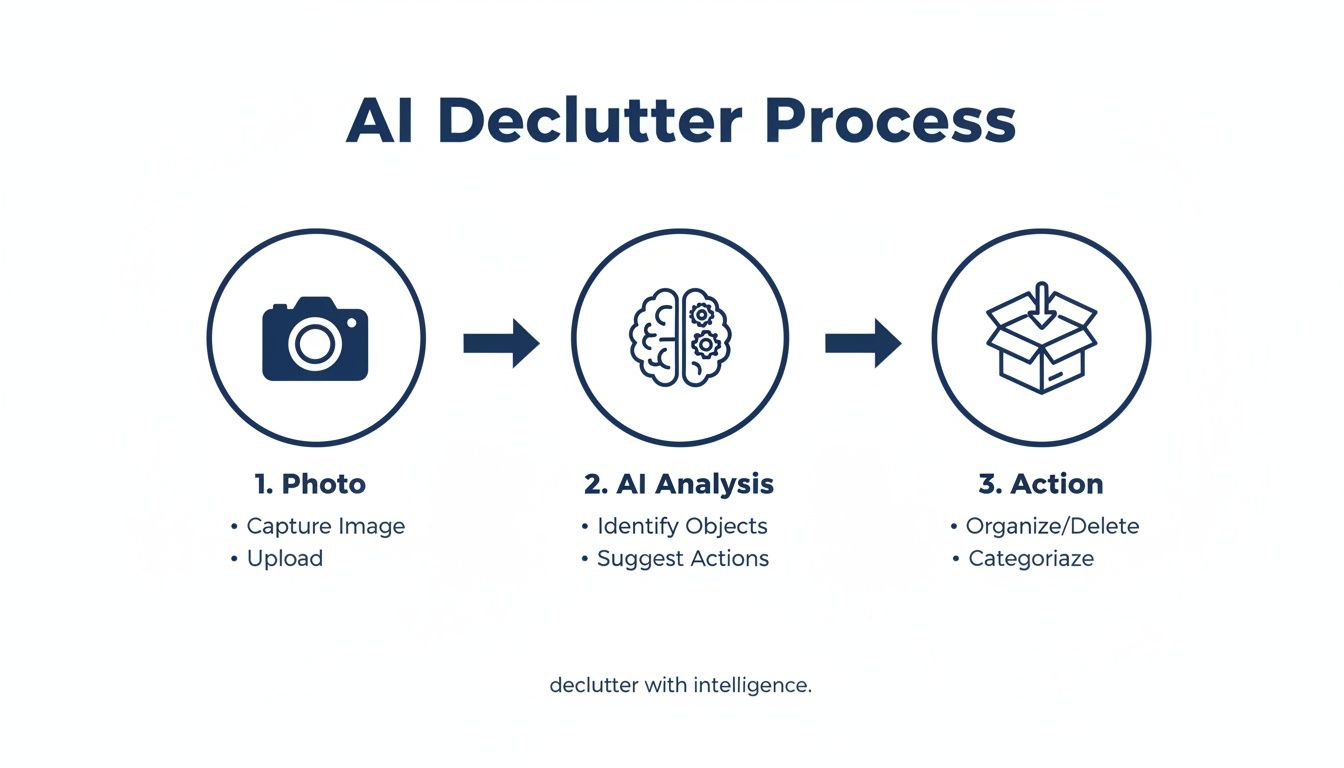
The real magic here is in its simplicity. It turns a mentally draining task into a straightforward, guided activity.
From Gut Instinct to Data-Driven Action
Trying to declutter when your brain is tired and overwhelmed is like relying on gut instinct for a huge business decision. It rarely ends well. Research has shown that companies using data to decide faster see 16% higher profit growth. Yet, a surprising 79% of leaders admit they still fall back on instinct for major calls.
DeclutterNow brings that same data-driven advantage right into your home. It uses AI to give you instant, clear verdicts—Keep, Donate/Sell, or Trash—which can slash your decision time from hours down to seconds.
Just like a successful business, a calm and functional home is built on a series of small, smart, and swift decisions. The goal is to stop agonizing and start acting.
To really get good at making faster decisions, it helps to think beyond just managing your calendar. It's about understanding your cognitive resources. One powerful idea is to explore the difference between energy management vs time management, which can help you set yourself up for more decisive action. This isn't just about finding more hours in the day; it's about using your peak mental energy wisely.
By starting with one small box and following this simple, tech-assisted plan, you can clear your first space in under 15 minutes. This isn't just a small victory; it's the proof you need that you can do this. You're now equipped to make decisions faster and finally turn clutter paralysis into progress.
Got Questions? Let's Talk About Making Faster Decisions
Even with the best techniques in your back pocket, you're bound to hit a few snags when you're trying to unwire a habit as deep-rooted as indecision. That's totally normal. Getting stuck is frustrating, and it's fair to wonder if a new approach will really make a difference for you.
Let's dive into some of the most common questions I hear about speeding up decisions, especially when you're staring down a mountain of clutter.
Why Do Even Simple Choices Feel So Overwhelming?
This is the very essence of clutter paralysis, and let me be clear: it has nothing to do with being lazy. It's all about cognitive load. Think of your brain like a smartphone battery. It starts the day with a full charge, but every single decision you make—big or small—drains a bit of that power.
When you look at a cluttered room, you aren't just making one big decision to "clean up." You're actually facing hundreds, maybe thousands, of tiny decisions for every single object. Keep? Toss? Donate? Where does this go? Do I need it?
This constant barrage of questions is what leads to decision fatigue. It's the exact same reason picking a movie on Netflix feels impossible after a long, stressful workday. Your brain is just tapped out. The real trick is to drastically cut down the number and difficulty of the decisions you're asking it to make at any given moment.
How Does Starting With Trash Actually Help Me Decide Faster?
The "Trash First" method is a brilliant little psychological trick that short-circuits that feeling of overwhelm. It’s effective because it kicks things off with decisions that require zero mental energy. Is this crumpled receipt trash? Yes. This empty Amazon box? Yep.
Those quick wins accomplish two very important things:
- You see immediate, tangible progress, which is a massive motivator.
- Your brain releases a little hit of dopamine—the "feel-good" chemical—which creates a positive feedback loop and makes you want to keep going.
By building momentum on the no-brainers, you're conserving your precious mental energy for the tougher calls later on. You're essentially training your brain to see decluttering as a rewarding activity, not a stressful chore.
If there's one thing to take away, it's this: The best way to make faster decisions is to stop forcing your brain to make hard ones when it's already tired. Start with trash, build momentum.
Is It Cheating To Use AI To Help Me Decide?
Not at all. Think of it less like cheating and more like having a super logical, completely unbiased assistant by your side. It's incredibly difficult to be objective when you're mentally drained or have an emotional connection to an object. The AI provides that much-needed external perspective.
Our app, for instance, has no idea about the sentimental story behind that old t-shirt from college. It just sees a piece of clothing and helps you categorize it. This removes the emotional static from the equation, letting you see the item for what it truly is.
It’s a support tool, plain and simple. It’s there to make your job easier so you can act with more confidence and speed. You always have the final say, but now you have a clear, logical starting point instead of a jumble of feelings.
Ready to turn clutter paralysis into progress? DeclutterNow is built from the ground up to cut through decision fatigue using psychology-backed methods and a little help from AI.
Try DeclutterNow free →