
How to DeClutter Your Home Quickly. Those boxes in the garage that have been sitting there for years? That pile of stuff in the spare room you keep promising to tackle? It’s not there because you’re lazy. It’s because every time you look at it, your brain gets hit with a tidal wave of decisions. This is “clutter paralysis,” and it’s the real reason so many of us feel stuck.
The good news? The secret to breaking through isn’t about finding more motivation or becoming a minimalist overnight. It’s about psychology. It’s about starting with the easiest possible wins to build unstoppable momentum. Forget perfection. We’re aiming for progress.
Understanding Clutter Paralysis and How to Break Free
Have you ever stood in a room, looked at the piles of stuff, and felt completely and utterly frozen? That heavy, draining feeling isn’t a character flaw. It’s clutter paralysis, a very real state of decision fatigue. Every single item, from that stack of old magazines to a sweater a relative gave you that you never wore, is screaming for a choice.
Keep it? Toss it? Where does it even belong? The questions pile up until your brain just… stops. It’s a psychological short-circuit. The sheer volume of decisions drains your mental energy, making the simple act of starting feel like an impossible climb. So, you walk away, feeling defeated, and the clutter wins another day.
Why Traditional Methods Fail
So many popular decluttering methods tell you to start by asking deep, emotional questions like, “Does this spark joy?” While the intention is good, that can be the absolute worst place to begin when you’re already overwhelmed. It throws you into the deep end of difficult decisions right away, which only makes the paralysis worse.
I speak from experience. I had boxes sitting for YEARS in my garage. Every time I tried to tackle them, I was hit with a tidal wave of memories and tough choices. The weight of every item was palpable, and I’d quit before I’d even really started. It wasn’t until I realized the problem wasn’t laziness—it was decision fatigue—that I completely changed my approach and finally made progress.
The real problem isn’t the stuff itself. It’s the crushing mental load of deciding what to do with all of it. Clutter paralysis is just your brain’s defense mechanism against being overwhelmed.
Understanding the psychology behind this is your secret weapon. To turn that frozen feeling into forward motion, you have to work with your brain’s limits, not fight them. It’s about charging your decision-making battery with quick wins, not draining it dry.
Shifting from Self-Blame to Action
The very first thing you need to do is give yourself a break. You are not a disorganized or unmotivated person. You’re just experiencing a completely normal reaction to being overloaded. The key is to break that cycle by lowering the barrier to entry so much that starting feels ridiculously easy. If you want a full rundown on taking those first steps, check out our decluttering tips for beginners.
Here’s how you can reframe the problem and get ready to act:
- Acknowledge the Fatigue: First, just admit it. Your inability to start is a symptom of decision fatigue, not a character flaw. This simple shift in perspective is incredibly powerful.
- Focus on Progress, Not Perfection: The goal isn’t a pristine home by tomorrow. It’s to make one small, tangible bit of progress today.
- Start with Trash, Build Momentum: Forget the sentimental photo albums for now. Start with junk mail, old receipts, or expired spices. These are the things that require virtually zero emotional energy to discard.
When you embrace this psychology-backed approach, you’re setting yourself up for a new, actionable strategy. It’s all about building momentum, not achieving some mythical state of perfection. In the next section, we’ll dive into exactly how to get that crucial first win.
Start With Trash, Build Momentum: The “Trash First” Method
When you’re paralyzed by decisions, the last thing you should do is ask if a dusty old souvenir “sparks joy.” That question requires emotional energy, which is in short supply when you’re feeling stuck.
So, let’s flip that on its head. We’re not starting with “does this spark joy?”—we’re starting with “is this actually trash?” This is what I call the “Trash First” Method.
The whole point is to build instant, undeniable momentum. It’s a psychological trick on yourself, and it works beautifully. Deciding to toss an old receipt, a pile of junk mail, or a pen that ran out of ink takes zero mental effort. There’s no sentimental value to weigh, no future potential to consider. It’s just trash.
Every single time you make one of these no-brainer decisions, your brain gets a quick win—a tiny hit of dopamine that says, “Hey, good job!” This creates a powerful feedback loop. The more you toss, the better you feel, and the more motivated you become to keep going. It’s the perfect antidote to that “I don’t even know where to start” paralysis.
Your First 15-Minute Sprint
The goal here is progress, not perfection. We’re not trying to overhaul an entire room in one shot. We’re just trying to prove to ourselves that we can make a tangible difference in a very short amount of time. All you need is a garbage bag and a timer.
Ready? Let’s do this.
Pick one small, visible area. Not the whole kitchen—just the main countertop. Not the entire bedroom—just the top of your nightstand. Now, set your timer for 15 minutes and just go.
For these 15 minutes, you have only one mission: find obvious, undeniable trash. That’s it. Ignore everything else completely. Don’t worry about what to donate or what to sell. Don’t even think about where something should go. If you pick something up and hesitate for even a second, it’s not trash for this exercise. Put it down and move on.
This laser focus is the secret sauce. You’re training your brain to cut through the noise and just rack up quick wins. This is the core concept we break down in our guide on a simple trick to declutter your home in under 60 seconds.
By starting with trash, you’re not just clearing physical space; you’re clearing the mental fog. You’re replacing the heavy feeling of “I don’t know where to begin” with the empowering proof of “I just did.”
When that 15-minute timer goes off, stop. Tie up the garbage bag and—this is crucial—take it outside to the bin immediately. Don’t leave it by the door for later. This final step is what solidifies the accomplishment in your mind. Now, step back and look at the clear space you just created. It might be a small victory, but it’s real, and it’s the spark you need to turn paralysis into progress.
Your First 15-Minute Trash First Session
This isn’t some vague, all-day project. We’re talking about a quick, focused burst of activity with a clear start and a clear finish. Here’s exactly how to structure your first session to get the best results without any of the stress.
| Time | Action | Goal |
|---|---|---|
| Minutes 0-2 | Grab a trash bag and set a 15-minute timer. Choose one small, contained area like a kitchen counter or a nightstand. | Get set up and commit to the short, manageable timeframe. |
| Minutes 3-12 | Scan for obvious trash only. Ignore everything else. Think wrappers, old mail, expired products, broken items. | Fill the bag quickly and build momentum with effortless quick wins. |
| Minutes 13-15 | Tie up the bag and take it out immediately. Step back and admire the clear space you’ve created. | Solidify that feeling of accomplishment and lock in the win. |
That’s all there is to it. You just completed your first successful decluttering session. It’s that simple, and it’s the foundation for everything that comes next.
Taking It to the Next Level: Power Sessions and Sorting Systems
Remember that little spark of victory you felt after that first 15-minute “Trash First” sprint? That’s what progress feels like. It’s the proof you needed that you can absolutely turn that feeling of being stuck into real, visible change. Now that you’ve got some momentum, we’re going to build on it and tackle bigger spaces without getting bogged down.
Instead of quick sprints, it’s time for power sessions. Think of these as focused, 30- to 60-minute blocks where you can make a serious dent in an entire room, not just a single surface. The secret is to keep that same fast-paced, clear-headed energy you found in the shorter sessions. To do that, we need a simple way to sort everything that isn’t obvious trash.
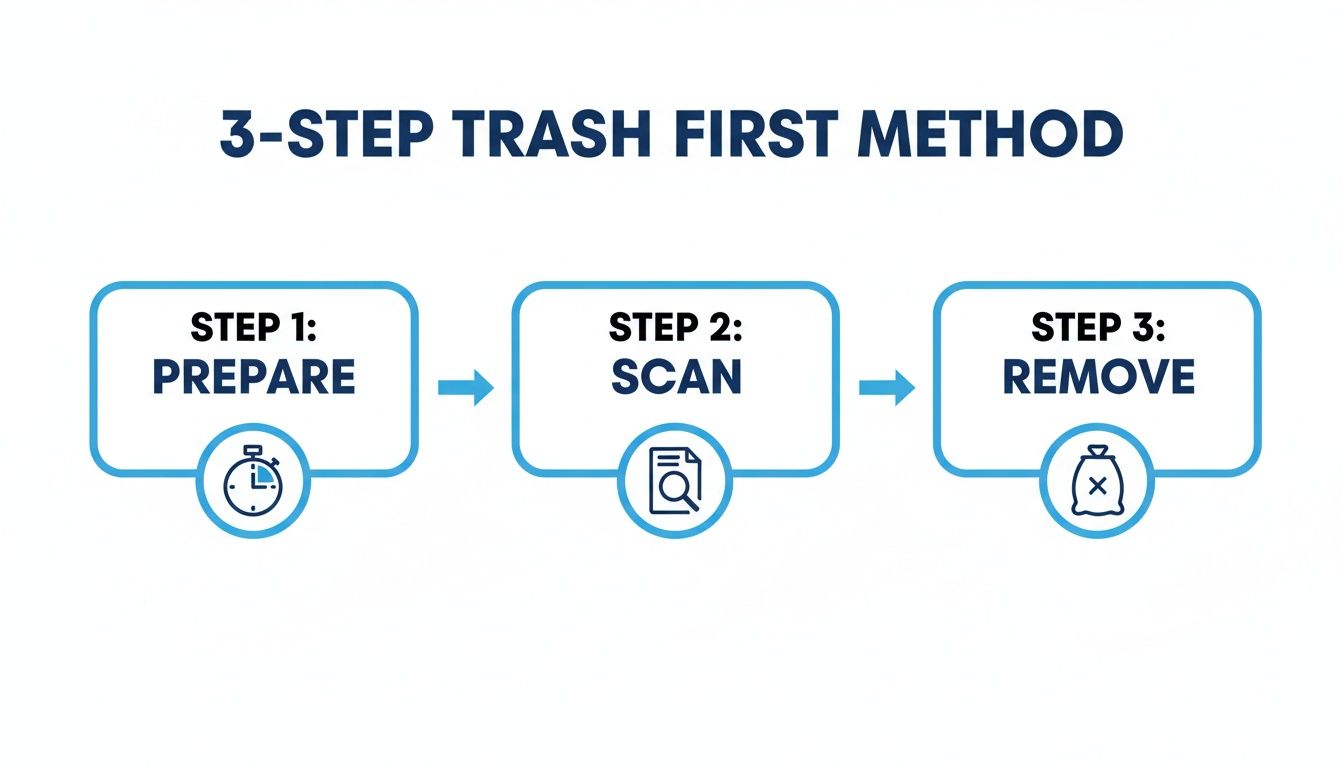
This is the simple, three-step flow of the Trash First Method that we’ll use for every single decluttering session. It’s a repeatable process that stops you from overthinking and just gets things done.
Introducing the Four-Box Method
Once the obvious trash is gone, you need a system to prevent you from just moving piles from one spot to another. This is where the Four-Box Method becomes your best friend. It’s a beautifully simple approach that gives every item a destination, which is the key to making quick, confident decisions.
Here are the only four categories you need:
- Keep: This is the good stuff. Things you genuinely use, love, or need. They have a purpose and a place in your life right now.
- Relocate: This box is for all the things that have wandered away from their proper home. The coffee mug on your nightstand, the kids’ toys in the hallway—they belong here.
- Donate/Sell: These are perfectly good items that just don’t serve you anymore. Clothes you haven’t touched in a year, kitchen gadgets still in their packaging, books you’ll never read again.
- Trash: Our old friend from the 15-minute sprint. This is for anything broken, expired, stained, or otherwise unusable.
As you start a power session, just grab four boxes (or laundry baskets, or just designate four corners of the room) and label them. Pick up an item, make a snap judgment, and put it in its place. Don’t overthink it. Just sort and keep moving.
Quick Decision Rules to Keep the Momentum Going
Hesitation is the enemy of a good power session. It’s what turns a 30-minute task into an all-day ordeal. To fight back, you need some simple, pre-decided rules. One of my absolute favorites is the 20/20 Rule.
The 20/20 Rule: If you can replace an item for less than $20 in under 20 minutes, it’s often easier to let it go than to agonize over it.
This little rule is a game-changer for all those “just in case” items cluttering up your space. That tangled mess of charging cables for phones you don’t even own anymore? Gone. That weirdly specific kitchen tool you used one time three years ago? It’s not worth the mental or physical space it’s taking up. The 20/20 rule gives you permission to release things without guilt.
How to Handle Sentimental Items Without Getting Stuck
Sooner or later, it’s going to happen. You’ll pick up something that stops you in your tracks—a child’s first drawing, a ticket stub from a favorite concert, a gift from someone you miss. These sentimental items are absolute momentum-killers. They require a totally different kind of emotional processing that has no place in a rapid-fire decluttering session.
That’s why we bring in a fifth, special-purpose container: the “Decide Later” box.
When you come across a sentimental item, your only job is to place it gently in this box and move on to the next thing. That’s it. You are not making a final decision today. You’re simply setting it aside so it doesn’t derail your entire session. Later, when you’re feeling rested and emotionally ready, you can schedule a separate time to go through just that box. This approach lets you honor your memories without sabotaging your progress.
Your Secret Weapon for Overcoming Decision Fatigue
The power sessions and sorting systems we’ve gone over are fantastic, time-tested tools. But what if you could put those psychology-backed methods on autopilot? Imagine having a personal coach in your pocket that helps you make every decision without the mental gymnastics.
That’s exactly why we built DeClutter Now. It was designed from the ground up to turn clutter paralysis into progress. The app takes proven frameworks like the “Trash First” rule and the “Four-Box Method” and turns them into a guided, even fun, digital experience that removes all the guesswork.
It’s surprisingly simple. You just snap a photo of any item you’re on the fence about, and our AI instantly helps you figure out the next step. Our AI breaks through decision fatigue by lifting the heavy mental load of making hundreds of tiny choices, which is exactly where most people get overwhelmed and just give up.
Your Personal Decluttering Coach, On-Demand
Let’s walk through a real-world scenario where progress usually grinds to a halt. You’re clearing out a closet and unearth an old gaming console that’s been collecting dust for years.
Immediately, the questions start swirling: Does it even work anymore? Is it worth anything? Maybe I should give it to my nephew? Or is it just junk? This one item can easily derail your entire decluttering session.
With DeClutter Now, that whole thought process changes:
- Snap a Photo: You take a quick picture of the console with your phone.
- Get an AI Suggestion: The AI analyzes the image, checks current market data, and suggests “Sell.”
- Take Action: From there, the app helps you list it right on eBay. Just like that, a piece of clutter that was causing you anxiety is on its way to becoming cash in your pocket.
Suddenly, a tough decision becomes an easy, rewarding action. This is how you turn that feeling of being overwhelmed into real, tangible progress, one item at a time.
Turning a Chore Into a Challenge You Can Win
Let’s be honest—motivation is the fuel that keeps you going, but momentum is what makes it last. That’s why DeClutter Now is built with psychology-backed features that create a powerful, positive feedback loop.
This isn’t just about sorting your stuff; it’s about celebrating every single step forward. Our app includes:
- Progress Trackers: Get a clear visual of how much you’ve accomplished. It helps turn a mountain of clutter into a manageable hill you’re actively conquering.
- Motivational Streaks: Build momentum by decluttering for a few days in a row, which helps turn a daunting task into a satisfying habit that actually sticks.
- Satisfying Before-and-After Sliders: Nothing feels better than seeing the transformation with your own eyes. You can create and share sliders that showcase your hard work and inspire you to keep going.
These gamified elements make the process feel less like a chore and more like a challenge you can actually win. For a deeper look at how technology can boost your efforts, check out our guide on the best home organization apps on the market today.
Decluttering isn’t just a physical task; it’s an emotional and mental one. By using AI to handle the decision-making load, you free up your energy to focus on the satisfying act of reclaiming your space.
There’s a reason solutions like this are exploding in popularity. The global home organization market hit a massive USD 8.5 billion in 2023 and is projected to reach USD 15.2 billion by 2032. That growth is fueled by a very real need—54% of Americans feel overwhelmed by their clutter, and 78% admit they have no idea where to even start. By making proven tools like the Four-Box Method effortless with AI-powered photo snaps, we bridge that gap and empower you to finally make progress. You can find more insights about the home organization market on dataintelo.com.
Ultimately, AI is the perfect tool for anyone who’s ever felt stuck. It provides the structure, motivation, and quick wins you need to finally move past those boxes that have been sitting there for years.
Building Simple Systems to Keep Clutter from Returning
You did it. You faced the piles, made the tough decisions, and finally reclaimed your space. That feeling of relief is real, isn’t it? But here’s the thing—the part that truly makes all that hard work stick is creating a few simple habits to keep the clutter from creeping back in.
Clearing everything out is a huge victory, but keeping your home that way is the real prize. This is where we shift from that initial, intense purge to easy, long-term maintenance. The goal isn’t to live in a sterile museum. It’s about creating a functional, peaceful space that’s easy to live in and even easier to keep tidy.
Adopt the One-In, One-Out Rule
One of the sneakiest ways clutter reappears is through the front door. A new sweater, another coffee mug, a book you just had to have—they all need a home. Without a plan, they just end up creating new piles.
The One-In, One-Out Rule is your best defense against this. It’s brilliantly simple: for every new thing you bring home, a similar item has to leave.
- Got a new pair of jeans? An old pair you don’t really wear anymore goes straight into the donation bag.
- Bought a new kitchen gadget? The one it’s replacing gets listed for sale or passed on to a friend.
- Couldn’t resist a new throw pillow? An older, faded one gets retired.
This simple habit forces you to really think about your belongings and stops that slow, steady accumulation that caused the problem in the first place. It turns mindless shopping into an intentional choice.
Create Designated Landing Spots
So much of the daily clutter that drives us crazy—mail on the counter, keys on the dining table, bags dropped by the door—isn’t a sign that we’re bad at this. It’s a sign that those items don’t have an obvious, easy-to-use home.
A landing spot is just a specific place where everyday items are supposed to live. The trick is to make it incredibly simple to use.
By creating obvious, effortless homes for the things you use daily, you eliminate the mental energy required to put them away. It becomes as automatic as brushing your teeth.
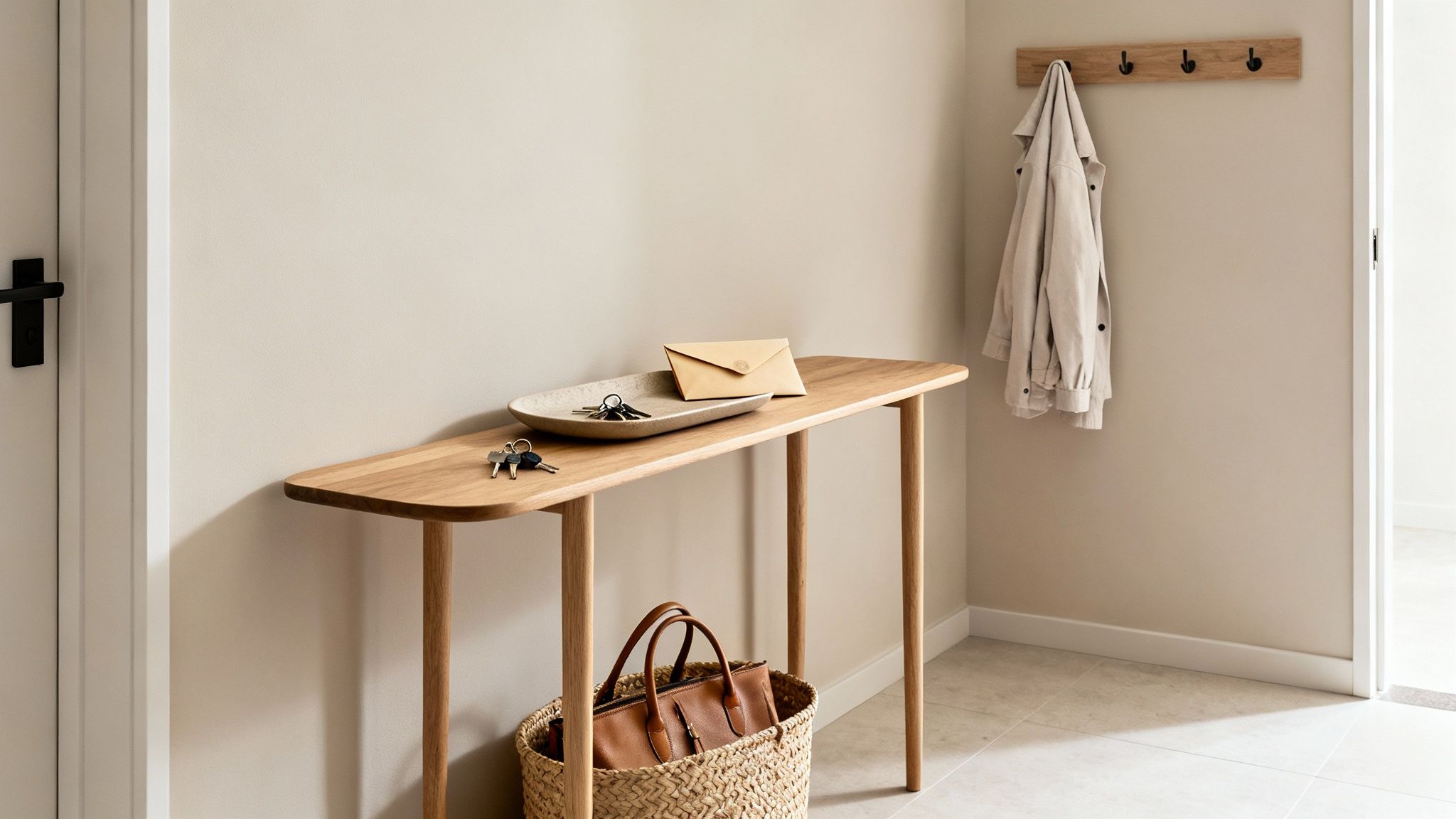
Think about what happens when you walk in the door. Instead of letting that entryway surface become a magnet for clutter, turn it into a functional station:
- A small bowl or a dedicated hook for your keys.
- A vertical file or a single tray for incoming mail.
- A specific hook for the bag you carry every day.
This kind of system takes mere seconds to use but saves you from the constant visual noise and the frantic “where are my keys?!” search later on.
The Weekly 10-Minute Reset
You don’t need to spend your entire weekend tidying up. A short, focused 10-minute reset once a week is way more effective at stopping clutter from taking hold again. This isn’t about deep cleaning; it’s just about quick course correction.
Set a timer and hit the hotspots—those areas where stuff just seems to collect on its own.
- Clear Flat Surfaces: Do a quick scan of the kitchen counters, the coffee table, and your nightstand. Put things back where they belong.
- Tackle the Mail Pile: Sort the mail from your landing spot. Recycle junk, file bills, and handle anything that needs a reply.
- Empty the “Relocate” Basket: Remember that “Relocate” box from your sorting sessions? Keep a smaller version of it handy all week, and take a few minutes to empty it during your reset.
This little routine stops small messes from turning into overwhelming projects. It protects the progress you’ve made and keeps your home feeling calm and under control.
The financial and mental cost of unmanaged stuff is staggering. Think about this: 80% of items we keep in our homes are never even used, yet they take up our physical and mental space. With 11.1% of US households renting storage units—that’s more locations than McDonald’s and Starbucks combined—it’s clear we’re spending billions just to house things we don’t need. DeClutter Now helps you break this cycle by giving you a tool to quickly decide if something is trash, a donation, or a potential sale, turning clutter into clarity and even cash. You can learn more about the impact of home organization on the market to see just how big this problem is.
Your Top Decluttering Questions, Answered
Even the best-laid plans can hit a snag. When you’re in the thick of it, questions are bound to come up. Here are some straight-up answers to the common challenges that can stop your progress cold.
What’s the Fastest Way to Declutter an Entire House?
I’ll be honest: the fastest way to get completely overwhelmed and give up is to try and declutter an entire house at once. Real speed comes from a series of small, focused victories, not one massive marathon session. The secret is to go room by room, starting with the area that causes you the most friction every single day.
For a lot of us, that’s the kitchen counter or the mess by the front door.
Pick your spot and attack it with the “Trash First” Method for just 15 minutes. Seriously, set a timer. This gives you an immediate, visible win that feels fantastic and builds the momentum you need to keep going. Once the obvious junk is gone, you can circle back for a longer session with the Four-Box Method to sort what’s left. It’s about getting one small, high-impact area completely done. That psychological boost is what will carry you into the next room.
How Do I Deal with Sentimental Items Without Getting Stuck?
Ah, sentimental items. They’re the ultimate momentum killers, aren’t they? Each one is packed with memories and emotions that you simply can’t process in the middle of a rapid-fire sorting session. If you try to decide what to do with your grandmother’s old teapot right then and there, you’ll derail your entire project.
The rule is simple: you don’t decide right now.
Instead, create a dedicated “Sentimental Box” or a “Decide Later” bin. When you encounter one of these items, your only job is to put it in the box—guilt-free—and move on to the next thing. This simple action acknowledges the item’s importance without torpedoing your energy and pace.
Later, schedule a completely separate time to go through just that box. Maybe a quiet Saturday morning with a cup of coffee when you’re feeling clear-headed and emotionally ready. This approach lets you give those cherished possessions the thoughtful attention they deserve without sabotaging your mission to reclaim your living space.
My ADHD Makes It So Hard to Focus. How Can This Plan Actually Help?
This whole system was practically designed for the ADHD brain. We built it to work with your brain’s wiring, not against it. Most traditional decluttering advice fails because it demands sustained focus and long-term planning, which can be absolutely draining and lead to shutdown.
Our psychology-backed method provides the structure, novelty, and immediate feedback needed to stay on track. Here’s why it’s so effective:
- Quick Wins Mean Dopamine: The “Trash First Method” gives you that instant gratification and sense of accomplishment. That’s a dopamine hit, and it’s the rocket fuel for motivation.
- Time-Boxed Bursts: Using a timer for short, intense sessions (like 15 minutes) makes the task feel achievable. It has a clear start and a clear end, which prevents that feeling of endless, overwhelming work.
- Slash Decision Fatigue: This is where an AI tool like DeClutterNow.ai becomes a game-changer. By having the AI make the initial suggestion for each item, it drastically cuts down on the mental energy you have to spend making choices.
By breaking a huge, daunting project into a series of clear, manageable steps with built-in rewards, you can finally turn that feeling of being stuck into real, consistent progress.
Ready to stop feeling paralyzed and start making progress? DeClutter Now turns these psychology-backed methods into a simple, guided experience on your phone. Snap a photo, get a smart suggestion, and finally make progress on those boxes that have been sitting for years. Try DeClutter Now free →