
How to DeClutter Your Home Fast. If you’ve ever stared at boxes that haven’t moved in years, you know the feeling. It’s not because you’re lazy. You’re stuck in “clutter paralysis”—the decision fatigue that stops you before you even start. The secret to decluttering your home fast isn’t about making perfect decisions. It’s about building momentum with the easiest win possible. It all starts with the trash.
Why You Feel Paralyzed by Clutter and How to Break Free
Let’s be real about those boxes. They aren’t sitting in your garage or spare room because of a character flaw. They’re there because every time you think about starting, your brain gets overwhelmed and just shuts down. This is clutter paralysis, and it’s a classic case of decision fatigue.
Our brains have a limited capacity for making choices each day. When you’re facing a room full of forgotten things, you aren’t just looking at stuff. You’re looking at hundreds, maybe thousands, of tiny decisions.
- Should I keep this?
- Is this worth anything?
- Will I actually use this again?
- Where on earth would I even put it?
A lot of popular decluttering advice, like asking “does this spark joy?”, can actually make paralysis worse. When you’re already feeling stuck, it’s just another complicated, emotional decision to make. It’s not the right tool for the job when you’re overwhelmed.
The Psychology of Starting with Trash
So, what actually works? Simple. We don’t start with “does this spark joy?”—we start with “is this actually trash?”
This is the whole idea behind the “Trash First” methodology. It’s a psychology-backed way of decluttering that works with your brain, not against it. By focusing only on the obvious junk—old mail, broken gadgets, empty product boxes—you sidestep that decision fatigue completely.
The goal isn’t perfection. The goal is to make one decision, then another. You turn small, easy wins into unstoppable momentum that finally gets those boxes cleared out.
Every piece of trash you toss is a completed task. It’s a quick win that gives your brain a little hit of dopamine. That chemical reward fuels your motivation, making it easier to move on to the next item, and the one after that. You’re not just cleaning; you’re rewiring your brain to see decluttering as progress, not paralysis. If you want to dive deeper into this feeling, you can learn more about how to get rid of clutter and take back your space.
This simple shift in focus is the key. You stop seeing a mountain of overwhelm and start seeing a clear path of small, manageable steps. It’s how you finally turn “I don’t know where to begin” into “I’ve already started.”
Your One-Hour Plan for Instant Decluttering Progress
Feeling overwhelmed? Let’s turn that paralysis into progress. You can make a real, visible dent in the clutter in just one hour. Seriously. This isn’t about achieving perfection; it’s about building momentum and proving to yourself that you can reclaim your space. We’re going to use a focused, time-boxed approach that shuts down decision fatigue before it even starts.
This whole strategy is designed to get you out of your head and into action.
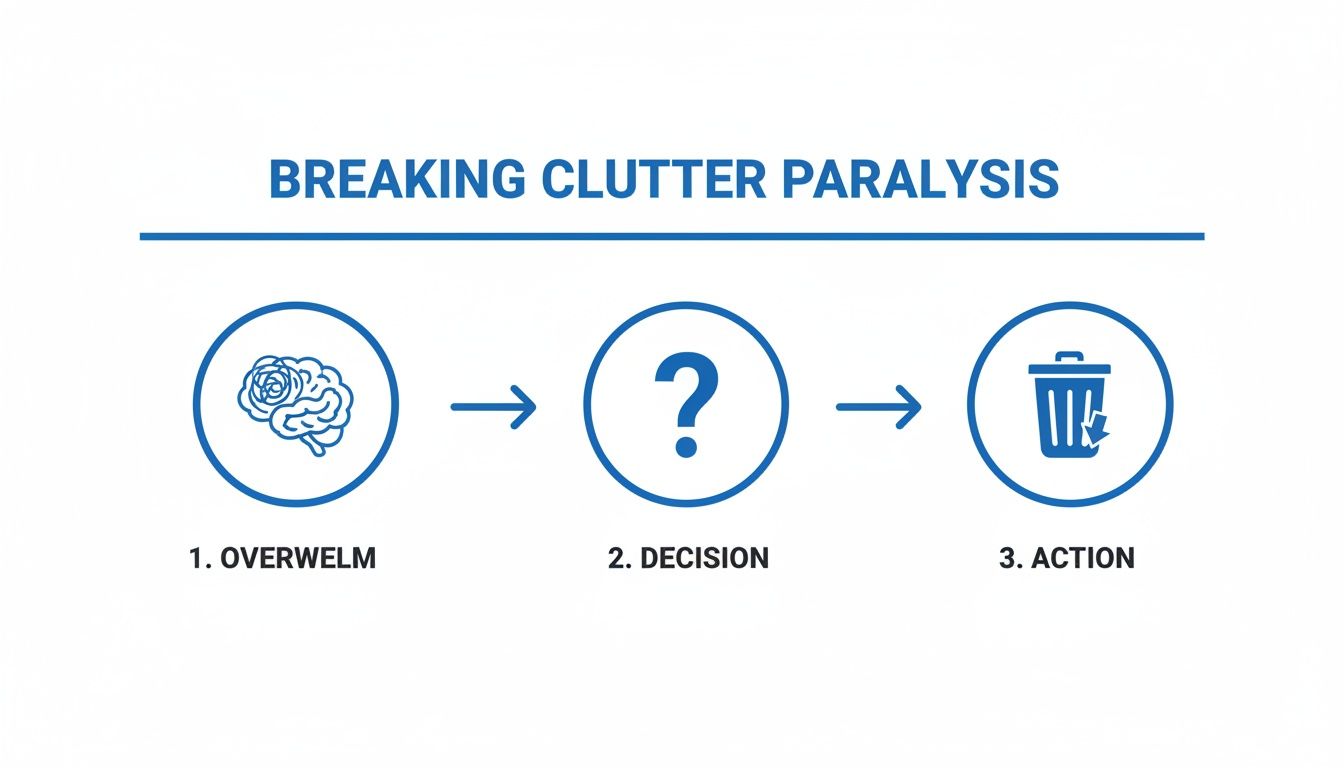
The secret is to simplify. We’ll start with the easiest wins to break that feeling of being stuck and get things moving.
Gear Up for Success
First, gather your tools. Don’t worry, the list is short. All you need are four boxes, bins, or even just large trash bags.
Grab a marker and label them:
- Trash
- Donate/Sell
- Relocate (for things that live in another room)
- Keep
This simple setup is the backbone of decluttering fast. By giving every potential decision a home before you start, you’re short-circuiting the mental gymnastics that usually happen. It creates a smooth, repeatable workflow.
The 15-Minute Sprints
Okay, find a timer and set it for 60 minutes. We’re going to tackle this hour in four intense, 15-minute bursts. Pick one small, manageable spot to start. Think kitchen counter, coffee table, or just the top of your dresser. A visible area works best for that instant morale boost.
This minute-by-minute plan keeps you from getting sidetracked. Each time block has just one job.
The One-Hour Declutter Sprint
| Time Block | Action | Goal |
|---|---|---|
| 0-15 Mins | Trash Sweep | Grab anything that’s obvious garbage. Don’t think, just toss. |
| 15-30 Mins | Donation Sort | Identify items you don’t use or need. Be quick and decisive. |
| 30-45 Mins | Relocation Run | Gather anything that doesn’t belong in this specific area. |
| 45-60 Mins | Final Sweep & Reset | Put the few “Keep” items away, and deal with the other boxes. |
Let’s break down exactly what to do in each sprint.
Sprint 1 (Minutes 0-15): The Trash Sweep
For the first 15 minutes, your only mission is to find trash. Nothing else matters. Scan for old mail, product packaging, broken gadgets, dried-up pens—anything that is clearly garbage. This is the ultimate quick win and clears the deck for the real decisions to come.
Sprint 2 (Minutes 15-30): The Donation Sort
Timer resets. Now, your eyes are only looking for things to put in the “Donate/Sell” box. Don’t get bogged down in sentiment. A great rule of thumb I use is the 20/20 Rule: if you could replace an item for less than $20 in under 20 minutes, it’s safe to let go.
This isn’t about what you might need someday. It’s about what serves you and your space right now. The mental clarity you gain is far more valuable than a third spatula you never use.
Sprint 3 (Minutes 30-45): The Relocation Run
Next up, quickly scan the area for anything that’s simply in the wrong room. A book that belongs in the bedroom? A coffee mug that should be in the kitchen? Toss it all into the “Relocate” box. The key here is not to stop and put things away one by one. That kills your momentum. Just box it up for now.
Sprint 4 (Minutes 45-60): The Final Sweep and Reset
Last sprint! Place the few items you’re actually keeping back in their designated spots (or into the “Keep” box if you’re reorganizing later). Now, take action. Haul the trash bag out. Put the donation box by the front door or in your car. Do a quick run around the house to put away everything from the “Relocate” box.
Step back and look at what you did. You didn’t just shuffle clutter—you made real, tangible progress.
A Room-By-Room Guide to the Four-Box Method
Alright, you’ve got the system. Now, let’s put it to work. The Four-Box Method is your framework to reclaim your entire home, one space at a time. The real secret here is to stop seeing a “disaster of a garage” and start seeing a handful of small, winnable categories.
By zeroing in on one room and sticking to a few simple rules, you can make decisions quickly and confidently without getting pulled in a million different directions. This is how you transform an overwhelming project into a series of satisfying wins.
Conquering the Kitchen Clutter
The kitchen is the heart of the home, which also means it’s a total clutter magnet. It’s so easy to feel buried under duplicate gadgets, expired spices, and a cabinet full of mugs you haven’t touched in years.
I always tell people to start with the easiest wins. Start with trash, build momentum.
- Expired Foods: Raid your pantry, fridge, and spice rack. Anything past its prime goes straight into the Trash box. No hesitation needed.
- Duplicate Utensils: Be honest—how many whisks or spatulas does one person really need? Keep your absolute favorite and put the extras in the Donate/Sell box.
- Unused Gadgets: Remember that bread maker or panini press gathering dust? If you haven’t fired it up in the last year, it’s time to find it a new home.
Clutter costs you more than just space. It costs you time and peace of mind. Every item you remove is a bit of that time you’re getting back.
This approach is powerful because it reframes the task. You’re not “cleaning the whole kitchen.” You’re just sorting expired food. That feels much less intimidating, right?
The Bedroom and Closet Reset
Your bedroom should be a sanctuary, a place to recharge. But a closet bursting at the seams can make it feel anything but restful. This is where having a simple, non-negotiable rule is your best friend.
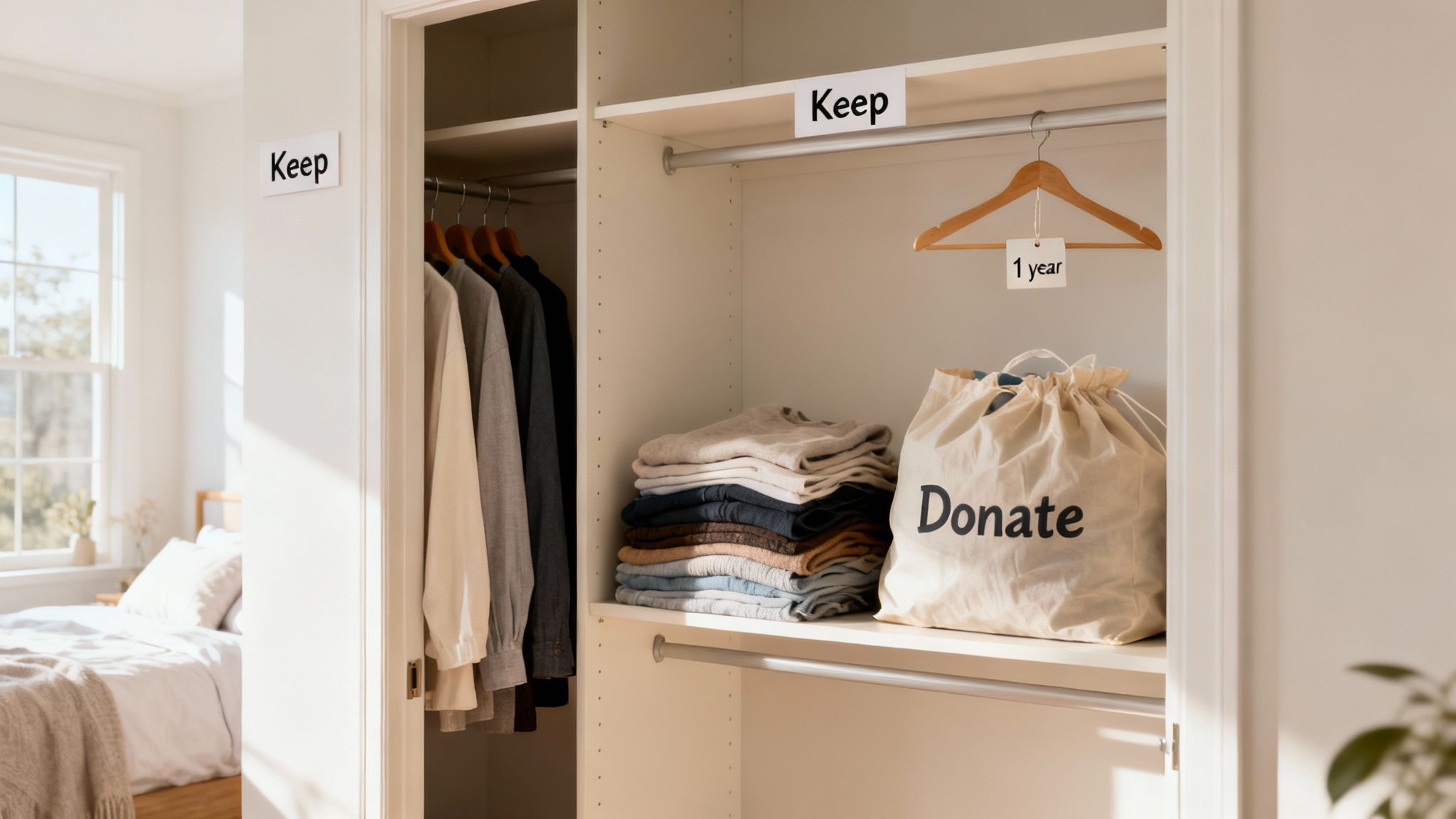
For clothing, I swear by the one-year rule. If you haven’t worn something in the last 12 months—through all four seasons—it’s a prime candidate for the Donate/Sell box. Try not to get tangled up in the “what ifs.” Focus on what you actually wear and love.
If you hit a wall and just can’t make a choice, that’s decision fatigue kicking in. It happens to everyone. When I get stuck, I find a tool like the DeclutterNow app can be a real game-changer. The app’s AI breaks through decision fatigue by giving you an objective suggestion instead of you wrestling with an emotional attachment.
Tackling Tough Spaces Like the Garage or Basement
Big, undefined spaces like a garage or basement feel impossible because they’re just… a big pile of stuff. The trick is to not even think about tackling the whole room at once. Pick one small corner—just one—and apply the Four-Box Method to that area alone.
Maybe you just focus on that one shelf of old paint cans. Or that pile of forgotten sports equipment. The goal isn’t to finish the entire garage today. It’s to make visible progress in a single spot, which gives you the confidence and energy to come back for another round later.
This room-by-room strategy is about more than just cleaning; it’s about taking back your home from the stress of clutter. For an even deeper dive with more specific tactics, check out our guide on how to organize your home room-by-room.
Turning Your Clutter into Cash
After a few solid decluttering sessions, you’re probably looking at a pretty full “Donate/Sell” box. And let’s be honest, this is where a lot of us get stuck again. The thought of taking photos, writing listings, and dealing with buyers can feel like a whole new project. That box of progress quickly turns into a box of procrastination.
But what if you could flip that script? Turning stuff you don’t need into cash is more than just financially rewarding—it’s a massive psychological win. It can be the very fuel that keeps your decluttering fire going. The secret is making the process fast and painless, not another chore to dread.
Sell or Donate? The Quick-Sort Method
First things first, you need to sort that pile. Not everything is worth selling, and that’s perfectly fine. We’re aiming for speed and momentum here, not trying to open a second-hand shop in the garage.
Here’s a simple framework I use to decide:
- Donate It: Anything that’s useful but not especially valuable goes straight into the donation bag. Think everyday clothes, basic kitchen gadgets, or paperback novels. The goal is just to get it out of the house.
- Sell It: Reserve your selling efforts for items with real, obvious value. This includes things like brand-name electronics, designer handbags, collectibles, or furniture that’s still in great shape. A quick search for the item on eBay can tell you in 30 seconds if it’s worth your time.
My golden rule: If you can’t decide whether to sell or donate something in under a minute, just donate it. Hesitation is the enemy of progress. Keep moving.
Let AI Make Selling Effortless
For the items that made the “sell” cut, the old way of doing things is a known motivation killer. The manual research, the description writing, the lighting for photos… it’s exhausting just thinking about it. This is where modern tools can completely change the game and help you declutter your home fast.
I’ll be upfront: the DeclutterNow app’s eBay assistant exists because I personally had boxes of things to sell sitting in my closet for years. I knew what was holding me back—the sheer friction of the listing process. So, we built a tool to eliminate it.
Instead of agonizing over the details, you can now:
- Snap a few photos of your item right from the app. No fancy setup needed.
- Let the AI generate an optimized title and a compelling description instantly.
- Get smart pricing suggestions based on what similar items have actually sold for recently.
What used to be a 20-minute chore for a single item now takes maybe two. The AI handles all the tedious work, so you can just point, shoot, and list. That box of “stuff” is no longer a burden; it’s a stack of cash waiting to be claimed. Nailing the price is key, and you can dive deeper into how to price items for resale with our in-depth guide. It’s a simple, psychology-backed way to turn that overwhelming feeling into satisfying action.
Simple Habits to Keep Your Home Clutter-Free
You’ve done the hard work, cleared the space, and felt that incredible sense of progress. So, how do you protect that feeling and stop the slow creep of clutter from taking over again? The secret isn’t a life of endless cleaning; it’s all about building simple, psychology-backed habits that fit into your real life.
The whole point is to stop clutter before it even starts, making sure that familiar feeling of being overwhelmed never comes back. This is about progress, not perfection. It’s about creating systems you can actually stick with to keep your home feeling calm and under control.
Adopt Powerful Micro-Routines
The best habits are the ones that feel almost automatic. Forget planning another huge decluttering session and instead, weave these tiny routines into your existing schedule.
- The ‘One-In, One-Out’ Rule: This is your best defense against accumulation. Whenever you bring something new into your home—a new shirt, a book, another kitchen gadget—an old one has to leave. This simple exchange keeps your stuff from multiplying and makes you think twice about every purchase.
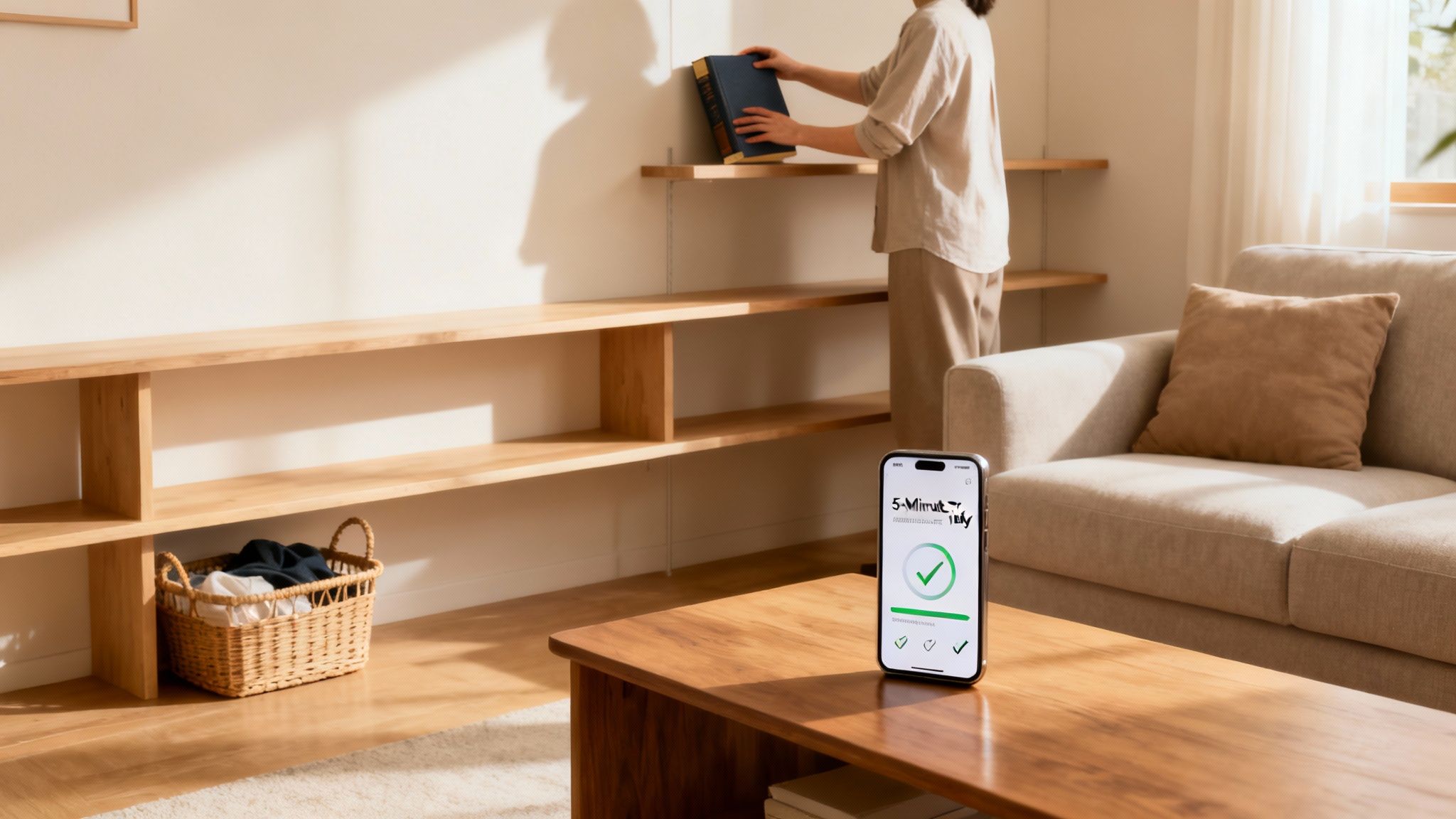
- The 5-Minute Tidy: Before bed, set a timer for just five minutes. Use that short burst of time to reset a single high-traffic area. Maybe you wipe down the kitchen counter, straighten the living room pillows, or finally deal with the day’s mail. It’s a tiny investment for a huge payoff: waking up to a sense of order.
Stay Motivated by Tracking Your Progress
Momentum is everything. The desire to maintain a decluttered space is so universal that the home organization market is booming, projected to hit USD 15.2 billion by 2032. This proves just how much people want systems that make it easier to maintain progress. You can actually explore the full home organization service market report to see the data behind this trend.
This is where apps like DeclutterNow can make a real difference. They tap into our need for motivation by using gamification—think points and streaks—to turn the chore of maintenance into a surprisingly rewarding game.
Celebrating small wins is crucial. Clearing a single junk drawer isn’t just a task completed; it’s a reinforced habit. Acknowledge that progress—it’s the dopamine hit that makes you want to do it again.
When you track your progress, you create a visual record of your success. You’re no longer just “tidying up”; you’re actively maintaining the peaceful space you worked so hard to create. This is how you finally make progress, all without the pressure of being perfect.
Got Questions? We’ve Got Answers
Even with the best plan, you’re going to hit a few snags. It’s completely normal. That moment when you’re standing in a room, surrounded by stuff, feeling that familiar paralysis creep in? That’s not a sign you’ve failed; it just means you’ve hit one of the classic decluttering roadblocks.
Let’s walk through some of the biggest hurdles I see people face. Think of this as your field guide to getting unstuck and keeping the momentum going.
“What Do I Do with All This Sentimental Stuff?”
Ah, the big one. This is where most people get bogged down. We’re talking about your grandma’s china you never use, a box filled with your kids’ macaroni art, or that t-shirt from a concert 20 years ago. These items feel heavy, both physically and emotionally, and trying to deal with them can shut down the whole process.
The secret is learning to separate the memory from the item. Your love for a person or a moment isn’t literally stored inside a physical object.
Here are a few ways to honor the memory without drowning in the clutter:
- Become a memory photographer. Take a high-quality photo of the item. Create a digital album titled “Cherished Memories.” Now you can revisit that feeling anytime, without needing a storage unit.
- Keep a single representative. You don’t need the entire 12-piece dish set that gives you anxiety every time you open the cabinet. Pick one beautiful teacup and saucer and display it on a shelf. It becomes a piece of art that tells a story, rather than a box of guilt in the attic.
- Create one—and only one—memory box. Get a reasonably-sized, finite container for things like old letters, your kid’s first pair of shoes, or special cards. Once it’s full, the one-in-one-out rule applies. This forces you to be a curator of your own past.
The goal isn’t to erase your history. It’s to make sure you actually have room for your present life. You can hold a memory close without being buried under the weight of the thing itself.
“How Do I Deal with Clutter That Isn’t Even Mine?”
Living with other people is… a journey in shared spaces. It’s maddening to clear a countertop only to see it fill back up with someone else’s mail, keys, and random projects. Going on the attack rarely works and just creates tension. The key is to lead by example and create gentle systems.
First, focus entirely on your own domains. Your side of the closet, your desk, your stuff. The visible progress you make often inspires others without you having to say a word. When you’ve created a pocket of calm, it makes the surrounding chaos feel more obvious.
Then, you can open a conversation framed around a shared benefit. Something like, “Wow, it feels so much easier to find things in the kitchen now that we’ve cleared some space, doesn’t it?”
A great practical trick is to designate a “landing zone” for each person—a nice-looking basket or a specific bin. When you find their things adrift, you just place them in their basket. No nagging, no passive-aggressive sighs. Just a simple, “Hey, I popped those magazines you left on the table into your basket.” It’s a respectful way to set a boundary.
“Help! I’ve Lost My Motivation Halfway Through.”
It happens to the best of us. You start with a burst of energy, feeling amazing, and then… you hit a wall. The initial excitement wears off, you look at the mountain of stuff still left to tackle, and that crushing sense of overwhelm comes flooding back.
When this happens, you need a quick win. Immediately.
Forget about the big picture. Don’t try to power through and “finish the office.” Instead, shrink your focus to something almost ridiculously small. Your new mission is to “clear one corner of the desk.” That’s it. Just one corner.
Set a timer for 10 minutes and go. The feeling of seeing that one small space completely clear will give you the little dopamine hit you need to get back in the game. This whole thing is a marathon of tiny sprints. Remember, progress over perfection. Every single item you sort is a win.
Ready to turn clutter paralysis into progress? The DeclutterNow app was built for these exact moments. Let our AI break through decision fatigue and help you build unstoppable momentum.
Try DeclutterNow free →