
You want to know how to declutter and organize, but before you can even start, you have to understand what's really stopping you. It's almost never about the physical work. It's about a mental roadblock called decision fatigue. That’s the real reason those boxes have been sitting in the corner for years. The whole process isn't just sorting things; it’s about getting past the "clutter paralysis" that keeps you stuck. To do that, you need a smart, psychology-backed approach that actually builds momentum.
Why You Feel Stuck in Clutter

Let’s be real—you’ve stood in front of that cluttered room or pile of boxes and felt a wave of exhaustion before you even touched a thing. That feeling isn't a character flaw or laziness. It’s a very real psychological response I call clutter paralysis.
I know it firsthand. I had boxes sitting in my garage for YEARS, completely untouched since my last move. Every weekend, I'd tell myself, "This is the day," only to open one, stare at the random stuff inside, and feel completely and utterly paralyzed. My brain would just freeze.
This experience is incredibly common, and it's not your fault. Staring at hundreds of items forces your brain to make an equal number of decisions. Keep? Sell? Donate? Trash? Each choice, no matter how small, saps your mental energy. It's not laziness—it's decision fatigue.
The Problem with Traditional Methods
A lot of popular decluttering advice, while well-intentioned, can actually make things worse by starting with the hardest, most emotionally loaded questions. Take the famous "Does this spark joy?" prompt. It’s a lovely idea, but it can completely backfire when you’re already feeling paralyzed by decisions. We don't start with "does this spark joy?"—we start with "is this actually trash?"
Asking yourself if your grandmother's chipped teapot sparks joy isn't a simple yes or no. It's a complex emotional calculation. You're weighing sentimentality, guilt, and practicality all at once. Multiply that by a few hundred items, and it's no wonder you feel like giving up.
It’s not your fault you feel stuck. The problem isn’t a lack of willpower; it’s that you’re being asked to run an emotional marathon before you've even warmed up. That’s a recipe for decision fatigue.
We Are Surrounded by "Stuff"
The modern home has become a battleground for our attention and our energy. Just consider this: the average American home contains a staggering 300,000 items. This explosion of possessions is a fairly recent development in human history.
That isn't just a quirky statistic; it's a symptom of a much larger trend. Over the last 50 years, the size of the typical U.S. home has nearly tripled. And yet, even with all that extra space, 1 in 10 Americans still rents an offsite storage unit. This has fueled a massive industry built entirely on our excess. You can read more about the growth of the global home organization market and see for yourself.
What does this all mean for you? It means the sheer volume of "stuff" is practically designed to exhaust your mental resources. Every single item demands a tiny sliver of your cognitive load, contributing to a constant, low-grade sense of being overwhelmed. The key to learning how to declutter and organize effectively is to recognize this reality. The problem isn't you—it's the process. You need a strategy that bypasses the tough emotional calls and instead focuses on building momentum.
Building Momentum with the Trash First Method
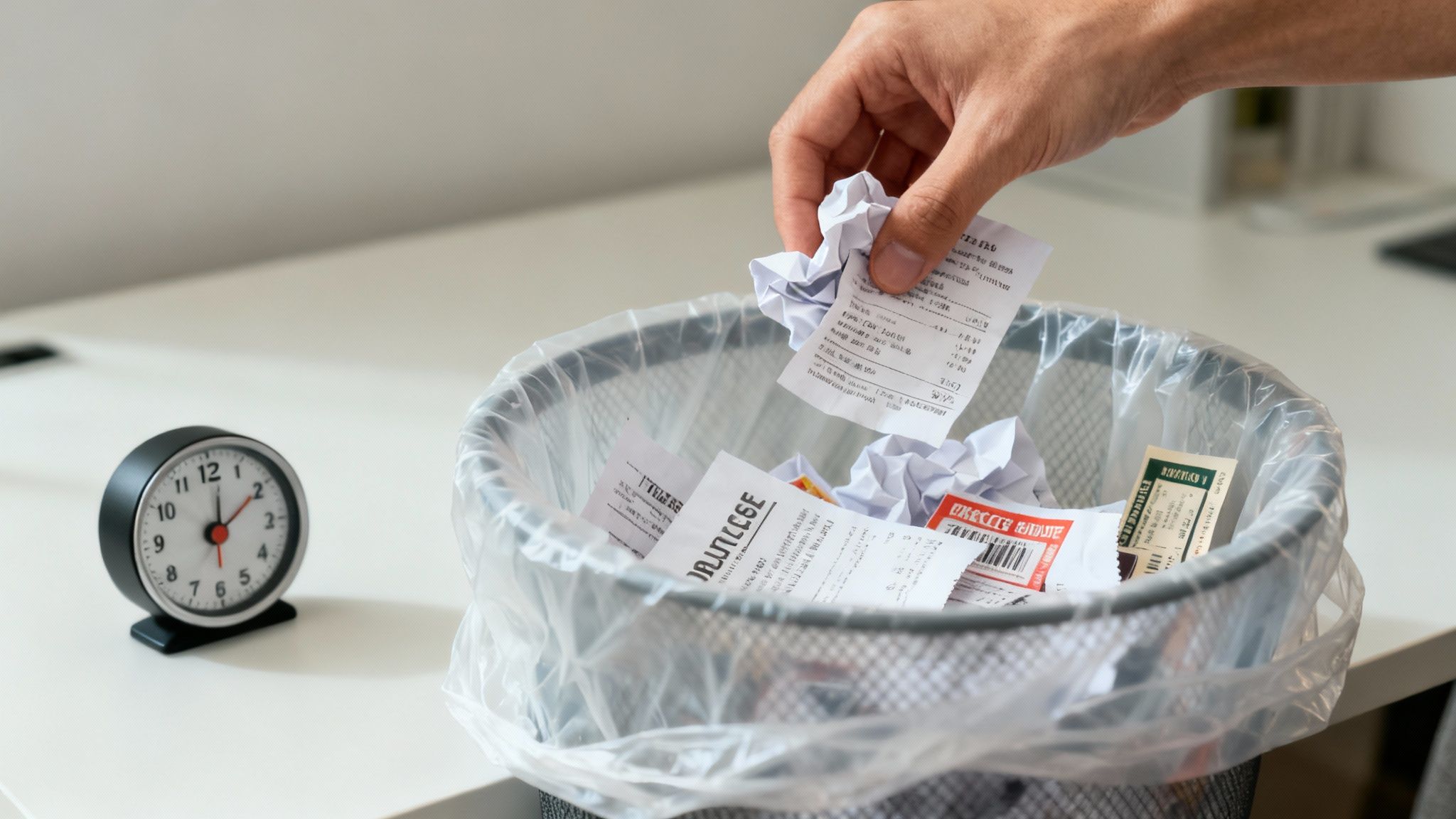
What if the secret to breaking through clutter paralysis wasn't some huge, weekend-long purge? What if it was just one tiny, simple win? The real trick to learning how to declutter and organize is to sidestep decision fatigue altogether.
This is where the Trash First Method comes into play. It’s a dead-simple, psychology-backed strategy designed to get you moving from the very first minute. The whole idea is to stop asking emotionally loaded questions and start with the easiest question imaginable: "Is this trash?"
You’re focusing only on the obvious stuff—expired coupons, crumpled receipts, junk mail, pens that don’t work. These things don’t require any soul-searching. They’re just garbage, and their fate is clear.
Why This Simple Trick Actually Works
Every time you make a quick, easy decision like tossing an old magazine, your brain releases a little bit of dopamine. It’s that tiny hit of pleasure and reward—a quick win—that fuels motivation. That quick win feels good, plain and simple.
This initial burst of accomplishment creates a powerful snowball effect. That one good feeling makes the next decision just a little bit easier. Before you know it, you’ve cleared a countertop or filled a trash bag. You’re not stuck anymore; you're making real, visible progress.
The goal isn't perfection. It's momentum. We're changing the decluttering process from a dreaded emotional chore into a series of small, satisfying actions. It's about turning clutter paralysis into progress.
This is a world away from methods that demand you tackle your entire wardrobe at once. We’re not starting there. We’re starting with the junk mail on your kitchen counter. It’s a practical first step anyone can take, even on a day when you feel completely overwhelmed. You can find more strategies that build on this same principle in our other decluttering tips for beginners.
Putting the Trash First Method into Action
Getting started is as easy as it sounds. You don't need to block out your entire Saturday or buy a bunch of color-coded bins. All you really need is a trash bag and 15 minutes.
-
Pick one small spot. Don't even think about the whole room. Just focus on a single surface, like your coffee table, a messy nightstand, or the top of your dresser.
-
Set a timer for 15 minutes. This isn’t about finishing; it's about starting. The timer creates a low-pressure window to just get something done.
-
Hunt for obvious trash only. Your one and only job is to find and throw away things that are clearly garbage. Go on a mini-mission for things like:
- Old mail, flyers, and magazines
- Empty food wrappers or containers
- Packaging from products you’ve already opened
- Receipts you don’t need for taxes or returns
- Broken items that can't be fixed
- Pens or markers that have dried up
When the timer rings, you're done. You’ll probably be surprised by how much you cleared out and how much better that small space already looks. More importantly, you've just proved to yourself that you can do this. You've taken the first and hardest step—you started.
A Practical Action Plan for Any Overwhelming Space
Theory is great, but lasting change comes from having a concrete, repeatable plan. You’ve already used the "Trash First Method" to get that first, crucial bit of momentum. Now, we need a system to handle everything else that’s left. This is where we shift from quick wins to a structured approach that will show you exactly how to declutter and organize any space, no matter how chaotic it feels.
Forget trying to tackle an entire room at once. That's a surefire recipe for getting overwhelmed and giving up. Instead, let's break it down into manageable chunks. We'll use a common, real-world example: clearing out a chaotic home office.
The 15-Minute Trash Sweep Revisited
Even if you’re feeling motivated, I always recommend starting each new session with another quick 15-Minute Trash Sweep. Think of it as a warm-up. It gets your brain back into the right gear, focusing on easy, unemotional decisions first, which makes everything that comes after feel so much smoother.
Set a timer and just look for the obvious garbage. We're talking dried-up pens, old sticky notes with scribbles from last year, junk mail, and empty Amazon boxes. This simple act clears the immediate visual noise and gives you that instant hit of progress.
Introducing The Four-Box Method
Once the obvious junk is gone, you're left with the "real stuff"—the things that require a decision. This is where most people get stuck. To push through that, we'll use a brilliantly simple but effective system I swear by: the Four-Box Method.
All you need are four boxes, bins, or even just designated piles. Label them clearly:
- Keep
- Relocate
- Donate/Sell
- Trash
This simple framework forces you to make a choice. Instead of a dozen possible outcomes for every single item you pick up, you only have four. This dramatically cuts down on decision fatigue and, most importantly, keeps you moving.
By defining the categories upfront, you remove the mental gymnastics from each decision. An old book doesn't become a source of internal debate; it simply fits into one of the four boxes, and you move on.
Let's apply this to our cluttered home office. Working in one tiny zone at a time—like just the top of your desk—pick up each item and assign it to a box.
- A stack of important tax documents? Keep.
- Your kid’s toy that wandered into the office? Relocate.
- A business book you read once and know you won't touch again? Donate/Sell.
- A frayed charging cable that’s seen better days? Trash.
Work your way through the space, one small area at a time, until the boxes are full. Then, and this is key, immediately take action. Put the trash out, walk the "Relocate" items to their proper homes, and put the "Donate/Sell" box by the door or in your car. Done.
Supercharge Your Decisions with AI
Sorting is simple, but it can still be slow, especially when you hit an item you're unsure about. What if you could make those tough calls even faster? This is where a little tech can give you a modern boost. The DeClutter Now app is built for this exact moment.
Instead of just staring at an item and wondering, you can snap a photo. The app's AI gets to work, instantly recognizing what it is—whether it’s a vintage camera, a specific book, or an old piece of tech—and gives you an immediate suggestion.
Imagine you pick up an old webcam. You have no idea if it’s worth anything or if you should just donate it. With the app, you take a picture, and it might tell you, "This model is still in demand and sells for around $25 on eBay. We recommend placing this in your Sell box." All of a sudden, a five-minute deliberation becomes a five-second decision.
The AI helps break through decision fatigue. It acts as your objective, data-driven assistant, giving you the confidence to make a choice and keep your momentum going.
The Four-Box Method Explained
To make this system absolutely foolproof, here’s a simple guide to what goes where. Getting this down is the key to learning how to declutter and organize effectively for the long haul.
This table offers a simple guide to the four essential categories for sorting your items, making decisions faster and more organized.
| Category | What It's For | Action Required |
|---|---|---|
| Keep | Items that are actively used, loved, and have a designated home in the current room. This includes essential documents, functional supplies, and decor you truly enjoy. | Find or create a permanent, logical home for the item within the space you are organizing. |
| Relocate | Items you want to keep but that belong in a different room or area of your home. Think of coffee mugs that belong in the kitchen or tools that should be in the garage. | At the end of your session, take this box and distribute its contents to their correct locations immediately. |
| Donate/Sell | Items in good, usable condition that you no longer need, want, or have space for. This can range from books and clothes to electronics and household goods. | Place this box in your car or by the front door to take to a donation center or to be listed for sale. |
| Trash | Anything that is broken beyond repair, expired, or unusable. This also includes old papers with no personal information that can be recycled. | Take this bag directly to your main trash or recycling bin. Do not let it sit in the room. |
Remember, this isn't about achieving a flawless, magazine-worthy space in a single afternoon. It's about having a reliable roadmap to turn a daunting room into an organized one, one small step at a time. By combining a quick trash sweep with the systematic Four-Box Method—and adding an AI boost when you need it—you can finally turn overwhelm into action.
How to Turn Your Clutter into Cash
Let's be honest—that "Donate/Sell" box is often where good intentions go to die. It sits in the corner, and every time you look at it, the questions start swirling. Is this old camera actually worth anything? Is it worth the hassle of listing it online? That hesitation is a progress killer.
But what if you thought of that box differently? Instead of an obstacle, see it as an opportunity. Turning some of your unwanted stuff into cash adds a huge financial incentive to the whole process. The question changes from, "Is this worth the hassle?" to "How much money is hiding in my closet?"
Quickly Spotting What's Worth Selling
The trick is to be ruthless about what you try to sell. Not everything is destined for an online marketplace, and you'll burn out fast trying to list every last trinket. Your mission is to quickly cherry-pick the items that will give you the best return for your time.
Here's a quick mental checklist I run through:
- Brand Power: Is it a brand people actively look for? Think names like Sony, Coach, or LEGO. These get searched for by name.
- Condition: Be honest. Is the item in good, great, or like-new shape? Anything with original tags or packaging is a huge plus and much easier to move.
- Searchability: How easy is it to describe? "Apple iPad Air 2, 64GB, Silver" is a breeze for a buyer to find. "Small blue glass bowl" is not.
- Ship-ability: Is this thing a pain to ship? Big, heavy, or fragile items can be a nightmare. Shipping costs can eat your profit, so stick to things that are easy to box up and mail.
If an item hits most of these points, it’s a contender for the "Sell" pile. Everything else? It goes straight to the donation center, no guilt, no second thoughts. This frees you up to focus on what matters.
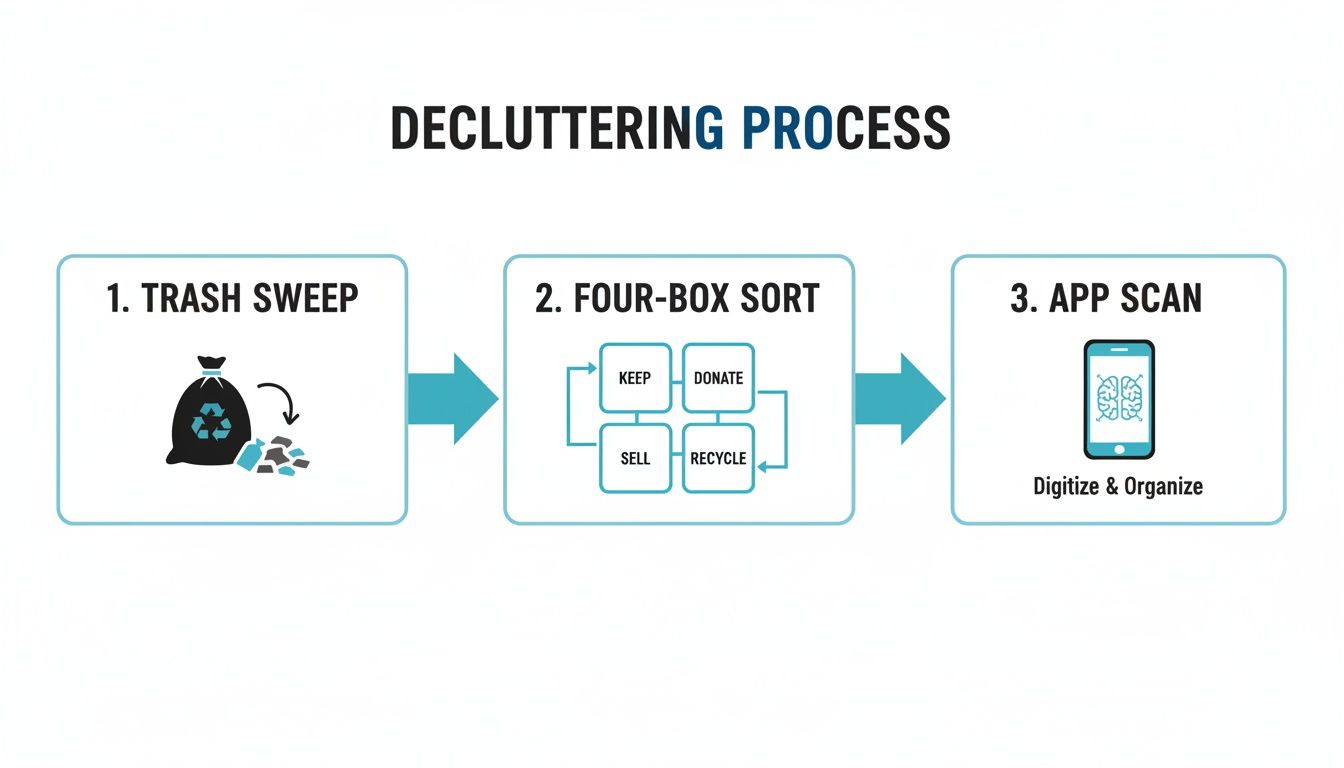
This simple workflow—a quick trash sweep, the Four-Box sort, and an app scan for the tough calls—is all about keeping you moving forward without getting bogged down.
Let an AI Assistant Handle the Grunt Work
Okay, so you've picked out your items to sell. Now comes the part that feels like a second job: writing descriptions, taking good photos, and figuring out what to charge. This is another classic spot where people stall out.
This is exactly where the DeClutter Now app’s eBay integration comes in handy. Instead of you having to do all the heavy lifting, the app does it for you.
Just grab an item and:
- Snap a few pictures of it right inside the app.
- The AI gets to work, identifying exactly what the product is from the photos.
- In seconds, it whips up a great, keyword-rich title and description.
- Finally, it suggests a smart starting price by looking at what similar items have sold for recently.
This isn't just about saving a few minutes. It's about completely removing the mental block that keeps that "sell" pile from ever making it online. You can go from a stack of stuff to a handful of live listings in less time than it takes to watch an episode of your favorite show.
By using a tool like this, your listings are basically optimized from the get-go, giving you a much better shot at a quick sale. For a deeper dive into pricing, check out our guide on how to price items for resale.
Tips for Photos That Actually Sell
Your photos are everything. They are the single most important part of your online listing. The good news? You don't need a fancy camera. Your smartphone is more than capable.
- Go Toward the Light: Find a spot near a window. Soft, natural daylight is your best friend—it shows true colors and avoids weird, harsh shadows.
- Keep the Background Simple: A plain white poster board or a clean, neutral-colored wall works perfectly. You want the item to be the star.
- Get All the Angles: Shoot the front, back, sides, top, and bottom. Buyers are curious and want to see it all.
- Show Off the Good and the Bad: Get close-ups of important details like brand logos or unique textures. And be honest! If there’s a small scuff, take a picture of it. Transparency builds trust and leads to happy buyers.
When you start thinking of your "sell" pile as a source of income, it changes the entire dynamic of decluttering. It stops being just a chore and starts feeling like you’re unlocking value that was hidden in your own home.
Building Habits to Keep Clutter from Coming Back
Getting organized is a fantastic feeling, but the real victory is keeping it that way. The initial purge is just the first step. The true secret to a calm, functional home lies in building simple habits that stop clutter before it even starts. This isn't about some impossible standard of perfection—it’s about creating systems that prevent you from ever feeling overwhelmed again.
You've already done the hard work of clearing out the backlog of stuff. Now, the focus shifts from one massive project to small, consistent actions that eventually become second nature. We're going to put a few simple routines in place to ensure you don't find yourself staring down a mountain of clutter a year from now.
The desire for an organized home is something almost everyone can relate to. A recent survey found that seven out of ten Americans believe a clutter-free home is key to their success in the coming year. An even more stunning 83% directly link organization to a clearer mind and better productivity. The benefits are real; studies even show that decluttering can slash housework time by 40%, giving you back precious hours every week. You can discover more insights about the decluttering trend on Accio.com.
Adopt the One In, One Out Rule
One of the most powerful ways to maintain balance is with the ‘one in, one out’ rule. Think of it as your first line of defense against the slow creep of accumulation.
The principle is brilliantly simple: for every new item you bring home, a similar item has to leave. Buy a new pair of jeans? An old pair gets donated. A new book arrives? One from your shelf goes to a friend or a Little Free Library. This forces you to be mindful of what you own and stops that unconscious pile-up that leads right back to clutter.
Establish Smart Drop Zones
Let’s be honest, clutter often starts right at the front door. Keys, mail, bags, and shoes get dumped on the nearest flat surface, and that small mess quickly spreads. A dedicated ‘drop zone’ for these everyday items can stop that chaos in its tracks.
- For Mail: Find a small, attractive tray or a vertical file holder and place it near the entrance. Your only job is to put all incoming mail there immediately. Once a week, sort through it—recycle the junk mail, file the important papers, and take action on any bills.
- For Keys and Wallets: A simple bowl on an entryway table or a few hooks on the wall is all you need. Make it a non-negotiable habit to put your keys there the second you walk in.
- For Bags and Coats: A few sturdy hooks or a small bench with storage underneath can work wonders. This gives everyone in the house a clear spot for their things, saving your dining room chairs from becoming a secondary closet.
Master the 10-Minute Reset
The most powerful habit you can build is the nightly 10-minute ‘reset’. This isn't about deep cleaning or a major reorganization project. It's just a quick, focused burst of tidying to put things back where they belong before you call it a day.
This small daily investment pays huge dividends. It prevents small messes from turning into overwhelming projects, ensuring you wake up to a calm, orderly space each morning.
Just set a timer for ten minutes and quickly blitz your main living areas. Put the remotes away, fold the throw blanket, load the last few dishes into the dishwasher, and wipe down the kitchen counter. If you need help creating and sticking to these routines, you might find some of the best home organization apps useful. You'll be amazed at what you can accomplish in such a short time. This simple routine is the real key to making your newly organized space a permanently organized home.
Got Questions? We've Got Answers
Even with the best plan in hand, you're bound to hit a few snags or mental roadblocks. That’s perfectly normal. Let's tackle some of the most common questions that pop up on the path to a clutter-free home.
"I'm So Overwhelmed I Don't Even Know Where to Start."
I hear this all the time. It’s clutter paralysis, and it’s a very real thing. When an entire room feels like an insurmountable mountain, you need to shrink your focus. Dramatically.
Forget the garage; look at one shelf. Not the whole kitchen; just that one junk drawer you've been avoiding. Your job is to find the path of absolute least resistance. Grab a trash bag, set a timer for five minutes—that’s it—and just find obvious trash. Old mail, empty wrappers, a broken pen. You’re not trying to finish a project; you're just trying to prove to yourself that you can make a single decision. That tiny win is often the spark you need to finally make progress.
"What Do I Do With All the Sentimental Stuff?"
Ah, the sentimental items. I like to call these the "final boss" of decluttering, which is exactly why you should never, ever start with them. For now, just give them their own space—a dedicated "Memory Box" or a "Decide Later" bin.
This isn't just kicking the can down the road; it's a strategic move. By clearing out all the easy stuff first, you reduce the visual noise and decision fatigue. You’ll be in a much better headspace to handle the emotional heavy lifting later on.
When it’s time to revisit that box, try asking a different kind of question. Instead of, "Can I get rid of this?" ask, "Does this item actually honor the memory, or is it just taking up space and making me feel guilty?" Sometimes, the best way to preserve a memory is to take a beautiful photo of the item, write down the story behind it, and let the physical object go.
"How Can I Get My Family to Help?"
This one’s tricky, and it requires a bit of finesse. The secret is to lead by example, not by decree. Focus on your own spaces first—your closet, your side of the bedroom, your home office. When your family sees how much calmer and more functional those areas become, their curiosity will naturally kick in.
Frame the project around shared benefits, not individual blame. Try things like, "Wouldn't it be amazing if we could always find the TV remote?" or "I'd love for us to have clear counters so we can cook together without the chaos." Use "we" and "us" instead of an accusatory "you." For anything that belongs to multiple people, the "Relocate" box is your best friend. Put shared items there and set aside a low-pressure time to sort through them as a team.
"Will This Method Work for Someone with ADHD?"
Yes, absolutely. In fact, this psychology-backed approach is incredibly effective for brains that struggle with executive function, because it’s designed to work with them, not against them.
- Quick Wins: Starting with the most obvious trash delivers an immediate dopamine hit from visible progress. That little reward is a powerful motivator to keep going.
- Built-in Structure: The DeClutter Now app acts as an external brain, adding a layer of gamification with points and progress tracking. This creates the structure and reward system that helps you stay on task when focus wanes.
- Less Mental Strain: Using a timer for short, intense bursts (think of it like the Pomodoro Technique), focusing on one tiny area, and letting an app guide you through the "keep or toss" decisions drastically reduces the mental load that so often leads to shutdown.
Ready to turn that feeling of being stuck into real, visible progress? The DeClutter Now app is your personal guide, using the same psychology-backed methods we've talked about to help you make decisions, build momentum, and finally take back your space.