
If you’ve ever stood in a room, surrounded by piles of stuff, and felt completely stuck—you’re not alone. Those boxes sitting in the garage for years aren't just a project you've been putting off. They're a classic symptom of decision fatigue, a very real mental exhaustion that can make the idea of sorting through everything feel impossible before you even start.
From Clutter Paralysis to Calm Control
That frozen, overwhelmed feeling has a name: clutter paralysis. It’s what happens when the sheer volume of your belongings makes the task of sorting, deciding, and acting feel too big to tackle. Every item triggers a flood of questions: Should I keep this? Where would it even go? Is it worth anything? Could someone else use it? It’s a draining mental spiral, and it’s why the typical "just get it done" advice so often falls flat. It’s not about laziness; it’s about needing a smarter system.

This is exactly where home inventory management software comes in. It's a psychology-backed approach that turns the chaos of "stuff" into a clear, digital catalog. Instead of staring down a physical mountain of decisions, you can start small, one item at a time, building momentum without the pressure of making a final choice on the spot.
Turning Overwhelm into Actionable Progress
Think of this software less like another chore and more like a command center for everything you own. It gives you a structured way to finally see what you have, where it is, and what it’s worth. The simple act of documenting creates a bit of healthy distance, letting you view your belongings more objectively instead of getting swept up in an emotional tidal wave.
The goal isn't to achieve perfection. It's about making consistent, small steps forward. Digitizing your inventory breaks the cycle of paralysis and gives you the breathing room to make thoughtful decisions later. A huge, daunting chore becomes a series of small, satisfying quick wins.
To get started, it often helps to tackle a high-traffic area first. For instance, learning strategies for organizing kitchen countertops can make a huge impact on your daily life. A home inventory system helps you pinpoint what actually belongs there. As you get into the rhythm of cataloging, you'll find you’re also learning https://declutternow.ai/how-to-make-decisions-faster/ and with more confidence.
Ultimately, home inventory management software is about taking back control. It’s the tool that empowers you to finally turn clutter paralysis into progress, transforming a source of constant stress into a feeling of order and real accomplishment.
Why We Get Stuck Decluttering (and How to Break Free)
If you've ever sacrificed a weekend to "The Great Decluttering," only to find yourself exhausted and staring at even bigger piles, you know the feeling. The problem isn't your motivation; it's the method. The classic "all-at-once" purge sounds great, but in reality, it often leads straight to burnout. It treats decluttering like a sprint, but for most of us, it’s a marathon that requires a sustainable pace. You might start with a burst of energy, but the endless stream of decisions quickly drains your mental battery, leaving you stuck and feeling worse than when you started.
This is especially true for popular methods that have you start with deeply emotional questions. Philosophies like Marie Kondo’s, which have helped many, often begin by asking you to hold an object and question if it "sparks joy." For someone already paralyzed by their clutter, that's like trying to lift the heaviest weight on your first day at the gym. You're immediately hit with complex, emotionally loaded decisions, which only amplifies the decision fatigue you were hoping to escape. We don't start with 'does this spark joy?' – we start with 'is this actually trash?'
The Psychology of Clutter Paralysis
When every item demands a verdict on its sentimental value, future usefulness, or forgotten memories, your brain's decision-making circuits get overloaded. This isn't a sign of weakness; it's a well-known psychological response. Faced with hundreds of these tiny but taxing choices, our minds naturally take the path of least resistance: making no decision at all. This is why those "maybe" boxes can sit there for years—it feels less draining to put it off than to confront the mental marathon inside.
This is where a modern, psychology-backed tool like home inventory management software changes the game. Instead of starting with an emotional purge, you begin with a simple, neutral action: just documenting what you have. You’re not deciding what to keep or toss yet. You're just taking stock.
By digitizing your inventory first, you create an objective, emotion-free list. This crucial step separates the emotional attachment from the physical object, empowering you to make clear-headed decisions later.
A Smarter Way to Build Momentum
This "digital-first" approach is the perfect partner to our "Trash First" methodology. Instead of wrestling with heirlooms right away, you can scroll through your digital inventory and easily flag the obvious junk—the broken toaster, expired vitamins, stained t-shirts. Each small, painless decision is a quick win. That little victory provides a tiny dopamine hit that builds the motivation you need for the next, slightly tougher choice. The software becomes your partner in finally breaking through the paralysis.
The demand for this kind of help is skyrocketing. The home inventory apps market, valued at USD 1.39 billion in 2024, is expected to jump to an incredible USD 4.56 billion by 2032. This explosive growth signals a major shift toward using digital tools to manage our physical worlds, driven by a growing need for better household documentation. You can discover more insights about this market shift and its drivers. This isn't a niche trend—it's a global recognition that we need smarter, less stressful ways to deal with our stuff. With the right software, you can move from a state of overwhelm to one of calm, objective control.
7 Essential Home Inventory Software Features
Knowing you need help is the first step, but picking the right home inventory management software can feel like just another overwhelming decision. Let's be honest, not all of these tools are designed to break through clutter paralysis. Some are little more than fancy spreadsheets, while others are built for complicated business needs.
To really turn that feeling of being overwhelmed into forward motion, you need software with specific features that actively fight decision fatigue. Think of it like a good personal trainer. You don't want someone who just stands there with a clipboard. You want a partner who simplifies the exercises, cheers you on, and helps you see your progress. The right software does exactly that for your decluttering journey.
Let's break down the seven features that separate a genuinely helpful tool from another app just taking up space on your phone.
AI-Powered Item Recognition
The biggest hurdle for most people is the thought of all that manual data entry. Typing out "blue ceramic vase with floral pattern" for the fiftieth time is enough to make anyone quit. This is where AI completely changes the game.
AI-powered item recognition lets you just snap a photo, and the software instantly figures out what it is. It removes all the friction from that tedious first step. Instead of typing, you’re just pointing and shooting. Suddenly, a massive chore becomes a series of quick, satisfying little wins. It's the digital version of our "Trash First" method—start with the easiest possible action to build momentum.
Automated Categorization
Okay, so the item is identified. Now what? Deciding where it belongs—"Kitchen," "Decor," "Sentimental," "Office Supplies"—is another one of those little decision points that can drain your mental energy. Good software gets rid of this hurdle with automated categorization.
The AI doesn't just see a book; it suggests putting it in your "Books" or "Living Room Decor" category. This simple prompt saves you from thinking about it. You can always change it later, but having a smart starting point keeps you moving forward instead of getting bogged down in minor details.
This flowchart shows how modern, software-based decluttering methods are fundamentally different from traditional approaches that so often lead to burnout.
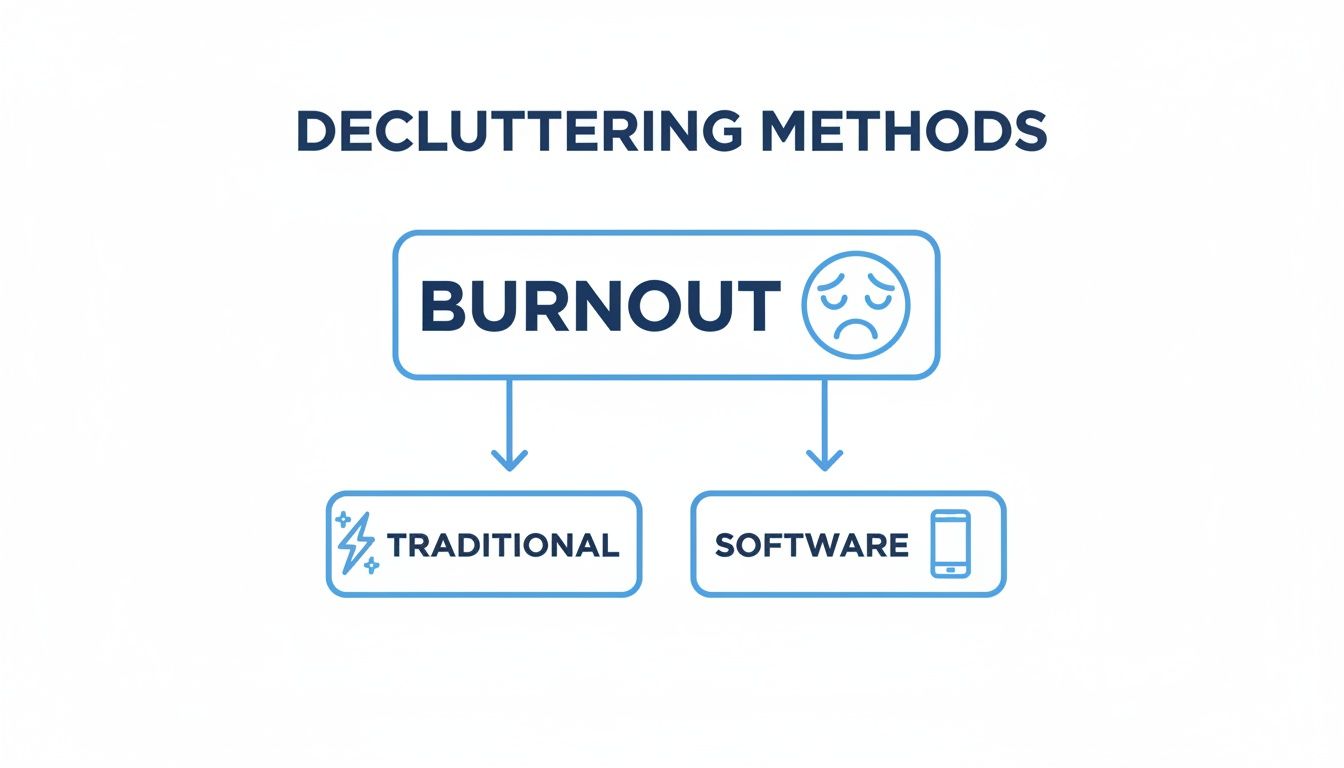
As you can see, relying only on high-effort, manual methods is a fast track to exhaustion. A software-guided approach gives you a structured path that helps you conserve your energy for the long haul.
Real-Time Valuation
"Is this even worth anything?" That single question can stop your progress dead in its tracks. Real-time valuation gives you an immediate, data-backed answer.
By scanning online marketplaces, the software can give you an estimated resale value for your stuff. This is a huge help for two reasons: it makes decisions about selling versus donating objective, not emotional, and it gives you crucial documentation for your home insurance policy. That's real peace of mind.
Integrated Selling Platforms
One of the best motivators for decluttering is turning your unwanted items into actual cash. That’s why an integrated selling platform is such a critical feature. The software shouldn't just log an item; it should help you sell it.
This means automatically generating an optimized title, writing a compelling description, suggesting a competitive price, and even creating a pre-filled listing for sites like eBay. It transforms your clutter from a problem into an opportunity.
This feature bridges the gap between deciding to sell something and actually selling it. By automating the most tedious parts of creating a listing, it helps you follow through and see tangible rewards for your efforts.
Multi-User and Cloud-Based Access
Clutter is rarely a solo problem, so the solution shouldn't be either. Whether you're coordinating with a spouse, roommate, or your kids, multi-user support is a must-have. Everyone can chip in and add to the inventory from their own phone, turning a personal burden into a team effort.
This works hand-in-hand with cloud-based access, which ensures your inventory is always synced up and available from anywhere. It's no surprise that cloud-based home inventory apps now hold 56% of the global market, serving around 17 million households. Their popularity is fueled by features that fit our connected lives—in fact, 63% of users name family-sharing as a key benefit. You can read the full research on home inventory app trends to see just how these tools are evolving.
Robust Security and Privacy
You’re creating a digital map of your most personal belongings, so robust security and privacy are completely non-negotiable. Look for software that uses strong encryption to protect your data, both when it's stored on their servers and when it's being sent over the internet.
A clear, easy-to-understand privacy policy is also a must. You need to feel 100% confident that your personal information is being kept safe and secure.
Gamification and Progress Tracking
Finally, let's talk about the secret weapon against clutter paralysis: motivation. Features like gamification—think points, streaks, or achievement badges—provide those small dopamine hits that keep you going when you feel like stopping.
When paired with clear progress tracking, like before-and-after visuals or stats showing how many items you've cleared, these features make your hard work feel tangible. They reframe a chore into a rewarding challenge, helping you build and maintain the momentum you need to finally reclaim your space.
As you start looking at different tools, it helps to separate the must-haves from the nice-to-haves. The table below breaks down the features that directly combat clutter paralysis versus those that are simply helpful additions.
Essential vs. Nice-to-Have Software Features
| Feature | Why It's Essential for Overcoming Clutter Paralysis | Example Application |
|---|---|---|
| AI Item Recognition | Eliminates the mental block of manual data entry, making it easy to start and continue. | Just snap a photo of a lamp, and the app instantly identifies it as "Table Lamp," saving you from typing. |
| Automated Categorization | Reduces decision fatigue by providing smart suggestions for where items belong. | The app suggests placing your newly scanned blender into the "Kitchen Appliances" category automatically. |
| Real-Time Valuation | Provides objective data to help you quickly decide whether to keep, sell, or donate. | Find out instantly that an old camera is worth $75, making the decision to sell it much easier. |
| Integrated Selling Assistant | Bridges the gap between identifying an item to sell and actually listing it for sale. | The software generates a pre-filled eBay listing with a title, description, and suggested price for your item. |
| Progress Tracking | Offers visual proof of your accomplishments, which provides powerful motivation. | A dashboard shows you've decluttered 50 items this week, encouraging you to keep going. |
| Cloud Sync & Security | Gives you peace of mind that your data is safe, secure, and accessible anywhere. | You can add items on your phone in the garage, and your partner can see the updates instantly on their tablet upstairs. |
Focusing on these core features ensures you choose a tool that actively helps you overcome the psychological barriers of decluttering, rather than just adding another task to your to-do list.
Putting Your Home Inventory to Work
Creating a digital catalog of your stuff is a great start, but the real power comes when you put that inventory to work. A home inventory management software isn’t just for record-keeping; it’s a tool for action. It turns the overwhelming chaos of "stuff" into a clear, manageable resource you can use to make real-world progress.
Think of it as your personal command center for everything you own. No more guessing what's in that box in the attic. No more feeling stuck. Let's dig into four common situations where an inventory system becomes your most valuable ally, transforming stressful life events into organized, manageable projects.
The Decluttering Project Reimagined
For many of us, this is the starting point—staring at a room full of clutter and feeling that all-too-familiar sense of paralysis. With a digital inventory, that entire dynamic shifts. You don't have to physically pull everything out just to figure out where to begin.
Instead, you can grab a cup of coffee, sit on the couch with your tablet, and apply the "Trash First" method digitally. Just scroll through your catalog and start tagging the easy stuff: the broken toaster, the expired spices, the clothes you completely forgot you owned. Each tap is a quick win that builds momentum, making it easier to tackle the tougher decisions later. This simple change turns a physically exhausting chore into a series of calm, deliberate choices.
Insurance and True Peace of Mind
No one likes to think about worst-case scenarios like a fire, flood, or theft. But if the unthinkable happens, a detailed inventory can mean the difference between a quick insurance claim and a long, drawn-out nightmare. Trying to recall every single item you owned from memory in the middle of a crisis is a nearly impossible task.
An up-to-date digital inventory—complete with photos, purchase dates, and values—is the most powerful piece of evidence you can give your insurance company. It speeds up the claims process, helps ensure you receive a fair settlement, and provides undeniable proof of ownership for your most valuable items.
This isn't just about organizing your home; it's about protecting your financial stability and gaining genuine peace of mind.
Streamlining a Move or Downsizing
Moving is right up there as one of life's most stressful events. A huge chunk of that anxiety comes from not knowing exactly what you have to pack, move, or get rid of. An inventory makes that uncertainty disappear. Planning your move becomes a strategic exercise instead of a chaotic free-for-all.
You can easily sort and tag items for their final destinations: "Keep," "Store," "Donate," or "Sell." You can give movers a precise list of what's going, and you'll know exactly what’s inside every box without scribbling on the sides with a marker. When taking on a big project like this, a solid moving house checklist powered by an accurate inventory is a game-changer.
Unlocking Hidden Cash in Your Clutter
One of the best parts of decluttering is realizing your unwanted items might actually be worth something. That old camera collecting dust or the designer handbag you never use could be turned into cash. The problem is, the thought of creating online listings—taking good photos, writing descriptions, and figuring out prices—is usually enough to make people give up.
This is where your home inventory management software becomes a powerful selling tool. Since you've already done the hard work of cataloging everything, modern apps can help you spot the valuable items instantly. Even better, some have integrated selling assistants that can automatically create optimized listings for platforms like eBay, turning what used to be a tedious task into just a few clicks. Suddenly, your clutter isn't just a problem; it's a hidden asset waiting to be cashed in.
How AI Helps You Build Decluttering Momentum
Let’s be honest: starting to declutter can feel like staring up at a mountain. The sheer amount of stuff and the thought of manually identifying, categorizing, and deciding what to do with every single item is enough to cause "clutter paralysis." It’s a common roadblock, and it’s exactly where Artificial Intelligence completely changes the game.
AI in modern home inventory management software isn't just a fancy spreadsheet. Think of it as a personal assistant designed to break through that mental gridlock and get you moving. It all starts with one simple action: you just snap a photo.

That single click kicks off a series of automated tasks that dissolve the friction that usually grinds decluttering projects to a halt. It’s the digital version of our "Trash First" methodology—start with the easiest possible step to build unstoppable momentum.
Turning Decisions into Quick Wins
The real magic of AI is how it short-circuits decision fatigue. Instead of you having to stare at an object and wrestle with a dozen different choices, the software gives you an intelligent head start.
Here’s a look at how it plays out:
- Instant Item Recognition: You take a picture of that old blender collecting dust. The AI immediately recognizes it as a "kitchen appliance." No typing, no fumbling with menus—just a quick, satisfying win.
- Smart Categorization: Next, the AI suggests putting it in your "Kitchen" or "Small Appliances" category. This removes the small but surprisingly draining mental effort of having to organize everything on the fly.
- Objective Valuation: It can even scan online marketplaces in real-time to estimate what that blender is worth. This data gives you a clear, objective basis for deciding whether to sell or donate, taking emotional guesswork out of the equation.
By automating these first few steps, the AI clears the mental clutter so you can focus on making simple, guided decisions. If you're curious about how this tech-forward approach stacks up, see our guide on the best home organization apps to learn which features deliver real results.
Gamification: The Science of Staying Motivated
So you’ve started cataloging. Great! But how do you keep the momentum going when you’re halfway through the garage? This is where AI-powered gamification shines. Decluttering is a marathon, and staying motivated is everything.
AI doesn't just organize your stuff; it organizes your motivation. By creating a feedback loop of small wins and visible progress, it provides the psychological fuel needed to turn paralysis into lasting progress.
The system is designed to give you the little dopamine hits that are crucial for building new habits, which is especially helpful for those of us who struggle with executive function.
- Points and Streaks: Every item you log or decision you make earns you points. Do it a few days in a row, and you build a "streak," creating a fun challenge that encourages consistency.
- Progress Tracking: The software uses your inventory data to generate visual reports, charts, and even before-and-after sliders. Seeing that you’ve already cleared 50 items from one room is a hugely powerful motivator.
- Achievements and Levels: As you hit key milestones—like finishing your closet or clearing out the junk drawer—you unlock badges and new levels. These small rewards are a great way to acknowledge your effort and push you toward the next goal.
At the end of the day, this AI-driven system is about far more than making lists. It’s a psychology-backed tool designed to guide you from feeling completely stuck to making real, tangible progress, one enjoyable step at a time.
Choosing the Right Home Inventory Software
Deciding to finally get a handle on all your stuff is a massive first step. But picking the right home inventory management software can feel like just another overwhelming chore on the list. The trick is to find a tool that actually helps you fight the decision fatigue you're trying to escape in the first place. A great app should feel more like a helpful partner than just another digital to-do list.
To find the right fit, especially when you're feeling overwhelmed or have a diagnosis like ADHD, it's smart to ask a few key questions. Think of this as your personal checklist for turning that feeling of "clutter paralysis" into real, lasting progress.
A Practical Checklist for Making Your Choice
Before you download the first app you see, run it through these essential questions. The answers will point you toward a tool that's built to create momentum, not just catalog items.
- Does it fight data entry burnout? Let's be honest, the thought of manually typing in every single thing you own is a huge barrier. Look for AI-powered item recognition that lets you just snap a photo. The app should instantly identify and log your belongings, making the "getting started" part feel almost effortless.
- Does it keep you motivated? Decluttering is a marathon, not a sprint. Features like gamification—think points, streaks, and achievements—provide those small, consistent dopamine hits that are scientifically proven to help build good habits. This is what keeps you going long after the initial burst of motivation wears off.
- Can it turn your clutter into cash? One of the best rewards for decluttering is finding out what your old stuff is worth. Does the software have an integrated selling assistant? A good one will help you easily list items on platforms like eBay, turning things you don't want anymore into a tangible reward.
- How does it protect your data? You’re essentially creating a digital map of your home. Make sure the software has solid security, like end-to-end encryption, and a clear privacy policy. You need to feel confident that your information is being kept safe.
The screenshot below shows how a thoughtfully designed app presents these features in a clear, benefit-driven way.
Notice the focus isn't just on the tech, but on outcomes like "Build Momentum" and "Unlock Hidden Cash." This language speaks directly to the psychological needs of someone feeling stuck. If you're weighing your options, our guide to the best free organization apps can give you some more perspective.
The right software doesn’t just give you a list of features; it gives you a clear path forward. It should reduce the number of decisions you have to make, automate the tedious parts, and reward you for every small step you take.
At the end of the day, the best home inventory management software is the one that makes you feel empowered, not more overwhelmed. By looking for these user-focused features, you can choose a tool that will finally help you break through the paralysis and start making the progress you've been wanting.
Got Questions? We’ve Got Answers.
Diving into home inventory management can feel like a big step, especially when clutter already has you feeling stuck. It's totally normal to have questions. Let's tackle some of the most common ones we hear from people just like you.
"Is it actually safe to upload pictures of everything I own?"
We get it. You're creating a private record of your personal space, and the last thing you want is for it to be insecure. Any trustworthy app will treat your privacy as its top priority, using strong end-to-end encryption to keep your data safe, both while it's being uploaded and when it's stored.
Think of it like digital banking—the same level of security should apply. Before you commit, always check for a clear and easy-to-understand privacy policy. Your home inventory is your business, and it should stay that way.
"Seriously, how long will it take to inventory my whole house?"
This is the question that stops so many people before they even start. But here’s the secret: you don't inventory your whole house at once. That’s a recipe for burnout.
The goal is to build momentum, not run a marathon in a day. Pick one drawer. Just one. Or maybe that one messy corner of the living room. With a good AI-powered tool, you can knock out an entire room in less than an hour. The key is small, consistent efforts that add up over time, turning overwhelm into action.
"I have ADHD and feel completely overwhelmed. Can this really help me?"
Yes, and this is exactly why these tools are so effective. Traditional organizing methods often fizzle out because they rely heavily on executive functions—the very things that can be a struggle when you're feeling overwhelmed or have ADHD.
Modern, psychology-backed software flips the script by giving you the external structure you need.
- Gamification provides those little dopamine rewards that keep you going.
- AI-guided suggestions take the mental load off of making endless decisions.
- Seeing your progress visually makes your hard work feel real and rewarding.
It’s designed to break through that feeling of paralysis and help you get started.
"What’s the real difference between a free app and a paid one?"
Free apps are a great way to dip your toes in the water. But you’ll often hit a wall, whether it's a limit on how many items you can add or a lack of the features that actually save you time, like AI image recognition or valuation tools.
Think of a paid home inventory management software as an investment in yourself. You’re getting powerful, psychology-backed tools designed to do the heavy lifting for you, transforming a dreaded chore into a process that feels empowering and helps you finally make progress.
Ready to turn clutter paralysis into progress? We've been there, and we built the tool we wished we had.