
Have you ever stared at a room, a closet, or maybe just a pile of boxes that has been sitting there for years, and felt completely paralyzed? You want to start, but the sheer volume of decisions is exhausting before you even pick up a single item. If this sounds familiar, it’s not because you’re lazy; you’re experiencing “clutter paralysis.” It’s a real phenomenon where decision fatigue stops you in your tracks.
It’s not your fault. Many traditional methods fail because they ask you to make difficult, emotional choices right away—like “does this spark joy?”—which only adds to the overwhelm. But what if there was a better way to get started, one that bypasses that paralysis and builds momentum instead of demanding perfection?
This guide provides a collection of actionable, psychology-backed decluttering tips for beginners designed to do exactly that. We’ll explore eight specific strategies, from the simple Four-Box Method to quick, time-boxed routines that create immediate progress. Forget feeling stuck. This list is your roadmap to turning that sense of overwhelm into real, visible action, one small, easy decision at a time. You’ll learn how to finally make progress on those long-neglected spaces and build the confidence to keep going.
1. The “Trash First” Four-Box Method
If “clutter paralysis” has you stuck staring at a pile of stuff, unsure where to even begin, the Four-Box Method is your perfect starting point. It’s one of the most effective decluttering tips for beginners because it simplifies the overwhelming task of making hundreds of decisions into just four clear choices. This technique forces a decision for every single item you touch, preventing the common habit of moving clutter from one pile to another.
The process is simple: grab four boxes or large bags and label them clearly:
- Trash/Recycle: Start here. This is the easiest category. Anything broken, expired, or unusable goes in here first. This quick win builds momentum.
- Donate: For items in good, usable condition that someone else could benefit from.
- Sell: For valuable items you no longer need but are worth the effort to list online or take to a consignment shop.
- Keep: For items you actively use, love, and have a designated home for.
This method gives you a physical, visual system to process your belongings, turning abstract overwhelm into concrete action. By starting with trash, you build momentum with easy decisions, which science shows gives your brain a little dopamine hit, making it easier to keep going.
How to Implement the Four-Box Method
To make this strategy work, focus on one small, manageable area at a time, like a single drawer or one shelf. Set a timer for just 15-20 minutes and work quickly, trusting your initial gut reaction. Don’t get bogged down in sentimental debates. The goal is to make a quick, decisive choice for each item and physically place it into the corresponding box. Once a box is full, immediately move it to its next destination. Take the trash out, put the donation box in your car, and group sellable items together to photograph later. This immediate action prevents sorted piles from turning back into clutter and helps you finally make progress.
2. The One-In-One-Out Rule
Once you’ve made some progress, the biggest challenge is preventing the clutter from creeping back in. The One-In-One-Out Rule is a simple yet powerful maintenance strategy designed to stop accumulation before it starts. This rule transforms decluttering from a massive, one-time project into a sustainable, ongoing habit, ensuring your space remains balanced over the long term.
The concept is straightforward: for every new item you bring into your home, a similar item must leave. This creates a closed-loop system for your belongings, forcing you to consciously evaluate both new purchases and existing possessions. It’s one of the most effective decluttering tips for beginners because it shifts your mindset from passive accumulation to active curation of your environment.

This rule applies to nearly every category of item in your home:
- Clothing: Buy a new pair of jeans, and an old pair goes into the donation box.
- Books: Add a new novel to your shelf, and choose one to give to a friend or library.
- Kitchen Gadgets: Purchase a new air fryer, and the old, unused blender must go.
- Toys: When your child gets a new toy for their birthday, one they’ve outgrown is donated.
By linking every new acquisition to a removal, you maintain equilibrium. This practice not only prevents your home from becoming overstuffed but also encourages more mindful consumption, as you’ll think twice about a purchase if you know it requires a corresponding sacrifice.
How to Implement the One-In-One-Out Rule
To integrate this rule into your life, start small and be consistent. Designate a specific spot in your home, like a basket by the door or a box in a closet, for “outgoing” items. Every time you bring something new home, immediately find its counterpart and place it in this designated area. Once the box is full, schedule a donation drop-off or list the items for sale. To stay on track, consider making it a family rule so everyone is accountable. This simple, consistent action is the key to breaking the cycle of clutter and maintaining a peaceful, progress-oriented living space.
3. The KonMari Method
If you find that clutter is less about physical mess and more about a lack of connection to your belongings, the KonMari Method might be the right fit. Developed by Marie Kondo, this approach is one of the most transformative decluttering tips for beginners because it shifts the focus from what to discard to what to keep. It reframes decluttering as a mindful practice of choosing only items that “spark joy.”
The core principle is simple: instead of sorting by room, you declutter by category (clothing, books, papers, etc.). For each item, you physically hold it and ask yourself a single question: “Does this spark joy?”
- Keep: If the item brings you a genuine sense of happiness or appreciation.
- Discard: If the item evokes indifference or guilt. Before letting it go, you thank the item for its service.
This method is philosophy-based and encourages deep reflection. It’s not just about tidying; it’s about intentionally curating a space that supports the life you want to live. For some, starting with such an emotional question can increase decision fatigue. However, for others, focusing on joy helps build a more conscious and appreciative relationship with their possessions.
How to Implement the KonMari Method
To begin, start with the easiest category: clothing. Gather every single piece of clothing you own into one giant pile. This visual representation of volume is a key part of the process. Pick up each item one by one and assess your emotional response. If it sparks joy, fold it using Kondo’s signature vertical folding technique and place it back. If not, thank it and place it in a discard pile. Work through all your categories in the prescribed order: clothing, books, papers, komono (miscellaneous items), and finally, sentimental items. This builds your decision-making skills before tackling the toughest items.
The KonMari Method is powerful because it addresses the emotional roots of clutter. You can learn more about detaching your identity from clutter to support this mindset shift.
4. The 90/90 Rule
If emotional attachment or “just in case” thinking is what triggers your clutter paralysis, the 90/90 Rule is a powerful mindset shift. This is one of the most effective decluttering tips for beginners because it replaces subjective feelings with objective logic. It cuts through the noise of what-ifs and focuses squarely on your actual, recent behavior, making decisions less about emotion and more about practical utility.
The rule is a simple, two-part question you ask for any given item:
- Have I used this in the last 90 days?
- Will I use it in the next 90 days?
If the honest answer to both questions is “no,” then it’s a clear signal that the item no longer serves a practical purpose in your life and you can let it go. This logical framework is perfect for items like kitchen gadgets that seemed like a good idea, workout gear you never use, or clothing that doesn’t fit your current lifestyle.
How to Implement the 90/90 Rule
To use this rule effectively, apply it category by category for maximum impact. Start with your closet, your kitchen cabinets, or your hobby supplies. As you pick up each item, ask the two questions directly and be ruthlessly honest about your actual usage patterns, not your aspirational ones. Remember to account for seasonality; a heavy winter coat won’t be used in July, but it has a clear purpose in the next 90 days of winter. This rule is designed to build momentum by giving you a clear, non-negotiable reason to part with things, helping you progress without getting stuck in sentimental debates.
5. Room-by-Room Systematic Approach
If the thought of decluttering your entire home sends you into a spiral of overwhelm, the Room-by-Room Systematic Approach is your lifeline. This strategy is one of the most powerful decluttering tips for beginners because it breaks an enormous, undefined project into a series of smaller, self-contained victories. Instead of bouncing between piles in different areas, you focus all your energy on completely finishing one designated space before even thinking about the next. This prevents the common trap of starting multiple projects but finishing none.
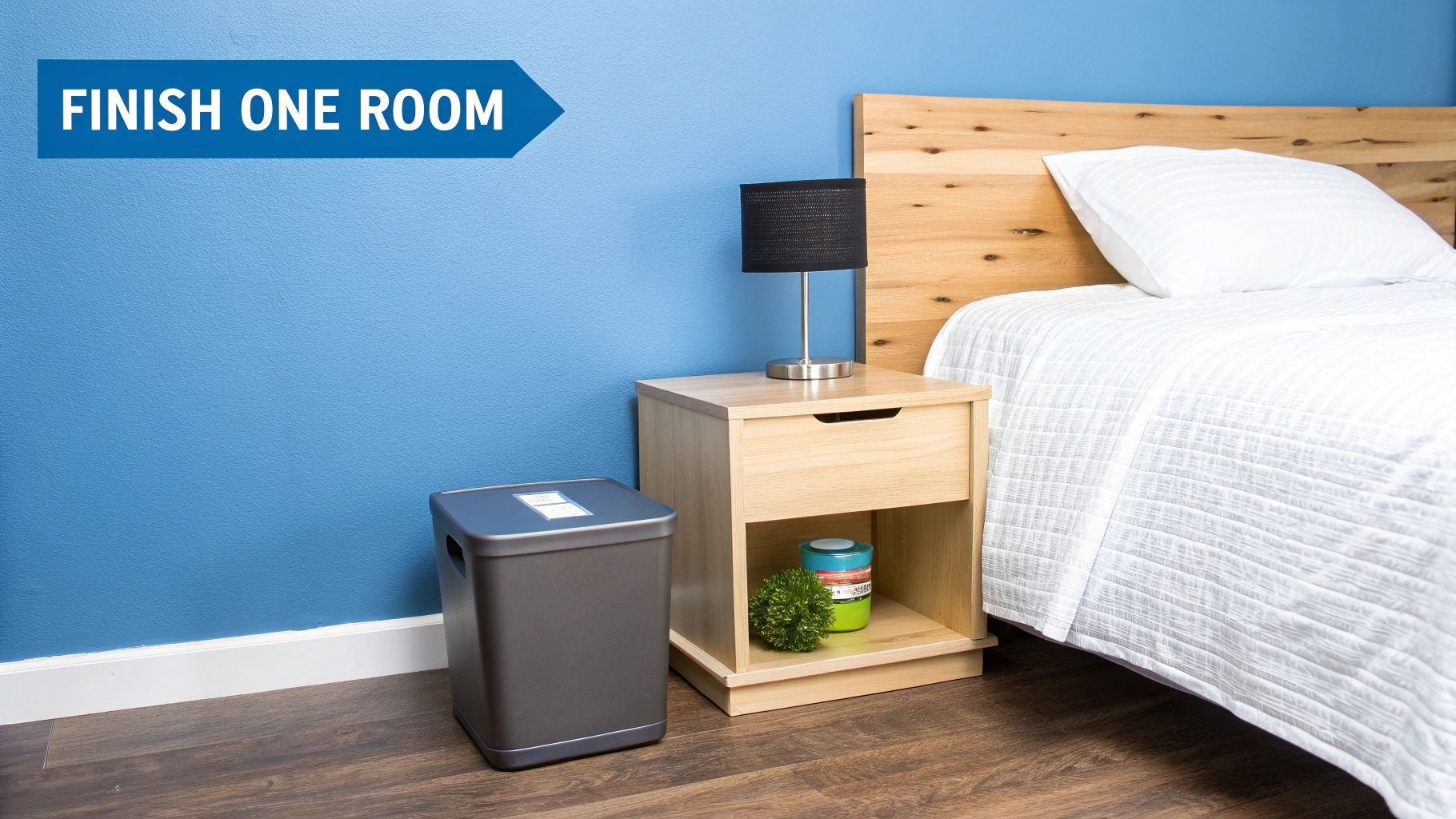
This method directly combats “clutter paralysis” by giving your brain a clear finish line. Completing just one room, like the bathroom, provides an immediate and tangible reward: a fully functional, tidy space. This success builds the psychological momentum needed to tackle more challenging areas. You’re not just moving clutter around; you are reclaiming your home, one room at a time. The visual proof of your progress is a powerful motivator that makes the entire process feel manageable and achievable.
How to Implement the Room-by-Room Approach
Start by choosing the easiest or smallest room first, such as a guest bathroom or a small office, to secure a quick win. Define the scope clearly: “This weekend, I am only decluttering the master bathroom.” Once you begin, commit to finishing it completely. This means every item is sorted, and the trash, donation, and sell boxes are removed from the space.
- Set a Realistic Timeline: Don’t try to tackle the kitchen in one afternoon. Allot a full weekend for a large room and a single morning for a smaller one.
- Take “Before” and “After” Photos: This simple step creates a powerful visual record of your success, boosting your motivation for the next room.
- Prepare Your Disposal Plan: Before you start, know where you will take donations and how you will handle trash and recycling.
- Finish a Room 100%: The golden rule is to not start the next room until the current one is entirely done. For more detailed guidance, learn more about a Room-by-Room Systematic Approach and other strategies.
6. The 30-Day Decluttering Challenge
If the thought of a massive, weekend-long decluttering session triggers immediate overwhelm, The 30-Day Decluttering Challenge offers a brilliantly simple alternative. Popularized by The Minimalists, this gamified approach turns a daunting task into a daily, manageable habit. It’s one of the most effective decluttering tips for beginners because it bypasses decision fatigue by creating a simple, numerical goal that builds momentum over time.
The concept is straightforward: you remove an increasing number of items from your home each day for a month.
- Day 1: Get rid of one item.
- Day 2: Get rid of two items.
- Day 3: Get rid of three items.
- …and so on, until you remove 30 items on Day 30.
By the end of the challenge, you will have removed a total of 465 items from your home. This incremental process makes decluttering feel less like a monumental chore and more like a fun game. It helps you build a “decluttering muscle,” making it easier to let go of things like duplicate kitchen utensils, expired cosmetics, and single socks that you tackle in the early, easier days of the challenge.
How to Implement The 30-Day Decluttering Challenge
Success with this method comes from preparation and a focus on progress, not perfection. Start by placing an empty donation box in a convenient, visible spot. On Day 1, find one easy thing to discard, like an old magazine or a broken pen. As the daily number grows, you’ll naturally move from obvious trash to items that require more thought. Document your progress with photos to stay motivated. If you feel overwhelmed by clutter and need more guidance, exploring different decluttering challenges can provide the structure you need. Don’t feel pressured to discard a valuable item just to meet your daily quota; the goal is to mindfully reduce clutter, not create regret.
7. The Trash Bag Technique
If the thought of making permanent decisions about your belongings triggers instant anxiety, The Trash Bag Technique is a game-changer. It’s one of the most effective decluttering tips for beginners because it temporarily removes the pressure of finality. This method acts as a trial separation from your stuff, allowing you to test whether you truly need or miss an item before letting it go for good, making it a perfect tool for overcoming decision fatigue.
The concept is brilliantly simple: gather items you’re unsure about, place them in an opaque trash bag or a sealed box, and store it out of sight for 30 days.
- Clothes: Bag up outfits you haven’t worn in a year or items that don’t quite fit.
- Sentimental Items: Gently pack mementos you feel guilty discarding to see if their absence affects you.
- Duplicate Kitchen Gadgets: Store that extra set of measuring cups or the second-string can opener to see if you ever reach for them.
This technique helps you move past mental roadblocks by postponing the final discard decision. It gives you a safety net, proving through experience, not just thought, what you can comfortably live without. By the end of the trial period, your emotional attachment often fades, making the final step much easier.
How to Implement the Trash Bag Technique
To make this method work, you need to be disciplined. Grab a few opaque trash bags or cardboard boxes. As you declutter an area, place any “maybe” items directly into a bag. Don’t overthink it; the whole point is to delay the hard decision. Once a bag is full, seal it securely.
Label the bag with the contents’ general category (e.g., “Guest Room Closet”) and the date. Most importantly, write a “Donate On” date exactly 30 days from now and set a non-negotiable calendar reminder. Store the bag somewhere inconvenient, like the garage, attic, or deep in a closet. The goal is to forget about it. If you don’t retrieve a single item from the bag before your calendar alert goes off, take the entire sealed bag directly to a donation center. Do not reopen it. This final step is crucial for turning indecision into real, lasting progress.
8. The Five-Minute Rule
While big decluttering sessions are essential for tackling long-term buildup, preventing new clutter from forming is just as important. The Five-Minute Rule is a powerful preventative habit that stops small messes from escalating into overwhelming projects. This strategy is one of the most effective decluttering tips for beginners because it focuses on immediate action, turning daily tidying into a simple, automatic routine rather than a dreaded chore.
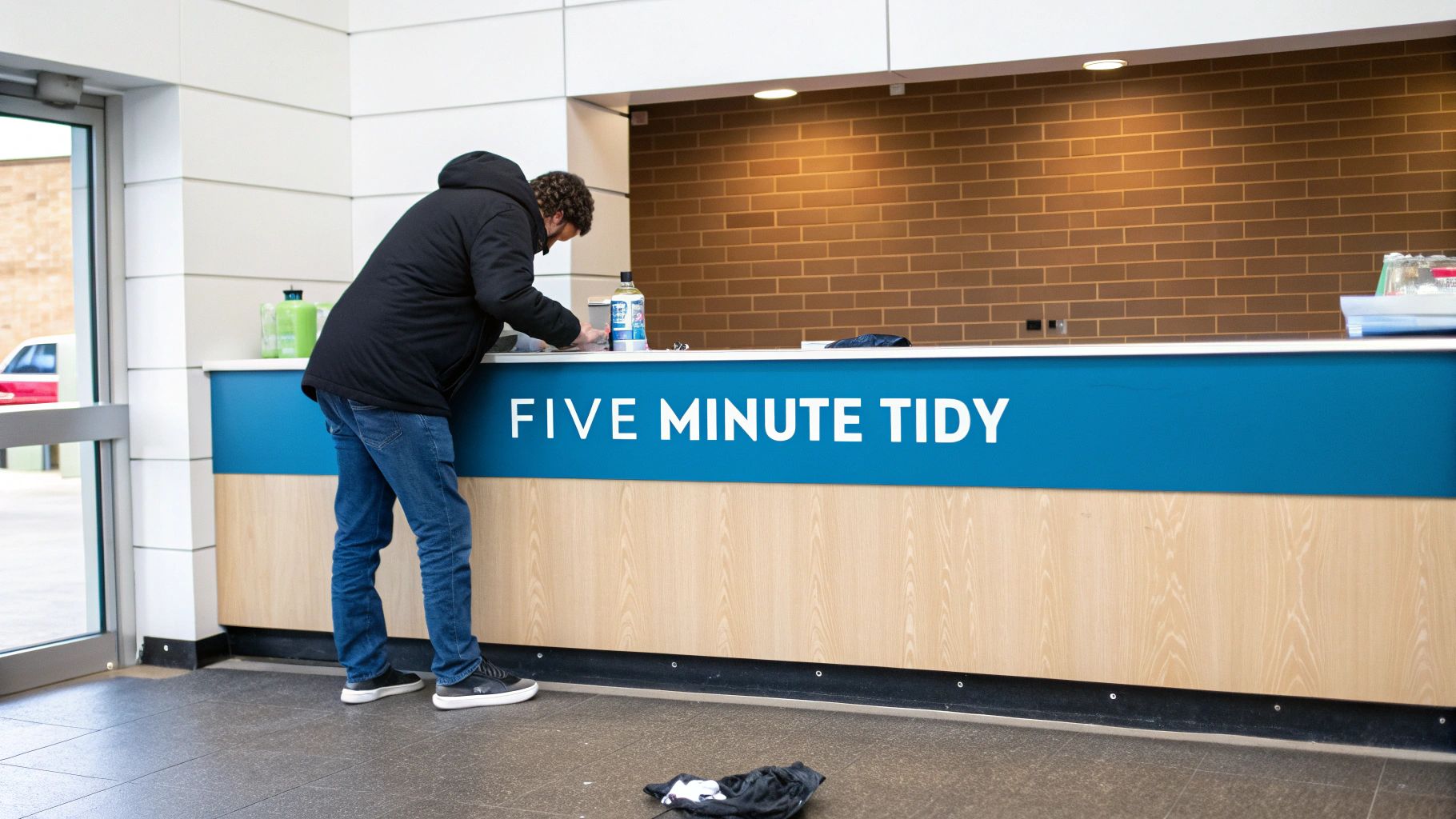
The concept is incredibly straightforward: if a task takes less than five minutes to complete, do it immediately instead of putting it off. This simple shift in mindset targets the small, everyday items that contribute to “clutter creep.” It’s about dealing with things in real time, like putting your shoes back in the closet, sorting the mail as soon as you bring it inside, or wiping the counter right after making a snack. By integrating this micro-habit into your day, you maintain a baseline of order and drastically reduce the need for future marathon cleaning sessions.
How to Implement the Five-Minute Rule
To make this rule a consistent part of your life, start by identifying your personal “clutter hotspots,” such as the kitchen counter, your entryway table, or the chair in your bedroom that collects clothes. Consciously apply the rule in these high-traffic areas first.
- Assign a “Home”: This rule only works if every item has a designated place to go. Ensure your keys have a hook, mail has a sorter, and shoes have a rack.
- Set a Timer: If you struggle to start, set a timer for just five minutes at the end of the day and tackle as many small tasks as you can. This gamifies the process and makes it feel more manageable.
- Involve the Household: Encourage everyone in your home to adopt the rule. When the whole family participates, the collective effort keeps shared spaces consistently tidy.
- Focus on Prevention: Use this rule as your primary maintenance strategy after a major decluttering effort. It protects your hard work and prevents you from falling back into old habits, ensuring you make lasting progress.
8 Decluttering Methods Compared
| Method | Implementation Complexity 🔄 | Resource Requirements ⚡ | Expected Outcomes 📊 | Ideal Use Cases 💡 | Key Advantages ⭐ |
|---|---|---|---|---|---|
| The Four-Box Method | Low 🔄 — simple sorting steps | Moderate — boxes/space, moderate time ⚡ | Clear actionable piles; measurable progress 📊 | Initial declutter of rooms or closets 💡 | Easy to learn; provides immediate action steps ⭐ |
| The One-In-One-Out Rule | Low 🔄 — habit-based maintenance | Minimal — ongoing discipline, little time ⚡ | Stable possessions; prevents re-accumulation 📊 | Post-declutter maintenance; frequent shoppers 💡 | Sustains order long-term; encourages mindful buying ⭐ |
| The KonMari Method | High 🔄 — emotion-focused, structured | High — significant time and emotional energy ⚡ | Deeply curated collection; lasting lifestyle change 📊 | Sentimental items; values-driven home redesign 💡 | Strong emotional clarity; durable results ⭐ |
| The 90/90 Rule | Low–Medium 🔄 — binary time test | Low — short assessments, honesty required ⚡ | Fast practical purging; reduced indecision 📊 | Seasonal/rarely-used items; pragmatic declutterers 💡 | Objective and quick decisions; reduces guesswork ⭐ |
| Room-by-Room Systematic Approach | Medium 🔄 — project-style planning | Moderate — time per room, possible coordination ⚡ | Visible before/after progress; sustained momentum 📊 | Large homes or overwhelmed users preferring phases 💡 | Prevents overwhelm; yields quick wins and focus ⭐ |
| The 30-Day Decluttering Challenge | Low–Medium 🔄 — daily increasing commitment | Low to Medium — daily removal, social support ⚡ | Habit formation; high quantity of items removed 📊 | Motivated or social participants; habit-building 💡 | Gamified motivation; measurable daily progress ⭐ |
| The Trash Bag Technique | Low 🔄 — rapid sort + delay period | Low — bags/temporary storage, discipline not to peek ⚡ | Tests attachment; reduces decision paralysis 📊 | Sentimental items or indecisive people 💡 | Fast initial purge; minimizes regret after trial ⭐ |
| The Five-Minute Rule | Low 🔄 — real-time, micro-actions | Minimal — a few minutes daily ⚡ | Maintains order; prevents small clutter buildup 📊 | Busy households; high-traffic zones, maintenance phase 💡 | Low effort with high consistency; prevents major projects ⭐ |
Turn Paralysis into Progress, Starting Today
You’ve just explored a powerful toolkit of decluttering tips for beginners, from the systematic Four-Box Method to the rapid momentum of the Trash Bag Technique. Each strategy offers a unique path forward, proving that there isn’t just one “right” way to reclaim your space. The common thread weaving through all of them is the principle of starting small to build momentum.
The journey isn’t about achieving a flawless, magazine-ready home overnight. It’s about breaking the cycle of “clutter paralysis,” that feeling of being so overwhelmed you don’t even know where to begin. The true victory lies in replacing that paralysis with consistent, tangible progress.
Your Path from Overwhelmed to Empowered
Remember these core takeaways as you begin:
- Momentum Over Perfection: Your goal is not to make the perfect decision for every single item. Your goal is to make any decision and keep moving. The Five-Minute Rule and the Trash Bag Technique are excellent for building this initial momentum.
- Decisions are Muscles: Just like any muscle, your decision-making ability gets tired. This is why a simple framework like the 90/90 Rule is so effective; it removes emotional guesswork and gives you a clear, logical reason to let an item go.
- Small Wins Fuel Big Changes: Every single item you remove is a victory. Whether it’s an old receipt, an expired can of food, or a sweater you haven’t worn in a decade, each decision builds confidence and makes the next one easier. Acknowledging these quick wins is essential for staying motivated.
Key Insight: The most successful decluttering journeys aren’t about radical, one-time purges. They are built on new, sustainable habits, like the “One-In, One-Out” rule, that prevent clutter from accumulating again.
Your First Actionable Step
Don’t let this newfound motivation fade. Your very next step should be simple and immediate. Choose one of the techniques that resonated with you and apply it for just five minutes. Set a timer, pick a single drawer or a small corner, and just start. You will be amazed at what you can accomplish before the alarm even sounds. This is how you prove to yourself that progress is not only possible but within your immediate grasp.
If you find that decision fatigue is still your biggest obstacle, that’s precisely where technology can help. We built DeClutter Now on a psychology-backed “Trash First” methodology to help you identify the easiest items to discard first, turning overwhelm into a series of rewarding quick wins. Let our AI be your guide, breaking through the paralysis so you can finally make the progress you deserve.
Start turning clutter into cash and clarity with DeClutter Now today →