
The Best Way to DeClutter Your Home? The key to finally decluttering your home isn’t finding a sudden burst of motivation. It’s about using a method that works with your brain, not against it. For most of us, that means ditching the overwhelming “all-at-once” marathons for small, psychology-backed wins that build real, unstoppable momentum.
Why Traditional Decluttering Methods Fail
Have you ever stood at the doorway of a cluttered room, felt a wave of pure exhaustion hit you, and just walked away? You’re not lazy. It’s a very real psychological response called “clutter paralysis,” and it’s the main reason most decluttering advice just doesn’t work.
We’re told to “just get started” or to empty the entire closet, but that advice completely misses the point. Your brain isn’t just seeing a room full of stuff. It’s seeing hundreds, if not thousands, of individual decisions that need to be made. Keep it? Toss it? Where does it even go? Will I need this someday? Faced with that kind of onslaught, your brain does what any overloaded circuit would do: it shuts down. This is decision fatigue at its most potent.
I’ve Been There—Stuck in “Clutter Paralysis”
I know this feeling all too well because I lived it. For years, I had boxes sitting in my garage from a move, filled with things I just couldn’t face. Every single weekend, I’d tell myself, “This is the day.” I’d go out, open one box, stare at the random assortment of stuff for ten minutes, and feel that familiar, paralyzing sense of being stuck. Then I’d close the lid and walk away.
I tried all the popular methods. I asked myself if each item “sparked joy,” but honestly, everything felt like a potential “what if.” The sheer number of decisions left me paralyzed, trapping me in a cycle of good intentions and zero results. It wasn’t until I stopped blaming myself and started looking at the why behind my inaction that it clicked. The problem wasn’t laziness—it was decision fatigue.
“Clutter is not just physical stuff. It’s postponed decisions. It’s the mental weight of a thousand ‘I’ll get to it later’ thoughts, all demanding your attention at once.”
The Problem with “Perfection-First” Tidying
Many well-known decluttering philosophies, while coming from a good place, set the bar impossibly high. They ask you to imagine a perfect, idealized home or to forge deep emotional bonds with every single object you own. For someone who’s already overwhelmed, this is a massive roadblock.
Here’s exactly why these approaches so often backfire for people stuck in clutter paralysis:
- They force too many complex decisions right away. “Does this spark joy?” is a deep, abstract question. We don’t start there—we start with “is this actually trash?”
- They make a bigger mess before it gets better. Pulling every single thing out of your closet or dumping drawers onto the floor just amplifies the chaos, making the task feel even more insurmountable.
- They focus on the finish line, not the first step. The goal becomes this flawless, magazine-worthy home, which feels so distant that taking that tiny first step seems utterly pointless.
The reality is, you can’t organize your way out of a clutter problem. You have to decide your way out of it. The best way to declutter your home is to find a system that makes those decisions smaller, simpler, and more manageable. Forget about perfection. The real goal is just to make progress, one easy choice at a time. It’s all about turning that paralyzing feeling into forward motion, no matter how small that first step might feel.
The “Trash First” Method: How to Finally Make Progress
When you’re staring at a mountain of stuff, the real problem isn’t just the physical mess. It’s the mental exhaustion that comes from making a thousand tiny decisions. The key to decluttering for good is to start with the easiest decisions first to build momentum.
This is where the Four-Box Method, supercharged with our “Trash First” methodology, comes in. Forget trying to figure out if every little thing “sparks joy” right now. That can come later. We’re starting with a practical, brain-friendly system. All you need are four boxes (or even just four designated piles on the floor).
The Four-Box Method Explained
This table breaks down exactly where everything goes. It’s designed to make your decision for each item almost instantaneous, cutting through the indecision that keeps so many of us stuck.
| Category | Action | Key Question |
|---|---|---|
| Keep | Place it back where it belongs (in this room). | Do I use this regularly and does it belong here? |
| Relocate | Put it in the box to move to another room later. | Does this belong somewhere else in the house? |
| Donate/Sell | Place it in the box for items leaving the house. | Is this in good condition but I no longer need it? |
| Trash | Put it directly into a trash bag. | Is this broken, expired, or unusable? |
By limiting your choices to just these four categories, you immediately reduce decision fatigue. It’s an incredibly effective strategy, especially for anyone who struggles with executive function or ADHD and finds clarity in structured systems.
Start with the Easiest Wins First: The “Trash First” Sweep
Here’s the secret sauce to building momentum: start with a “Trash First” Sweep. Before you even think about what to keep, your only job is to scan the room and grab the obvious junk. We’re talking empty wrappers, old magazines, broken pens, junk mail—anything that requires zero emotional energy to toss.
Every piece of trash you throw away is a tiny victory—a quick win. It’s a completed task that gives your brain a little hit of dopamine, the chemical that fuels motivation. These quick wins create the psychological energy you need to tackle the harder stuff, turning that “I’m so overwhelmed” feeling into “Hey, I can do this!”
This is exactly how you turn clutter paralysis into progress.

By choosing an easy starting point, you sidestep that feeling of being stuck and jump right into action.
Putting It All Together
Once you’ve cleared the obvious trash and you’re feeling a bit of momentum, it’s time to sort everything else. Pick up one item at a time and, without overthinking it, put it into one of the four boxes. Trust your gut—your first instinct is usually the right one.
- The Keep Box is for things you genuinely use and love that belong in the room you’re working on.
- The Relocate Box is a true game-changer. It’s the holding pen for anything that has wandered away from its proper home. That coffee mug from your bedroom? The book from the living room? In the box they go. You’ll put everything away in one quick trip at the end.
- The Donate/Sell Box is for perfectly good items you just don’t need anymore. Don’t get stuck on how or where you’ll sell them yet. The goal is just to get them out of your main space.
- The Trash Box is for anything that’s broken, expired, or just plain unusable. Be ruthless.
This isn’t about getting your home perfect overnight. It’s about making real, tangible progress. You’re taking a huge, scary task and breaking it down into a series of small, manageable decisions. If you’re just getting started and want more tips, our guide on decluttering tips for beginners is a great place to build your confidence.
The Big Idea: Focus on momentum, not perfection. Starting with a “Trash First” Sweep and using the Four-Box Method breaks through the mental gridlock and proves to yourself that you can finally make progress.
Your Practical Room-by-Room Decluttering Roadmap
Alright, you’ve got the Four-Box Method and our “Trash First” principle. Now, let’s put it all together and actually start clearing out the clutter. The secret to success isn’t just diving in; it’s following a strategic plan. We’re going to start with the least emotionally draining spaces first. This way, you score some quick, satisfying wins and build unstoppable momentum before you ever have to face those tougher, more sentimental areas.
Think of it as training for a decluttering marathon. You don’t start with a full sprint—you start with a light jog to warm up.
Start Small in the Bathroom
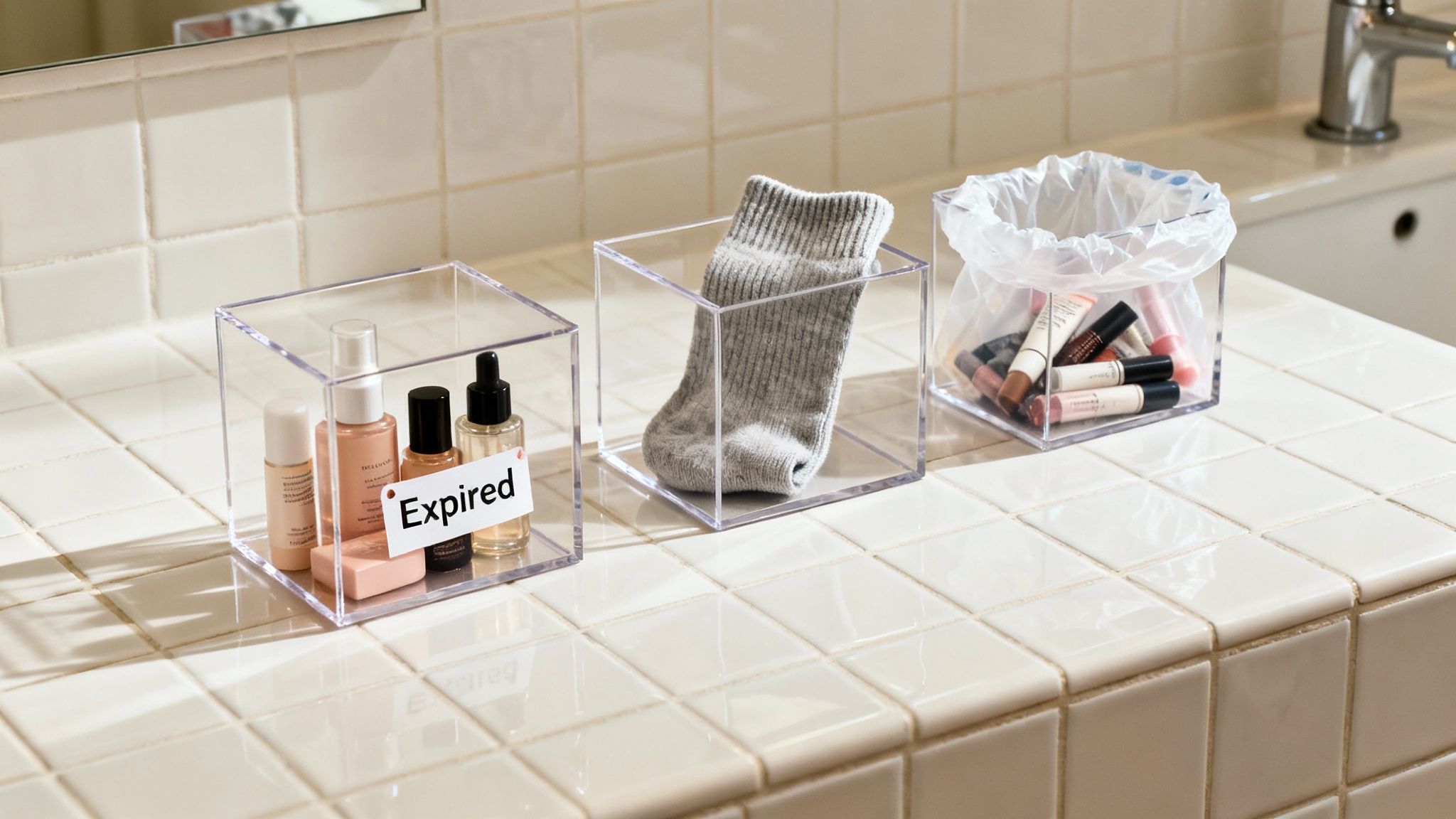
The bathroom is the perfect place to begin. It’s usually small, contained, and filled with items that have clear expiration dates and very little sentimental value. This setup is perfect for making fast, logical decisions without getting stuck in a nostalgia trap.
Your goal here is simple: speed and momentum. Set a timer for just 15 minutes and see what you can accomplish.
Your ‘Trash First’ Bathroom Hit List:
- Expired Medications & Cosmetics: Check every label. If it’s past its prime, it’s trash. No second thoughts.
- Old Toiletries: That crusty bottle of sunscreen from three summers ago? Gone. The tiny hotel samples you swore you’d use? Gone.
- Worn-Out Items: Say goodbye to frayed towels, old toothbrushes, and stretched-out hair ties.
- Empty Bottles & Containers: Scan the shower, drawers, and cabinets for empties that are just taking up precious real estate.
Once the obvious junk is out, bring in your four boxes. The “Relocate” box will probably be your best friend in here. It’s amazing how kids’ toys, coffee mugs, and other random objects find their way into the bathroom. Just box them up for now—don’t get sidetracked by putting them away. Stay focused.
Conquer the Kitchen One Zone at a Time
The kitchen can feel like a monster project, but the secret is to break it down into manageable micro-zones. Don’t even think about tackling the whole room at once. Instead, pick one tiny area to start with, like the utensil drawer, the spice rack, or that dreaded cabinet under the sink.
Every small zone you complete is a victory that fuels you to keep going.
A great tip for the kitchen? Focus on duplicates. Most of us don’t really need five spatulas, three can openers, or a dozen mismatched food containers with no lids. It’s a simple rule that makes decisions easy: keep the best one and let the rest go.
By focusing on one small zone, you turn an overwhelming project into a series of achievable 10-minute tasks. This approach lets you systematically reclaim your kitchen without causing burnout.
As you fill your “Donate/Sell” box with perfectly good but unneeded gadgets, you might be surprised at what they’re worth. If you want to turn that clutter into cash, check out our guide on what sells fast on eBay to make the process even more rewarding.
Move to the Living and Common Areas
Next up are the living rooms and family rooms. Clearing these spaces makes a huge, immediate impact on the entire household’s sense of calm. The items here are also generally less personal than what you’ll find in a bedroom or office, making decisions a bit easier.
Your ‘Trash First’ Hit List for Common Areas:
- Old magazines, newspapers, and junk mail.
- Dead remote control batteries and those mystery charging cords that fit nothing you currently own.
- Broken decor, dead plants, or worn-out coasters.
- Outdated DVDs, CDs, or video games you no longer play.
Use that “Relocate” box aggressively here. Common areas are notorious dumping grounds for things from all over the house. By quickly sorting items into their proper boxes, you avoid the classic decluttering trap: getting sidetracked by taking one thing to another room, only to start a new project there. Your only job is to clear the room you’re in.
Approach the Bedroom Closet Strategically
Finally, you’re ready for the big one: the bedroom closet. By now, you’ve spent time sharpening your decision-making skills in lower-stakes areas. Your “decluttering muscle” is stronger, and you’ve got real momentum on your side.
The biggest mistake people make here is pulling everything out at once. That’s a surefire recipe for overwhelm. Instead, work by category. Start with shirts. Then move to pants. Then shoes.
As you handle each item, ask yourself a few direct questions:
- Does this fit me right now?
- Have I worn this in the last year?
- Is it comfortable and in good shape?
If the answer to any of these is no, it’s a prime candidate for the “Donate/Sell” box. Sentimental items, like an old concert t-shirt, can be tricky. A good rule of thumb is to allow yourself to keep a small, designated number of these memory-keepers. You can honor the past without letting it take over your closet.
Using Technology to Gamify Your Decluttering
You’ve got your boxes lined up, you have a plan, and you’re feeling good. Then you hit a wall. You pick up an old gadget or a gifted sweater, and your brain just… freezes. This is exactly where modern tools can step in and completely change the game.
Decision fatigue is real, and it’s the number one reason decluttering projects stall out. When you consider the average American home has a staggering 300,000 items, it’s easy to see why we get overwhelmed. One in ten of us even rents offsite storage, often paying over $100 a month just to hang onto things we can’t decide about. That’s not just a mental burden; it’s a serious financial leak.
AI Breaks Through Decision Fatigue
What if you had a personal coach right there with you, ready to offer a nudge whenever you feel stuck? That’s the idea behind DeclutterNow. Instead of agonizing over an item, you just snap a photo. The app’s AI analyzes what it is and gives you an instant suggestion for which box it belongs in—Keep, Relocate, Donate/Sell, or Trash.
This one feature is a lifesaver for cutting through decision fatigue. It takes the mental load off your shoulders so you can keep your momentum going. For those really tough items where you’re truly stumped, a “Help Me Decide” feature acts like a mini-coaching session, asking targeted questions to guide you toward a clear choice.

Turning a Chore into a Challenge
Let’s be honest: for most people, decluttering feels like a thankless chore. Gamification completely flips that script. By adding game-like elements, the process shifts from a draining task to an engaging challenge that taps into your brain’s natural reward system.
- Earn Points: Every single item you categorize earns you points. It’s a small thing, but it provides a tangible sense of accomplishment with each tiny decision.
- Build Streaks: When you declutter for a few days in a row, you build a “streak.” Nobody wants to break a streak, which is a powerful motivator to stay consistent.
- Level Up: As you clear more items and conquer entire rooms, you can “level up,” unlocking achievements that mark just how far you’ve come.
This psychology-backed approach gives you those little dopamine hits that keep you going, especially when you’re staring down a closet you haven’t touched in years.
“The goal isn’t just a tidy room; it’s building the habit of making decisions. Gamification makes practicing that habit feel rewarding instead of exhausting, which is key for long-term success.”
Making Your Progress Tangible and Rewarding
One of the toughest parts of a big decluttering project is that it can be hard to see your progress in the moment. That’s where visual trackers are a game-changer. An app can create stunning before-and-after sliders of your room, making your hard work immediately visible and incredibly satisfying. Sharing those transformations with friends and family can also give you a powerful boost of encouragement.
Better yet, technology can help turn that “Donate/Sell” box into actual cash with surprisingly little effort. An integrated eBay assistant can be a lifesaver for anyone who has ever felt overwhelmed by the thought of selling online.
- Snap a few photos of an item.
- The AI generates an optimized title and a compelling description.
- It even suggests a competitive price based on what similar items are selling for right now.
Suddenly, that pile of stuff isn’t just clutter you’re getting rid of; it’s potential income. This doesn’t just make the process faster—it makes it far more rewarding. For a deeper dive, check out our guide on the best home organization apps that pack these kinds of powerful features. By using these tools, you’re not just clearing space—you’re turning clutter paralysis into real, measurable progress.
Building Habits to Keep Your Home Clutter-Free
Getting your home decluttered is a fantastic feeling, but the real win is keeping it that way. This isn’t about one massive, exhausting project. It’s about building simple, sustainable habits that stop “rebound clutter” in its tracks. The goal is to shift from a stressful cycle of cleaning out to a lifestyle of clarity and intention.
Think of it this way—you’ve just cleared the battlefield, and now it’s time to set up your defenses. Without a plan, those newly cleared surfaces become magnets for new stuff. Before you know it, you’re right back where you started.
The key is to weave tiny routines into your day that feel as natural as brushing your teeth. These aren’t huge, time-consuming chores. They’re small, consistent actions that protect the peace and space you worked so hard to create.
Adopt a “One-In, One-Out” Mindset
One of the most effective habits for preventing clutter is the “One-In, One-Out” rule. The concept is brilliantly simple: whenever you bring a new item home—whether it’s a pair of shoes, a coffee mug, or a book—an old one from that same category has to go.
This isn’t about depriving yourself. It’s about being more mindful of what you bring into your life. It forces a moment of reflection, making you ask, “Do I really need this enough to get rid of something I already own?” That simple question is often the only thing standing between a thoughtful purchase and an impulse buy that just becomes tomorrow’s clutter.
This single habit attacks the source of clutter build-up. It transforms your home from a passive storage unit into a curated space where every item has truly earned its place.
Harness the Power of a Daily 10-Minute Tidy
The idea of daily cleaning can feel draining, but a “Daily 10-Minute Tidy” is a whole different beast. This isn’t deep cleaning; it’s just a quick reset for your space. Set a timer for 10 minutes before you go to bed and do a quick sweep of the main living areas.
The only mission is to put things back where they belong.
- Toss the remote back on the coffee table.
- Hang up the jacket that’s been living on a chair.
- Carry the day’s mugs and glasses to the kitchen.
- Fluff the couch cushions.
It’s amazing what you can get done in just 10 minutes. This tiny investment of time stops small messes from snowballing into overwhelming chaos. Plus, waking up to a tidy space sets a much calmer, more positive tone for your entire day.
Create a Designated “Home” for Everything
An item without a home is, by its very definition, clutter. One of the most critical habits you can build is assigning a logical, permanent spot for everything you own. Keys go on a hook by the door. Mail goes into a specific tray. The gym bag lives in the closet, not on the floor.
When everything has a designated home, cleanup becomes almost automatic. You’re no longer making dozens of micro-decisions about where things should go; you’re simply putting them back. This is huge, especially when you realize that a staggering 80% of items we keep go completely unused. Our tidying efforts often fail because we just reshuffle these unused items. By creating designated homes, you quickly start to see what actually belongs and what doesn’t. You can find more great insights into the psychology of our possessions at The Simplicity Habit.
Tackling the Tough Questions About Decluttering
Even with a solid plan, you’re going to hit roadblocks. It’s just part of the process. Below, I’ve broken down some of the most common questions and mental hurdles people face, along with some practical advice to get you moving again. Remember, we’re aiming for progress, not some unattainable ideal of perfection.
The truth is, almost everyone feels buried in their stuff at some point. It’s a surprisingly universal problem. We lose an average of 2.5 days a year just looking for things we’ve misplaced, and all that visual noise can increase housework by a staggering 40%. So if you’re feeling overwhelmed, you’re in good company—54% of Americans feel the same way, and 78% have no idea how to even begin. If you’re curious, you can dig into more data on home organization trends and see just how common this is.
What If I’m Too Overwhelmed to Even Start?
This is classic “clutter paralysis,” and it’s completely normal. The sheer scale of the project freezes you in place. The best way to break through is to think incredibly small. Don’t even consider the whole room. Forget the closet.
Your mission is simple: grab one trash bag and find 10 obvious pieces of trash. That’s it. An old receipt, a junk mail flyer, an empty bottle. This tiny, achievable task creates a quick win, proving to yourself that you can do this and building a little spark of momentum.
How Do I Handle Sentimental Items?
Ah, the sentimental stuff. These are the hardest because their value is tied to memories and emotions, not function. Here’s the most important rule: leave them for last. Seriously. By the time you get to your memory box, you will have already spent hours sharpening your decision-making skills on much easier things, like expired spices or old magazines. Your “decluttering muscle” will be much stronger.
When you’re finally ready, ask yourself if you can keep the memory without keeping the bulky object.
- Could you take a really nice photo of it? Sometimes, that’s all you need to trigger the memory.
- Can you keep just one representative piece from a collection? Maybe one teacup from grandma’s set of 12 tells the story just as well.
- Could you write down the story behind the item in a journal?
This isn’t about erasing the past; it’s about honoring the memory in a way that doesn’t steal your physical space.
How Long Should I Declutter at One Time?
When you’re starting out, shorter is always better. Marathon sessions are the quickest way to burn out and hit a wall of decision fatigue. They turn what should be a liberating process into a grueling punishment you’ll never want to repeat.
Try the “pomodoro” technique: set a timer for just 15-20 minutes. Working in these short, focused sprints makes the task feel less daunting and prevents you from getting mentally drained. The real goal is building a consistent habit, not a one-day miracle overhaul.
What If I Just Can’t Decide on an Item?
It’s going to happen. You’ll pick something up, and your brain will just buffer. The absolute worst thing you can do is let that one item kill your momentum and derail the whole session. This is a common trap that leads right back to feeling paralyzed.
The fix is easy: create a “Decide Later” box. If you find yourself agonizing over something for more than a minute, just toss it in there and move on. Come back to that box in a week or two. Once you’ve cleared out more of the easy stuff and created some breathing room, the right choice often becomes surprisingly obvious.
Ready to turn clutter paralysis into progress? DeclutterNow is the AI-powered companion built to help you push through these exact sticking points. Snap a photo, get a smart suggestion, and feel the momentum build with every single item you clear.
Start your free journey from paralyzed to progress today at https://app.declutternow.ai