
If you're looking for the best home organization apps, you'll find the most powerful ones do more than just make lists. They're like a personal decluttering coach in your pocket, one that uses psychology-backed strategies and a little bit of AI to help you finally break through the overwhelm and tackle those boxes that have been sitting there for years.
Why You Feel Paralyzed By Clutter and How to Break Free
Ever stood in the middle of a room, surrounded by stuff, and felt completely frozen, unable to decide where to even begin? You're not alone. Those boxes sitting in the garage for years aren't a sign of some personal failing. The real culprit is a psychological roadblock called decision fatigue. It’s not laziness—it’s your brain being genuinely overwhelmed.
Our brains can only handle so many decisions in a day. A cluttered room isn't just a collection of objects; it's a minefield of hundreds, sometimes thousands, of tiny choices. Keep it? Toss it? Donate it? Sell it? Where should it live? Each question drains your mental battery, leading to what we call "clutter paralysis."
The Failure of Traditional Methods
Many popular organizing methods, while well-intentioned, can actually make decision fatigue worse. Take the famous question, "Does this spark joy?" It's a lovely concept, but it asks you to make a deep, emotional judgment about every single item you own, right from the start.
Asking yourself to make a heartfelt decision about a sentimental photograph, then an old t-shirt, then a random power cord is mentally exhausting. It’s like trying to run a mental marathon without any training. No wonder it leads to that all-too-familiar feeling of being stuck.
This is exactly why so many decluttering projects fizzle out. Your brain simply runs out of steam, and the project gets abandoned, leaving you feeling even more paralyzed than before.
The Psychology-Backed Path to Progress
So, what actually works? The secret isn't to muscle through more hard decisions. It's to build momentum by starting with the easy ones first. This is the powerful idea behind the "Trash First" methodology, a psychology-backed approach that flips the traditional model on its head.
Instead of wrestling with emotionally charged items, you start by hunting for obvious trash—things like expired coupons, broken gadgets, or old receipts. Every piece of trash you toss is a small, easy win. This simple action triggers a tiny burst of dopamine, the brain's reward chemical, creating a positive feedback loop that makes you want to keep going.
This initial momentum is incredibly effective for two reasons:
- It shrinks the pile, reducing the total number of items you need to make tough decisions about later.
- It builds your confidence and energy, making you feel capable and motivated to tackle the more challenging choices ahead.
By starting with trash, you turn that overwhelming feeling into forward motion. You're not aiming for a perfectly organized home on day one; you're aiming to finally make progress. The best apps are built on this exact principle, guiding you through one simple choice at a time to break through decision fatigue. To dig deeper into this strategy, check out our guide on how to organize a cluttered home. It's the key to finally clearing out those long-neglected spaces, one quick win at a time.
What to Look For in a Great Home Organization App
Once you realize the real enemy isn't the stuff but the decision fatigue that comes with it, your search for the right home organization app gets a whole lot clearer. You're not just looking for a glorified to-do list. You need a partner—something that actively helps you make choices, builds momentum, and turns that feeling of being completely overwhelmed into real, visible progress.
Not all apps are created equal. The right features can be the difference between another half-hearted attempt and finally clearing out those boxes that have been gathering dust for years. The best ones are designed with human psychology in mind, using technology to break down the mental barriers that keep us stuck. They guide you, simplifying the process so you can just focus on one small, achievable step at a time.
This is the classic cycle of clutter paralysis: the mess creates overwhelm, which leads to inaction, which just lets the mess get worse.
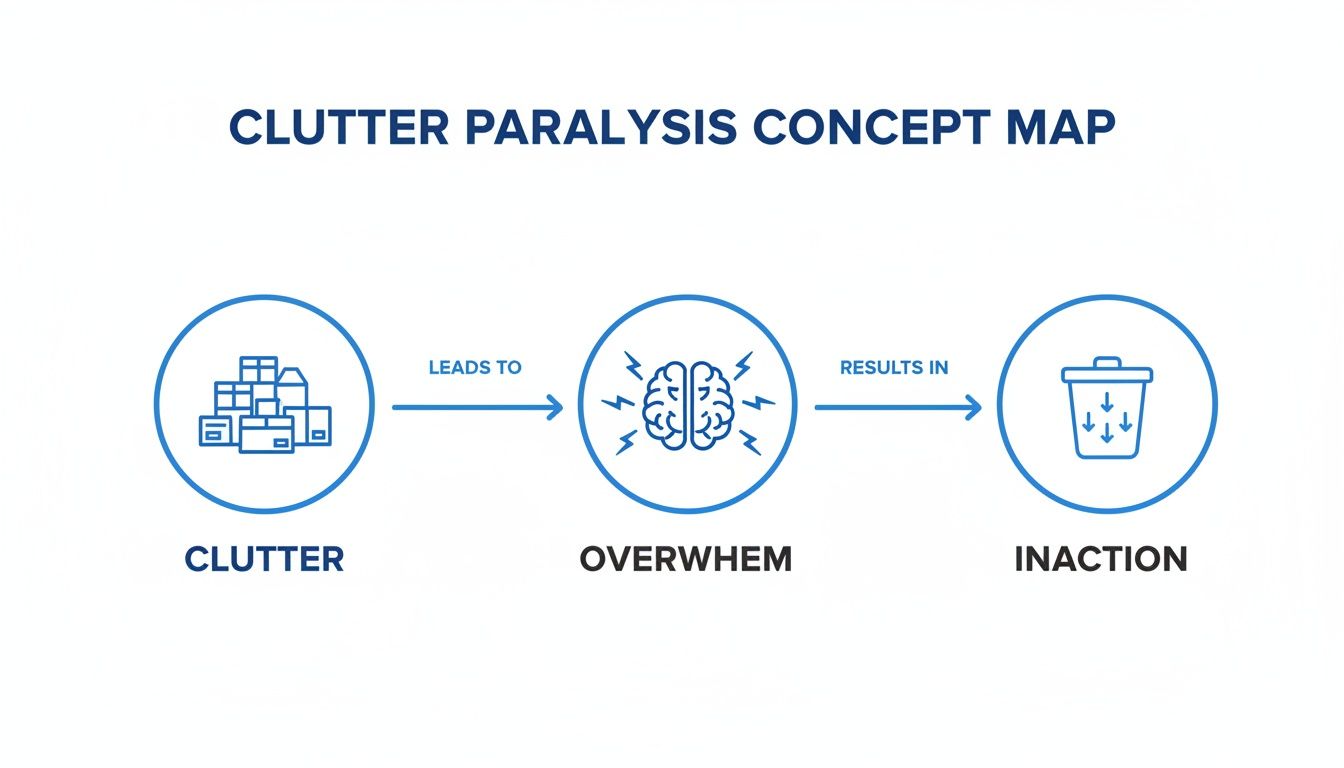
A good app intercepts this cycle. It breaks it down into manageable pieces, turning that paralysis into forward motion.
To find an app that actually works, you need to look beyond simple checklists and focus on features that solve the core problems of clutter.
Essential Features in a Modern Home Organization App
This table breaks down the must-have features and explains exactly why they're so effective at breaking through the mental logjam of clutter.
| Feature | How It Helps You | Why It's a Game-Changer |
|---|---|---|
| AI Item Recognition | Instantly identifies objects with your phone's camera. | Skips the soul-crushing task of manually inventorying every single item, lowering the barrier to just getting started. |
| Decision Frameworks | Guides you with simple, psychology-based sorting methods. | Fights decision fatigue by giving you easy "wins" first (like obvious trash), building momentum for harder choices. |
| Selling & Donation Integrations | Helps you list items for sale or find local donation spots. | Solves the "what now?" problem by turning unwanted items into cash or a good deed, preventing new "to-deal-with" piles. |
| Gamification & Progress Tracking | Uses points, streaks, and visual trackers to show your progress. | Makes a tedious chore feel rewarding. Seeing how far you've come is powerful motivation to keep the momentum going. |
These features aren't just bells and whistles; they're thoughtfully designed tools that directly address the psychological hurdles of decluttering. Let's dig into what makes each one so important.
AI-Powered Item Recognition
Imagine pointing your phone at a pile of stuff and having an app instantly identify what’s there, saving you from typing it all out. This isn't science fiction anymore; it’s a core function of the best decluttering apps.
AI item recognition uses your phone's camera to identify everything from books and electronics to clothes and kitchen gadgets. This is a game-changer because it demolishes one of the biggest initial hurdles: creating an inventory. By automating this step, the app makes starting feel less like a chore and more like a simple act of discovery.
Psychology-Backed Decision Frameworks
A great app doesn't just show you a list of your things; it helps you figure out what to do with them. Look for apps that build in a psychology-backed decision framework, like a "Trash First" approach. Instead of forcing you to make a tough call on a sentimental item right away, these apps steer you toward easy wins first.
The goal here is to build momentum, not achieve perfection on day one. An app that encourages you to start with trash is using the power of quick wins to build your motivation for the tougher decisions down the road.
These frameworks slice through the paralysis by giving you a clear, simple place to begin. They reduce the mental load and make the entire project feel manageable, one small choice at a time.
Integrated Selling and Donation Tools
One of the biggest roadblocks after you've decided to get rid of something is the "what next?" phase. Items that are too valuable to just throw away often end up in a "sell pile" that quickly becomes its own new form of clutter.
The most helpful organization apps solve this with integrated selling and donation tools. Look for features like:
- Automated Listing Creation: The app can use the photo you took to generate a good title, a compelling description, and even suggest a competitive price for marketplaces like eBay.
- Donation Center Locators: For things you'd rather give away, a good app can help you find nearby donation centers and even tell you what kinds of items they accept.
This transforms the intimidating process of selling or donating into a simple, guided workflow, helping you turn clutter into cash or a good deed with way less effort.
Gamification and Progress Tracking
Let’s be real: decluttering can feel like a long, thankless slog. That's why gamification is such an incredibly powerful feature. By turning the process into a kind of game, these apps can provide the little dopamine hits you need to keep going.
Look for elements like:
- Points and Streaks: Earn points for every item you sort and build streaks for being consistent.
- Levels and Achievements: Unlock new levels or earn badges as you clear more space, giving you a tangible sense of accomplishment.
When you combine that with clear progress tracking—like before-and-after photos or stats showing how many items you've processed—your hard work becomes visible and rewarding. Seeing how far you've come is often the best motivation to continue.
This shift toward smarter home management isn't a niche trend. The global smart home market is projected to hit about USD 230 billion by 2025, proving that people want and expect technology to actively help them run their homes better. You can explore more about home organization trends to see how these tools are continuing to evolve.
How AI Helps You Make Decluttering Decisions
Let's talk about how artificial intelligence can turn clutter paralysis into progress. If you've ever stood in a room, completely frozen by the sheer amount of stuff, you know the real battle isn't physical. It’s mental. The smartest home organization apps now use AI to step in as your personal coach, helping you make one simple decision at a time.
Think of it like having a savvy friend who can glance at an item and immediately know what to do with it. That’s what AI does. It's a GPS for your clutter. Just like a GPS takes the stress out of navigating by giving you one turn at a time, a decluttering AI lifts the mental burden of evaluating hundreds of items by offering you a single, clear suggestion.
Breaking Through Decision Fatigue with AI
The main problem AI tackles here is decision fatigue. It cuts through the overwhelm by automating the tedious first steps and giving you a clear path forward. Instead of you having to pick up every single object, identify it, categorize it, and then agonize over its fate, the app does the heavy lifting for you.
Here’s what that looks like in action:
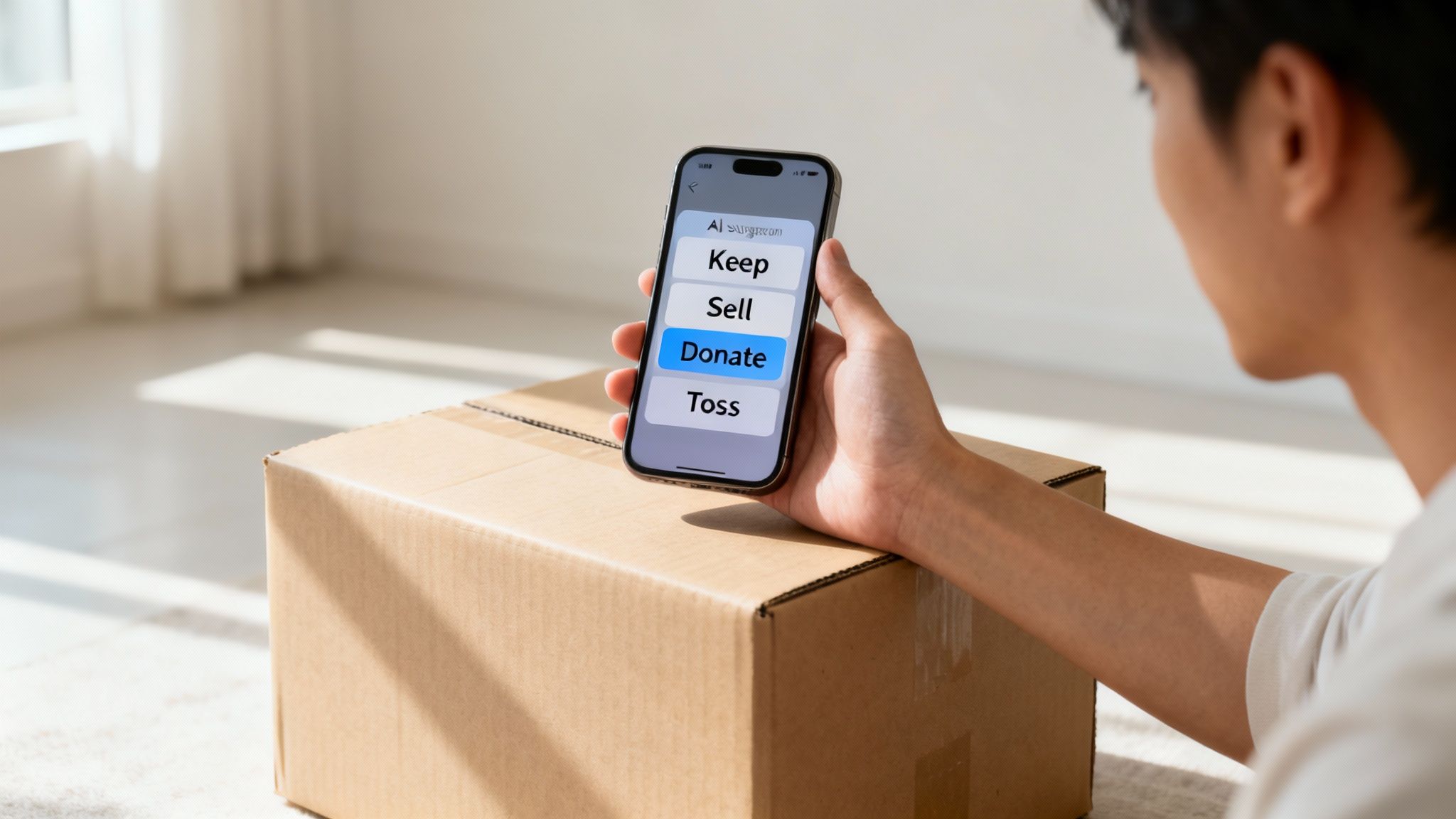
- You snap a photo. Just point your phone at that old gadget or pile of clothes.
- The AI analyzes it. It figures out what it's looking at—a book, an old electronic, a sweater.
- You get a guided choice. Based on what the item is, the app presents a logical next step: Keep, Sell, Donate, or Recycle.
This simple process is a game-changer because it breaks the cycle of feeling stuck. You're no longer facing a mountain; you're just answering one easy question. This is how you turn that feeling of being frozen into real, visible progress. If you want to dive deeper into the psychology behind this, we've explored how AI breaks the cycle of decision paralysis versus clutter-free living.
From Simple Lists to Smart Companions
This shift in technology is fundamentally changing how we approach our homes. Organization apps sit right at the intersection of two huge markets: the physical storage products we buy and the digital tools we use to track everything. The market for home inventory apps alone was valued at around USD 1.2 billion in 2023 and is projected to hit nearly USD 4.8 billion by 2032.
What does that tell us? That software is growing more than three times faster than traditional storage hardware. People are looking for smarter ways to manage what they own. The best apps are no longer just passive list-makers; they’re becoming AI-powered companions that actively guide you. You can see the full research on the growth of home organization products to get a sense of this trend.
The real power of AI in these apps isn't just about identifying a sweater. It’s about removing the mental friction that stops you from even starting. It makes the first step so easy, you can’t help but take it.
Building Momentum with Every Decision
Ultimately, AI is all about helping you build momentum. Every time you follow the app’s suggestion—tossing an expired coupon or adding a book to the "donate" pile—you score a quick win. And those quick wins are everything.
This taps directly into psychology-backed decluttering. These quick victories trigger a little release of dopamine in your brain, the chemical tied to reward and motivation. Suddenly, the process feels less like a chore and more like a game you’re winning. One good decision makes the next one easier, creating a positive feedback loop that turns a few minutes of effort into a clear shelf, then a clean closet, and eventually, a more peaceful home.
Choosing the Right App for Your Decluttering Style
Why are you really decluttering? The answer to that question is everything. The perfect home organization app for someone downsizing for a big move is going to be completely different from what a budding reseller needs. There’s no magic bullet app that works for everyone.
The trick is to match an app's core features to your personal goals and challenges. When you find that perfect fit, what felt like an impossible chore starts to feel like a series of small, satisfying wins. Let's figure out which approach is right for you.
For the Overwhelmed Homeowner
If you’re staring at years of accumulated stuff and just feel stuck, you’re experiencing clutter paralysis. The last thing you need is an app with a million complicated features. Your mission is to find something that can act as a gentle guide to help you build momentum.
Look for tools that are grounded in psychology, like those using a "Trash First" method. These apps don't force you into tough emotional decisions right away. Instead, they point you toward quick wins—like bagging up obvious trash—to build your confidence and make the whole process feel less daunting. It's all about making progress, not achieving perfection on day one.
For Those Moving or Downsizing
Moving puts a hard deadline on your decluttering. There's simply no time for a slow, sentimental journey through your possessions. You need to be fast, efficient, and crystal clear about what’s coming with you.
The best apps for this situation are all about logistics. You'll want:
- Rapid Sorting Features: Tools that let you quickly tag items as "Keep," "Move," "Sell," or "Donate."
- Inventory Management: A way to create a digital list of everything going into boxes or storage, complete with photos so you know what's where.
- Checklist Integration: Built-in trackers for all the other moving tasks, from packing the kitchen to calling the utility companies.
Think of these apps less as a therapist and more as a project manager for your move. They cut through the noise so you can make practical decisions when the clock is ticking.
For the Side Hustler
See those piles of unused gadgets and clothes as potential income? Then your perfect app is one that helps you sell things without all the hassle. Manually creating listings on eBay or Facebook Marketplace for dozens of items can be just as draining as the decluttering itself. A great app automates that work.
Focus on apps with powerful selling integrations that can:
- Use AI to generate catchy titles and detailed descriptions.
- Suggest a fair market price based on real-time data.
- Create pre-filled drafts right inside your seller account.
This transforms the tedious job of listing items into a smooth, simple workflow. You get to turn your clutter into cash with a fraction of the effort.
For ADHD or Executive Function Challenges
When you struggle with executive function, just getting started—and staying on task—is the real battle. The best apps for this scenario are designed to provide the external structure and motivation that traditional methods just don't offer.
Gamification is non-negotiable. Features like points, streaks, levels, and badges provide the immediate, positive feedback needed to stay engaged and motivated.
These apps turn a boring chore into something that feels more like a game. Every small decision provides a little dopamine hit, giving you the reinforcement needed to maintain focus and build momentum over time. There's a huge demand for this kind of support; residential organizing is projected to make up 38.1% of service revenues, with individual clients representing 46.1% of the market. Apps that can replicate that one-on-one guidance are a game-changer.
If you're on a tight budget, don't worry. We've also put together a guide on the best free organization apps to help you get started without spending a dime.
Your First Steps to Making Progress Today
It's one thing to read about decluttering, but it’s another thing entirely to actually start. This is where most of us get stuck, staring at the mess and feeling completely overwhelmed. But it doesn't have to be that way. You can start turning that paralysis into real, tangible progress right now with a simple, proven plan.
We’re not talking about overhauling your entire house this weekend. The goal here is to build momentum, not achieve perfection overnight. This plan is all about scoring a quick, satisfying win that gives you the energy and confidence to keep going.
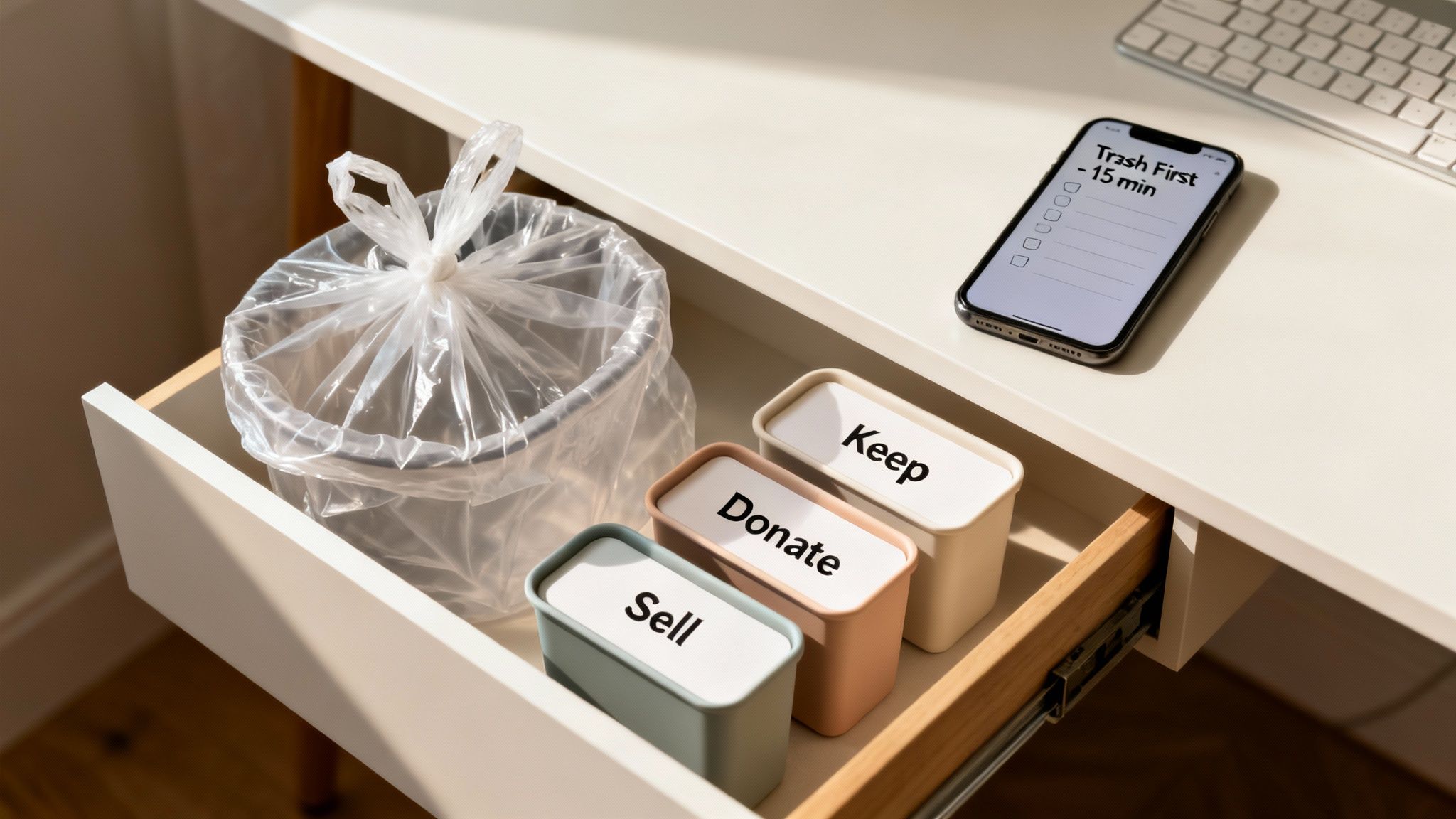
The Action Plan: Turn Overwhelm into Action
Forget blocking out an entire Saturday. All you really need is 15 minutes and the right mindset. We're going to use the "Trash First" method, a simple technique designed to give your brain the easy wins it craves to stay motivated.
Here’s your three-step plan to finally get the ball rolling today:
Step 1: Pick One Small, Contained Area
This is the most important part, so don't skip it. Forget the garage, the attic, or even a whole room. Your mission is to pick a target so small you almost can't fail.
Think about places like:
- A single junk drawer in the kitchen.
- That one mystery cardboard box that's been sitting in the corner for years.
- Just one small section of your bathroom counter.
- The glove compartment in your car.
By choosing a tiny, contained space, you’re making the task feel finite. You’re telling your brain, "This is all we have to do right now," which instantly makes it feel less daunting.
Step 2: Focus Only on Obvious Trash
Okay, you’ve got your target. Now, your only job is to find what is obviously, without a doubt, trash or recycling. We are not making any hard decisions here. Don’t ask yourself if something sparks joy or if you might need it "someday."
Your only question should be: "Is this actually trash?" Think expired coupons, old receipts, broken pens, dried-up markers, or empty product packaging.
This is the heart of the "Trash First" method. Every piece of junk you toss is a quick win. It’s a small victory that proves you can do this, clearing both physical and mental space to build momentum for the tougher decisions later.
Step 3: Acknowledge and Celebrate Your Progress
When your 15 minutes are up (or you've cleared out the obvious trash), just stop. Seriously. Take a second to look at what you’ve accomplished. You took a cluttered space and made it objectively better.
This isn't about finishing the whole project; it's about proving to yourself that you can start. That little pile of trash you've collected is visible proof that you've turned a feeling of overwhelm into concrete action. You’ve broken through the paralysis.
Do this for just 15 minutes a day, and you'll start building a real habit. You're training your brain to see decluttering not as some insurmountable mountain, but as a series of small, manageable steps. This is exactly how you start reclaiming your space, one junk drawer at a time.
Common Questions About Home Organization Apps
We get a lot of questions from people who are curious but maybe a little skeptical about using an app to organize their home. Let's tackle some of the most common ones we hear.
Are These Apps Really Better Than Just Making a To-Do List?
It’s a fair question. While a to-do list is great for tracking simple tasks, it falls short when it comes to the real villain of clutter: decision fatigue. Your list might say "clean out the closet," but it offers zero help when you’re standing in front of 50 different things, completely paralyzed about where to even start.
That's where a great organization app steps in. Think of it less like a list and more like a partner. It uses smart tech to identify your stuff and proven methods (like the "Trash First" approach) to suggest the very next thing you should do. This guidance is what breaks the cycle of overwhelm.
A to-do list is like having a map. An app with a decision framework is like a GPS giving you one simple, turn-by-turn direction at a time. It takes the mental load off of figuring out the entire route yourself.
How Much Time Do I Actually Need to See Results?
This is the best part: you don't need to clear your entire weekend. The whole philosophy here is progress over perfection. Committing just 15-20 minutes a day is a surprisingly powerful way to build momentum without burning yourself out.
Focus on one small, manageable space—a single shelf in the pantry, one junk drawer, or a single box from the garage. An app makes these micro-sessions incredibly productive because it slashes the time you'd normally spend staring and wondering what to do. You can jump right in and make confident choices almost immediately.
What if I Want to Sell My Stuff but It Feels Like Too Much Work?
This is a huge one. For so many people, the thought of listing things online is so daunting that they just… don't. The "to-sell" pile quickly becomes just another pile of clutter.
The best apps are designed to solve this exact problem. Look for one with built-in selling tools that streamline the whole process.
- Spotting Value: The app can help you identify items that are actually worth selling.
- Listing Help: It can suggest a good title, write a compelling description, and even recommend a price.
- Simple Steps: What once felt like a complicated chore becomes a guided, step-by-step workflow that turns your clutter into cash.
Can an App Really Help Me Deal with Sentimental Items?
Absolutely. We all know that parting with sentimental items is an emotional process, not a logical one. A good app understands this and doesn't just force you into a "keep" or "toss" box.
Instead, many offer a "Digital Memory" feature. This lets you capture a photo of the item and write down the story behind it, preserving the memory and honoring its meaning without having to keep the physical object. It’s a compassionate middle ground that helps you let go and reclaim your space.
Ready to turn clutter paralysis into progress? DeclutterNow uses psychology-backed methods and AI to guide you through every decision, starting with the easiest wins to build momentum.
Try DeclutterNow free → https://app.declutternow.ai