
If you've ever felt completely frozen, unable to make a decision when faced with a mountain of clutter, I want you to know one thing: it's not your fault. That feeling of being stuck isn't laziness or a lack of willpower. It's a real, predictable brain response called analysis paralysis, and it’s the key to understanding why you can’t seem to get started.
What's Really Going On? The Science Behind Clutter Paralysis
Have you ever stared at a cluttered room, or even just one of those mystery boxes that's been sitting in the garage for years, and felt your brain just… shut down? That’s clutter paralysis. It's a specific, and frankly exhausting, form of analysis paralysis where every single item triggers a storm of decisions.
Should I keep it? Sell it? Donate it? Where does it even belong? Who would want this? Each question multiplies, and the mental load becomes crushing.
I know this feeling well. For years, I had boxes sitting for years that hadn't moved. I realized the classic decluttering advice—asking emotionally charged questions like "Does this spark joy?"—was actually making things worse. My brain was already in overdrive; it didn't need more complex problems to solve. It's not laziness – it's decision fatigue.
The Real Culprit: Decision Fatigue
Think of your ability to make decisions like a muscle. It gets tired. Psychologists call this decision fatigue. Every choice you make throughout the day, from what to wear to what to eat, slowly drains your mental energy.
When you turn to a cluttered space, you’re not making just one decision. You’re facing hundreds, maybe even thousands, of them. The sheer volume is staggering. Your brain, in an effort to conserve what little energy it has left, hits the emergency brake. It defaults to the easiest option: doing nothing at all. That's why those boxes are sitting for years.
Why It’s Not Just You
This is an incredibly common experience. The feeling of being overwhelmed can apply to anything from piles of paper to digital junk. That old server gathering dust in the storage closet isn't just an eyesore; it's another set of decisions you're putting off, feeding the paralysis.
The numbers back this up. Research shows that a staggering 85% of people report feeling distressed when faced with too many choices. When you realize the average home can contain over 300,000 items, it's no surprise so many of us get stuck in a cycle of procrastination.
It's not about your character. It's a simple mismatch between your brain's processing power and the overwhelming number of decisions clutter throws at you.
Getting this is the first real step forward. It moves the conversation away from self-blame and toward finding a smarter strategy—one that works with your brain's limits, not against them. If you want to dive deeper into this skill, our guide on how to make decisions faster is a great next step.
So much of getting unstuck comes down to shifting your internal monologue. It's about moving from a mindset that fosters paralysis to one that builds momentum.
Here’s a look at how those two mindsets stack up.
The Paralysis Trap vs The Momentum Mindset
| The Paralysis Trap (What Keeps You Stuck) | The Momentum Mindset (How to Get Unstuck) |
|---|---|
| "I have to get this perfectly organized." | "Progress over perfection. I'll just start." |
| "I don't know where to begin, so I won't." | "I'll start with this one small corner for 10 minutes." |
| "What if I need this someday?" | "What is this item's job? Is it doing it right now?" |
| "This is too emotionally overwhelming to deal with." | "I can handle this one item. The emotions will pass." |
| "I'm so disorganized." | "My past habits don't define my future actions." |
Recognizing which column you're living in is half the battle. The goal isn't to instantly jump from one side to the other, but to consciously choose thoughts from the "Momentum Mindset" column, one quick win at a time.
Start With Trash to Build Real Momentum
When you're staring at a mountain of stuff, completely paralyzed by decisions, the last thing your brain can handle is a big, emotionally loaded question. This is precisely why the common advice from people like Marie Kondo to "start with 'does this spark joy?'" so often backfires spectacularly. If you really want to break through that feeling of being stuck, you need a smarter entry point—one that gets you moving from the very first minute.
I call it the "Trash First" method, and it's dead simple. We don't start with 'does this spark joy?' – we start with 'is this actually trash?' Walk into a room and ignore everything except the most obvious, no-brainer trash. I'm talking about empty Amazon boxes, junk mail, expired coupons, and old receipts. These things require zero emotional bandwidth and almost no thought. That dried-up pen on the counter? Trash. Last week's grocery list? Gone.
There's some real psychology at play here. Every time you make one of these tiny, successful decisions, your brain gets a small hit of dopamine. Instead of draining your willpower, these quick wins actually start to recharge your mental battery. You’re building a positive feedback loop that makes the next decision feel just a little bit easier than the last. Start with trash, build momentum.
Why Quick Wins Matter So Much
Let's be clear: starting with trash isn't about making a huge dent in the clutter on day one. It’s about shifting your mental state from "frozen" to "in motion." You're proving to yourself that you can make decisions and take action, which is a powerful antidote to that feeling of being completely overwhelmed.
Without this small first step, it's easy to get trapped in the classic clutter paralysis cycle.
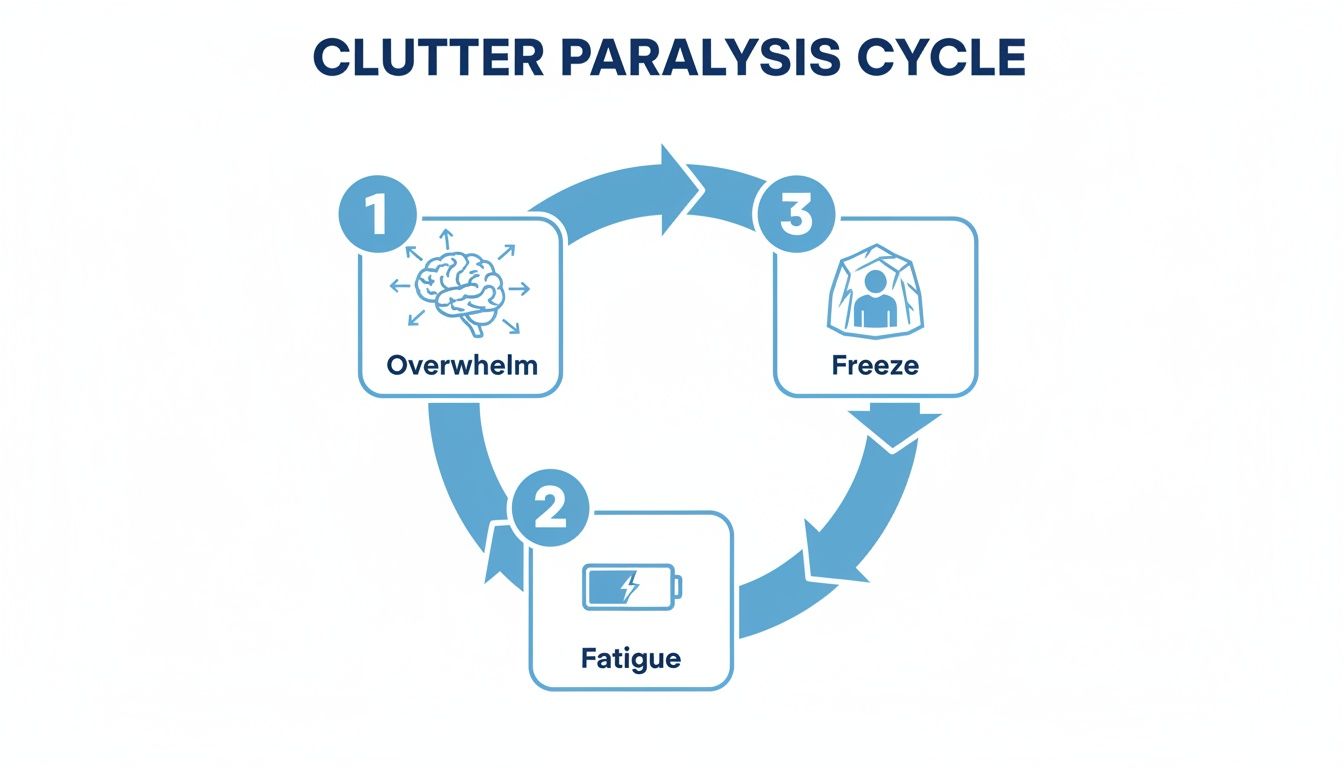
As you can see, the initial overwhelm leads straight to mental fatigue, which causes the freeze. By grabbing a trash bag and just looking for garbage, you break the cycle before it even starts. You're not trying to solve the entire mess at once; you're just taking the smallest possible step to create forward motion. This mindset is a cornerstone of decluttering, and if you're interested in applying it more broadly, you might find some great ideas in our guide on minimalist lifestyle tips.
Build momentum, not perfection. Your goal isn't to achieve a perfectly organized space in one go. It's simply to build enough momentum to make the next decision, and then the one after that.
Instead of facing a hundred complex choices about what to keep, donate, or sell, you're only asking one simple question: "Is this definitely trash?" It's a powerful way to reframe an impossible task into a series of small, achievable wins, giving you the energy you need to finally make progress.
Simplify Your Decisions Before You Start
One of the biggest reasons we get stuck in a decluttering project is that we try to make complicated decisions on the fly. It's a classic mistake. You pick up an old gadget or a sweater you haven't worn in years and ask yourself vague, open-ended questions like, "Will I ever need this?" or "Is this important?"
That kind of questioning is a one-way ticket to analysis paralysis. Your brain immediately starts spinning, trying to predict every possible future scenario where that item might come in handy. It's exhausting, and it’s why so many projects stall before they even really begin.
The fix? Stop making it up as you go. Before you even touch a single item, you need to create a simple, non-negotiable set of rules for the day. Think of it as creating a decision-making shortcut for your brain. By setting clear boundaries upfront, you take the guesswork out of the equation and dramatically lower the mental energy each choice costs you.
From Vague Questions to Concrete Rules
The trick is to swap out those fuzzy, abstract questions for concrete, yes-or-no criteria. This simple shift turns what feels like a heavy emotional debate into a quick, factual check.
Here are a few examples of how to reframe your thinking:
Instead of: "Will I ever use this again?"
- Ask: "Have I used this in the last 12 months?"
Instead of: "Do I like this?"
- Ask: "If I saw this in a store today, would I buy it?"
Instead of: "Is this still good?"
- Ask: "Is this item broken, expired, or stained beyond repair?"
This isn't just a theory; it works. This strategy is all about shutting down the endless "what if" scenarios that keep those boxes of clutter gathering dust for years. In fact, without pre-set rules, people can waste up to 40% of their time just agonizing over their choices. That’s a huge amount of stalled progress.
Experts I’ve followed for years suggest setting clear guidelines—like only keeping items you have 80% confidence you'll use—can slash that analysis time. You can learn more about how to avoid analysis paralysis with a few simple rules from researchers who study this stuff.
Your goal isn't to predict the future with perfect accuracy. It's to make a good-enough decision right now so you can finally make progress and move forward.
This kind of pre-planning is exactly how a tool like DeclutterNow’s AI can help break through that decision fatigue. It doesn't get tangled up in the emotion of it all; it just applies a simple, logical framework to guide you toward a quick action.
Whether you create your own rules or use a guided system, you're offloading the heavy mental lifting. You're not just decluttering your stuff; you're decluttering the decision-making process itself.
Turn Decluttering Into a Game You Can Actually Win
Let's be honest: motivation is a finite resource. When it comes to a big project like decluttering, that initial burst of "I'm going to get this done!" energy can fizzle out fast, leaving you stuck staring at a pile of stuff, paralyzed by where to even start.
The secret to keeping the momentum isn't about powering through with sheer willpower. It's about tricking your brain into having fun. This is where a little gamification can completely change the dynamic. By turning a monotonous chore into a series of mini-challenges, you tap into your brain's reward system, making it easier to keep going.
Create Your Own Decluttering Game
You don't need some elaborate setup to make this work. The idea is simple: inject a bit of structure, a dash of urgency, and a clear sense of accomplishment into the process.
Here are a few games I've used myself that work wonders:
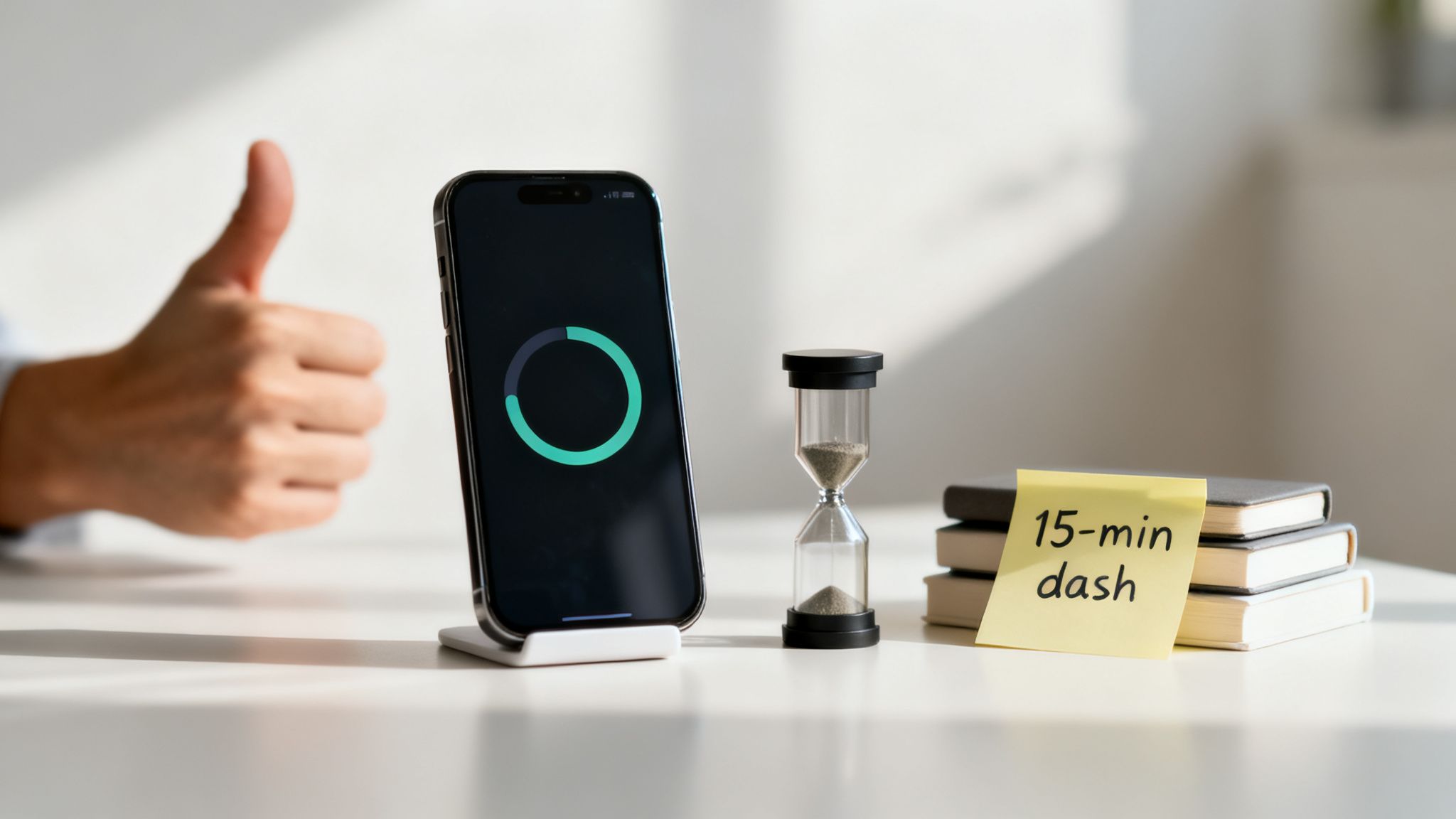
- The 15-Minute Trash Dash: This is my go-to when I feel completely stuck. I set a timer for just 15 minutes and race around a room with a trash bag. The only goal is to find things to throw away. It forces you to make snap decisions without getting bogged down.
- Beat the Clock: Pick one tiny, manageable area—a single kitchen drawer, one shelf on the bookcase. Give yourself a time estimate, set a timer, and see if you can beat it. It adds a little competitive fun against yourself.
- Set a Personal Reward: Link your progress to something you actually enjoy. Maybe clearing out five boxes means you get to order takeout from your favorite spot, or finishing the closet earns you an hour of guilt-free Netflix.
Why This Psychology-Backed Approach Works
These little games aren't just silly distractions; they are a direct assault on the mechanics of paralysis. By setting artificial deadlines and ridiculously small goals, you bypass your brain's tendency to get lost in endless "what if" loops. You're no longer deciding the final, permanent fate of every single item you own. You’re just trying to win the next five minutes.
Tangible feedback is crucial for breaking through the feeling that you're making no progress. Seeing a point total go up or a streak continue provides the concrete evidence your brain needs to stay motivated.
This is the very reason we designed DeclutterNow with gamified elements built right in. As you sort your items by snapping photos, you earn points, build streaks, and unlock achievements. The app’s progress trackers and satisfying before-and-after photos give you that instant feedback loop, transforming a draining task into something genuinely rewarding. When you can actually see the progress, it's one of the most powerful tools for learning how to overcome analysis paralysis and finally get unstuck.
Use Technology to Outsmart Your Indecision
Trying to make tough decluttering decisions all by yourself is a fast track to paralysis. When you're emotionally tied to an object or just plain tired, making a rational choice can feel impossible. This is the perfect moment to bring in some backup. Technology can act as a neutral, objective partner, helping you slice right through the indecision. AI breaks through decision fatigue.
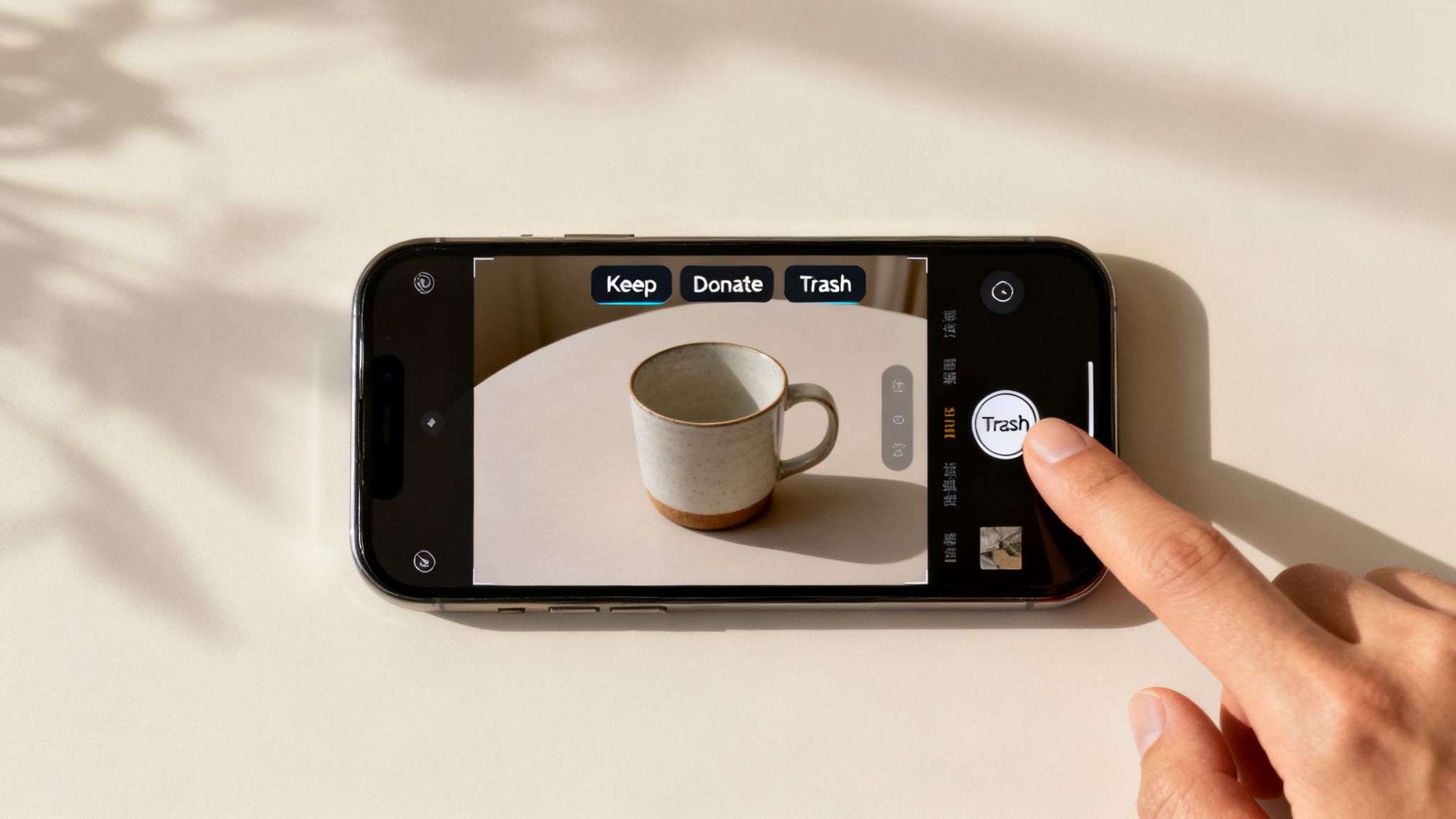
Think of it as offloading the mental work to a capable assistant. That’s exactly what a tool like DeclutterNow does. You just snap a picture of an item, and its AI gives you an instant sorting suggestion. It takes the emotional weight out of the equation and gives you a concrete starting point.
This isn't just a household hack; it's a strategy used by successful businesses. Companies drowning in data often see decision-making slow down by 30-50%. But when they use the right tools to highlight what's important, they can make choices 50% faster. You can bring that same efficiency into your home, turning overwhelming chaos into manageable clarity.
Turn Clutter Into Cash Without the Headache
One of the biggest roadblocks I see is the thought of selling unwanted stuff. It just feels like so much work. You have to figure out a price, write a good description, and then manage the listing. It’s no wonder the "to-sell" pile often sits in a corner gathering dust for years.
This is another area where a smart assistant can completely change the game. For example, DeclutterNow has an eBay assistant built right in that makes the whole process painless.
- It helps you spot the items actually worth selling.
- It writes a title and description for you that will attract buyers.
- It even suggests a fair price, so you don't have to guess.
Suddenly, a major source of paralysis becomes a simple, even profitable, task. Similarly, this virtual staging guide shows how technology helps people visualize changes and make decisions without all the physical effort, making a complex job much easier.
Leaning on smart tools isn't a sign of weakness; it's a smarter strategy. You're outsourcing the analysis so you can focus on what matters: taking action and seeing real progress.
This kind of tech support is a fantastic way for how to overcome analysis paralysis because it gives our overwhelmed brains the structure we desperately need. Instead of being stuck in a loop of "what ifs," you get a clear path forward. It empowers you to finally make choices with confidence and take back your space. We dive deeper into this idea in our guide to the best app for home organization.
Common Decluttering Questions Answered
Even with a solid plan, it's easy to hit a wall. Certain questions and roadblocks always seem to pop up and kill your decluttering momentum. Let's tackle some of the most common sticking points I see, so you can push through when you feel stuck.
What if Every Room Feels Overwhelming?
Stop thinking about the whole room. Seriously. That’s a classic trap that leads right back to feeling paralyzed.
Your job is to shrink the task until it feels almost laughably small. Pick one single, highly visible spot—a kitchen counter, one bookshelf, or just the top of your nightstand.
Now, apply the "Trash First" method to only that tiny space. Your mission isn't to conquer the entire room; it's just to get one quick, satisfying win. This small, visible victory creates the psychological boost you need to keep going.
What if I Worry I'll Regret Getting Rid of Something?
The fear of future regret is probably the single biggest reason we hold onto clutter. It's the "just in case" voice in our heads that keeps us stuck. To get around this, you need to create a simple safety net for your brain. I call it the "maybe box."
If you're genuinely torn on an item, put it in the box. No big drama, just pop it in there.
Seal the box and write a date on it—say, six months from now. If you haven't needed or even thought about what's inside by that date, donate the entire box. Don't even open it. This little trick lets you delay the final decision, freeing you up to make progress without that immediate fear of regret paralyzing you.
Is Analysis Paralysis Related to ADHD?
Yes, there's a very strong link. For people with ADHD, analysis paralysis can be a major hurdle because of challenges with executive function—that's the brain's command center for planning, organizing, and making decisions.
The constant stream of choices involved in decluttering can be incredibly draining for an ADHD brain. This is why strategies that build in structure, deliver quick wins, and provide a little dopamine hit are so effective. A gamified, step-by-step approach isn't just a nice-to-have; it's a game-changer.
Things like breaking massive projects into tiny steps and using a timer aren't just good general advice; they're essential tools. They work with the way the ADHD brain is wired, helping to turn that feeling of being overwhelmed into focused action.
Ready to turn clutter paralysis into progress? The DeclutterNow app was built to guide you through these exact challenges with its psychology-backed, step-by-step process.