
Trying to maintain a clutterfree with kids home can feel like fighting an endless battle. Let's be honest, it often seems like toys, half-finished art projects, and outgrown clothes multiply overnight. If you're feeling overwhelmed, you're not alone. I've been there, staring at boxes that have been sitting in the garage for years, paralyzed by the sheer volume of stuff.
But here’s the good news: the goal isn't a pristine, show-home existence. It's about turning that feeling of overwhelm into action and making steady, noticeable progress. It's about momentum, not perfection.
Why Kid Clutter Causes Paralysis
You know that feeling? You walk into the playroom, see a tidal wave of toys, and just… freeze. You want to clean it up, but you're so overwhelmed you don't even know where to begin. It's not laziness—it's decision fatigue.
When every single Lego, crayon, and stuffed animal demands a decision—keep it, toss it, donate it, put it away—your brain just overloads and shuts down. This is what we call "clutter paralysis." It’s the reason those boxes of baby clothes have been sitting in the garage for five years. The sheer volume of stuff is just too much to process, so we do nothing at all. This is the very feeling I struggled with before creating DeclutterNow.
This paralysis gets so much worse when it comes to our kids' things. Every item seems to be attached to a memory or a feeling, from a smudged crayon drawing to a favorite toy that’s now broken. The classic "does this spark joy?" question falls flat when your toddler insists that everything sparks joy. We need a totally different, psychology-backed approach.
The True Cost of Clutter
This isn't just about a messy-looking house. The weight of all this stuff is very real. Did you know the average American home is filled with a mind-boggling 300,000 items? And that number skyrockets once kids enter the picture. We end up spending a shocking amount of time—some studies say a full year of our lives—just searching for things we can't find.
Starting with a solid system from day one can make a huge difference. Getting a handle on how to organize a nursery, for example, sets the stage for less chaotic years to come.
Shifting from Perfection to Progress
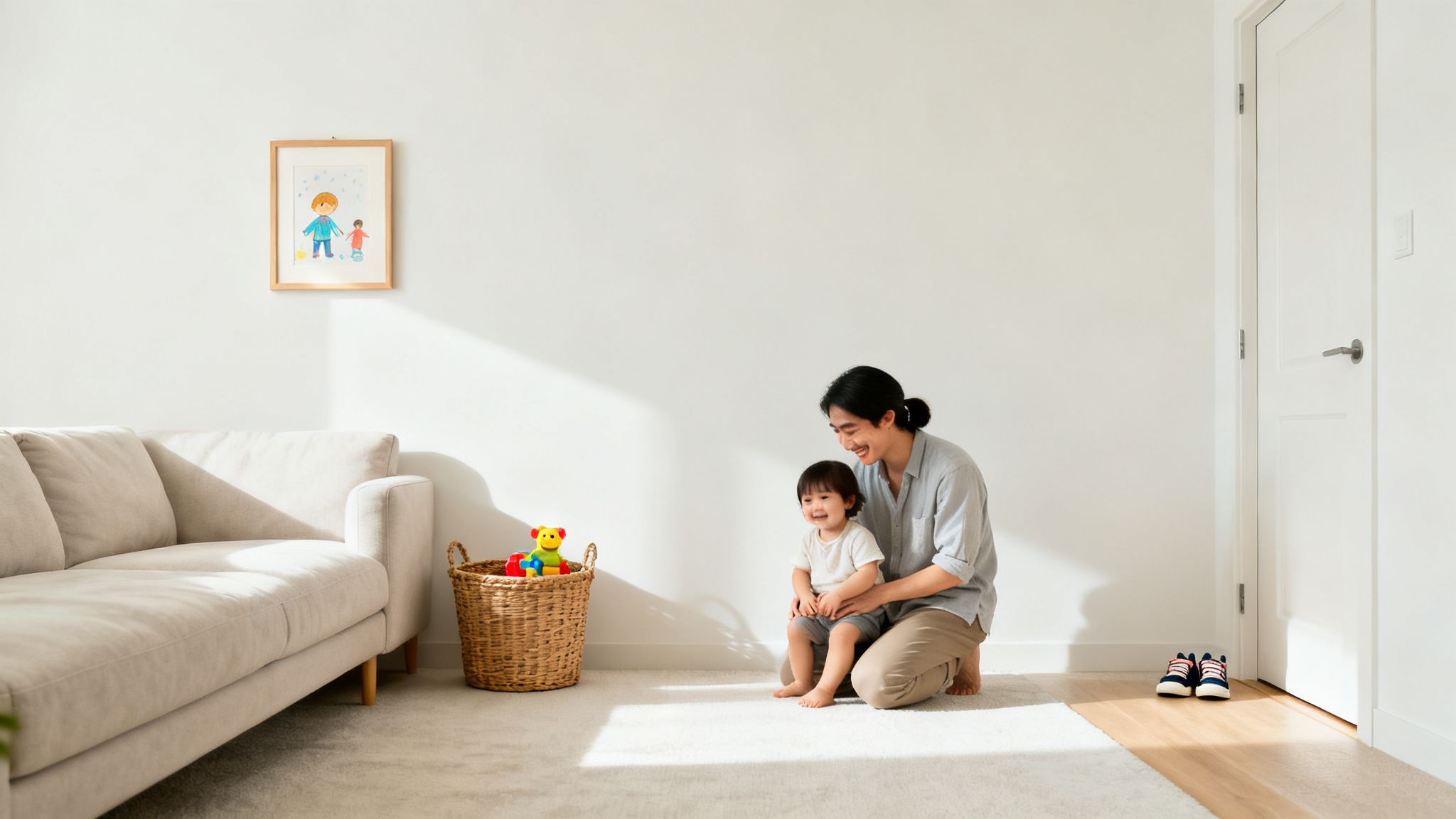
If you want to make being clutterfree with kids your new reality, the first thing you have to do is ditch the all-or-nothing thinking. The aim isn't a sterile home where nobody is allowed to make a mess. It’s a functional, peaceful space where your family can actually live and play.
Instead of trying to conquer the entire house in one weekend, the key is to build momentum. Small, consistent actions are what win this war.
The secret isn't a massive weekend purge that leaves you exhausted. It's about turning that feeling of being paralyzed by decisions into action with small, repeatable steps that add up to big changes over time.
This guide is built around a practical, psychology-backed system to get you there. We'll start with the easy wins to build your confidence and then tackle the tougher stuff. By focusing on small, forward steps, you can finally make progress and reclaim your home from the chaos of kid clutter.
Building Your Daily Clutter-Busting Habits
Let's be real: a massive weekend decluttering blitz feels great for about five minutes. Then Monday hits, and the chaos starts creeping back in. The real secret to a home that stays clutter-free with kids isn't about intensity; it's about consistency.
The goal is to weave small, manageable habits into your daily rhythm. Think of it less like a frantic purge and more like brushing your teeth—something you just do to prevent a bigger problem down the road. This approach stops the overwhelm before it can even start.
The 10-Minute Tidy
If you adopt only one new habit, make it this one. The 10-Minute Tidy is a game-changer. Every evening, right before the kids’ bedtime routine kicks off, set a timer for ten minutes. Crank up some fun music and make it a family race against the clock.
This isn't about deep cleaning or perfect organization. It’s a quick-win reset.
- Toys get tossed back into their bins.
- Books are slid back onto the shelf.
- Art supplies get corralled in their box.
- Shoes and jackets make their way back to the entryway hooks.
You will be stunned by how much you can accomplish in just ten focused minutes. This simple act resets your space, so you can wake up to a sense of calm instead of yesterday's chaos.
Adopt the One-In, One-Out Rule
Clutter is sneaky. It doesn't arrive all at once; it accumulates one little thing at a time. The One-In, One-Out Rule is your best defense. For every new item that comes through the door—a toy, a book, a shirt—something similar has to leave. This simple exchange maintains balance and forces you to be more intentional about what you bring into your home in the first place.
This rule is a lifesaver after birthdays and holidays. Before the new gifts are even opened, sit down with your child and pick out a few toys they've outgrown to donate. It's a fantastic way to teach them about generosity while keeping their space from being completely overrun.
Teaching Toddlers Simple Systems
Even the smallest members of the family can help. The key is to keep it incredibly simple and consistent. You don't need elaborate chore charts for a two-year-old.
Instead, use clear, simple phrases like, "Time to say bye-bye to the blocks! Let's put them in their red house." As you say it, physically guide their hands to the bin. It's all about repetition. Do this enough, and it will become their normal.
Building these habits is a process, but the daily payoff is huge. If you're looking for more ways to keep things on track, check out our guide on the best home organization apps—sometimes a little tech support can make all the difference.
Implementing Smart Toy Storage and Rotation
Let's be honest: toys are usually the biggest culprit behind that feeling of being completely overwhelmed by clutter. If you're tired of navigating a sea of plastic, you're not alone. But instead of just tidying up the same mess day after day, you can create a system that actually works—for you and your kids.
One of the best strategies I've ever used is toy rotation. It sounds simple, but it's a game-changer. By keeping only a fraction of the toys out at any one time, you drastically reduce the visible clutter. The surprising bonus? Kids actually play better. When they aren't overwhelmed by a mountain of choices, they engage more deeply with what's in front of them, rediscovering old favorites and sparking new kinds of imaginative play.
Getting Started With Toy Rotation
Ready to dive in? The first step is to gather all the toys in one central spot. Yes, it will probably look like a toy store exploded, but trust the process. This is the only way to get a true inventory.
From there, sort everything into broad categories. This helps you see exactly what you have.
- Building Toys: Think LEGOs, Magna-Tiles, and classic wooden blocks.
- Imaginative Play: This is your home for dolls, action figures, dress-up costumes, and the play kitchen food.
- Puzzles & Games: Board games, floor puzzles, and anything that gets the brain working.
- Art & Creativity: Crayons, paint, Play-Doh, and those half-finished craft kits.
- Active Play: Balls, jump ropes, and any other indoor-friendly toys that get kids moving.
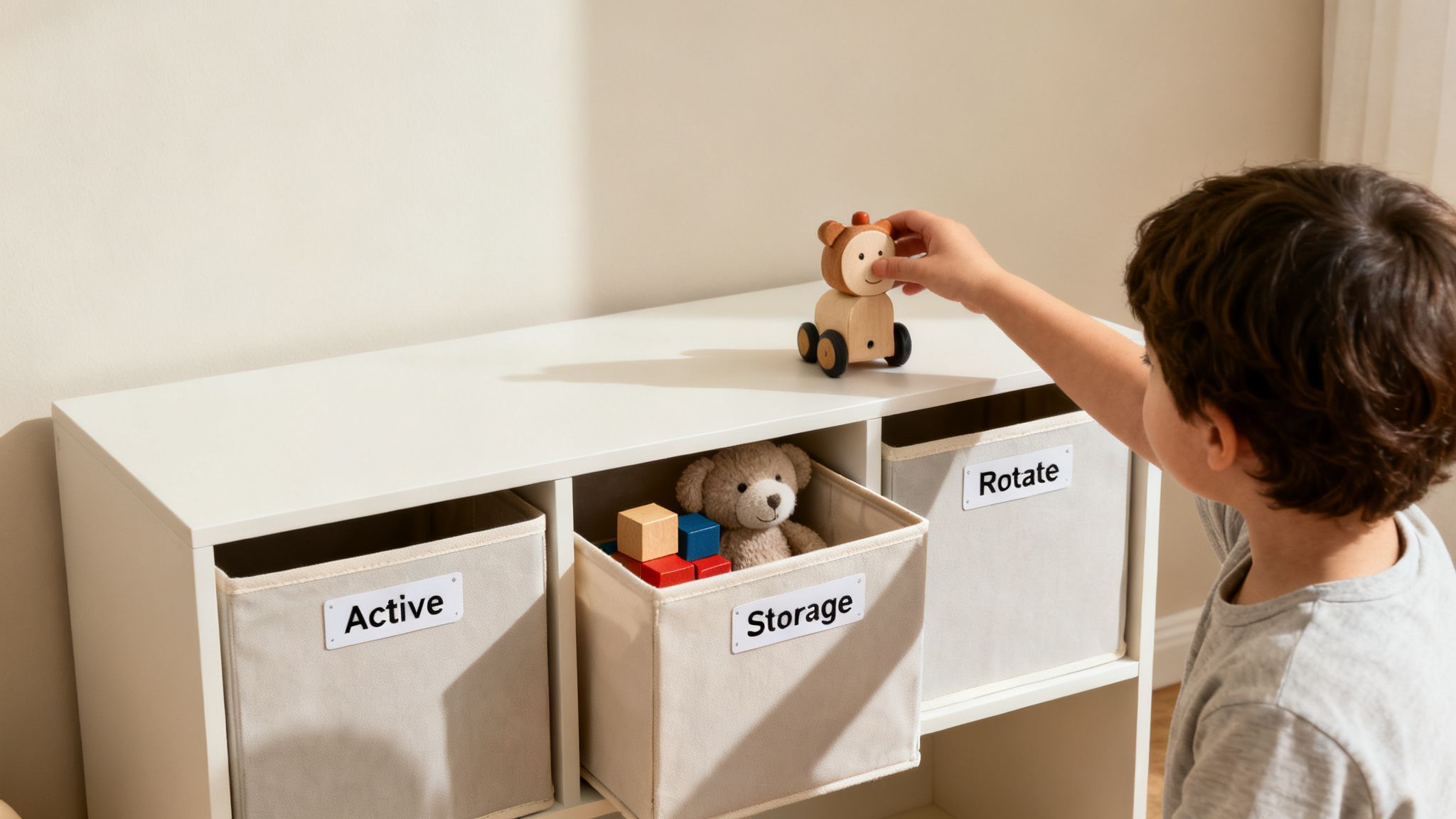
Once everything is sorted, take each category and divide the items into two or three separate groups. Keep one group out in an "active" bin where your kids can easily get to it. The rest? Pack them away in storage bins and tuck them out of sight in a closet or the garage.
Every few weeks (or whenever you sense boredom setting in), swap a storage bin for an active one. For your kids, it feels like getting brand new toys all over again.
Setting up your system doesn't have to be a massive undertaking. Here's how you can get it done in a single afternoon.
Your Toy Rotation Quick Start Guide
| Phase | Action Step | Pro Tip for Parents |
|---|---|---|
| 1. The Great Toy Round-Up | Gather every single toy from every room and pile them in a central location. | Don't panic! It gets worse before it gets better. Put on some music and grab a coffee. |
| 2. Sort & Categorize | Group toys into logical categories (building, dolls, puzzles, etc.). | Use laundry baskets or cardboard boxes to create sorting stations. Let your kids help with this part! |
| 3. Divide & Conquer | Split each category into 2-3 smaller collections. Aim for a good mix in each one. | Make sure each "active" set has a variety—a building toy, a puzzle, and an imaginative play item. |
| 4. Store & Label | Pack the "away" sets into storage bins. Label them clearly. | Opaque bins are best for "away" toys—out of sight, out of mind. Clear bins work for "active" toys. |
| 5. Set the Schedule | Decide on a rotation schedule (e.g., every 2-4 weeks) and put it on the calendar. | Don't be too rigid. The best time to rotate is when you notice your kids are getting bored with the current selection. |
Once your rotation is in motion, the right storage solutions will keep the system running smoothly.
The Container Rule and Smart Storage
You don’t need an expensive custom system. Cube shelves with fabric bins are fantastic because they make it easy for little hands to grab what they want and—more importantly—clean up on their own. And if you're tight on square footage, vertical organizers are a lifesaver.
For a little more guidance, checking out a guide to effective toys storage organizers can offer some brilliant ideas you might not have thought of.
My favorite trick for keeping toy collections from overflowing is the ‘Container Rule.’ It's simple: if a category of toys, like all the LEGOs, no longer fits in its designated container, it’s time to declutter some.
This one principle is your secret weapon against toy creep. It keeps your system manageable and teaches kids that space is finite.
This isn't about forcing your family into a minimalist lifestyle. It's about creating a sane, functional system that stops clutter before it starts. By making smart storage and rotation part of your family's rhythm, you give your kids the gift of focus and yourself the gift of a calmer, more peaceful home.
Mastering the Weekly Declutter Sprint
Even with solid daily routines, life with kids means clutter happens. Mail piles up, art projects take over the table, and stray socks seem to multiply. That’s where the Weekly Declutter Sprint comes in—it's your secret weapon for hitting the reset button.
This is a focused, 30-minute block of time where the whole family teams up to tackle the main living spaces.
Think of it less as a deep clean and more as a high-energy, focused burst to reclaim your home from the chaos of the week. When you turn it into a game, you might be surprised how quickly a dreaded chore becomes a fun family challenge.
How to Run Your Sprint
First things first, you need to pinpoint your family’s main clutter hotspots. If you're like most of us, they're probably the usual suspects:
- The Entryway: This area is a magnet for shoes, backpacks, mail, and whatever else gets dropped on the way in the door.
- The Kitchen Counter: It's the command center of the home, which means it’s also the unofficial drop-zone for everything from school permission slips to half-eaten granola bars.
- The Art Station or Play Corner: This is where creativity explodes, and often, so does the mess.
Once you know where to focus, it’s time to apply the "Trash First" methodology. This is a game-changer because it cuts right through clutter paralysis. Instead of agonizing over what to keep, you start with the no-brainers.
Give everyone a bag and send them on a mission to find obvious trash—junk mail, broken crayons, old snack wrappers, and ripped papers. Getting those quick wins right away builds dopamine-fueled momentum and makes the rest of the process feel so much more manageable.
The Hidden Financial Drain of Clutter
Beyond the mental stress, clutter can quietly drain your bank account, especially in a busy family home. It’s wild, but American families can spend up to $1,800 annually on clothes, only to toss an average of 65 pounds per person each year.
It gets worse. A shocking 23% of adults admit they’ve paid bills late because they couldn't find them in the mess. And collectively, we spend $2.7 billion a year replacing things we already own but can't find. These numbers really underscore why having systems to stay clutterfree with kids is as good for your wallet as it is for your sanity. If you're curious, you can find more stunning statistics in this eye-opening report on the simplicity habit.
The sprint isn't about getting everything perfect. It’s about restoring a sense of order so you can actually enjoy your weekend. By focusing on progress over perfection, you make maintaining a calm home feel achievable, not exhausting.
After all the trash is gone, the next step is just as simple: put away anything that has a clear "home" but was left out. This quick sort reinforces the idea that everything has its place, which makes those daily 10-minute tidy-ups a whole lot easier for everyone.
Creating a Painless Outgoing Items Workflow
Let's be honest, deciding to get rid of something is only half the battle. If you don't have a simple, automatic way to get those items out of your house, you’ll just end up swapping playroom clutter for piles of junk in the garage. A truly clutterfree with kids home depends on having a smooth exit strategy for everything you decide to part with.
This is how you avoid the dreaded "purgatory piles"—those bags and boxes that haunt your hallway for months, waiting for a trip to the donation center. It's a classic decluttering side effect that makes you feel stuck all over again. The key is to make the exit process as easy as the decision to let go.
The Power of the Designated Outbox
The single best tool I’ve found for this is the designated outbox. It can be anything—a sturdy bin, a big box, or even a heavy-duty tote bag. Just find a convenient spot for it, like in the mudroom or a closet by the door. Its job is simple: it’s the official holding pen for everything on its way out.
The rule for the family is easy to follow: once you decide something is a "go," it goes straight into the outbox. No leaving it on the stairs, no second-guessing. This little system removes a ton of decision fatigue and keeps your decluttering momentum alive. As soon as the box is full, it's time to act. No excuses.
Think of your outbox as a physical commitment. Once an item is in there, the decision is final. This stops you from re-evaluating your choices and "rescuing" things you already know you don't need.
Turning Clutter into Cash with Ease
For those items that are too nice or valuable to just donate—like that barely-used baby carrier or those designer kids' jeans—selling them online can feel like a whole other overwhelming project. Who has time to take perfect photos, write compelling descriptions, and research pricing?
This is where a little tech help can make a huge difference. AI-powered apps like DeclutterNow can take a quick photo of an outgrown snowboard or a pile of brand-name clothes and instantly whip up an optimized listing for you. AI breaks through decision fatigue by handling the hard parts. It turns a chore that used to take 20 minutes into a two-minute task, which means you're far more likely to actually do it and get some cash back. To really get into the nitty-gritty, learn more about selling unwanted items online in our detailed guide.
Make Donations a Weekly Errand
Finally, for everything else in that outbox, make the donation drop-off a non-negotiable part of your weekly routine. Just staple it onto an errand you're already running.
Maybe it's Saturday morning when you're heading to the grocery store, or on your way back from soccer practice. By "habit stacking" the drop-off with something you already do, you guarantee it actually gets done. This keeps the clutter flowing steadily out of your home for good.
Dealing with Sentimental Treasures and Making It All Stick
Let's be real for a moment. The tiny handprint art, the first pair of shoes, that worn-out stuffy they couldn't sleep without—this is where the decluttering process usually grinds to a halt. It’s not about erasing precious memories; it’s about curating them so they don't completely take over your home.
The goal here isn't ruthless minimalism. It's about being intentional. These items feel so heavy because they aren't just things. They're tangible links to a time that's already gone, and that emotional weight can be paralyzing.
How to Preserve Memories, Not Piles
One of the best ways I've found to manage the flood of sentimental items is to give them a physical boundary. A "memory box" for each child is a game-changer. I’m not talking about a giant plastic tub that gets shoved into the attic—think of a reasonably sized, maybe even beautiful, box. The rule is simple: only the absolute most treasured items get to live inside.
This hard limit forces you (and eventually, your kids) to become curators of their own childhood, making thoughtful choices about what truly represents a special moment. When the box is full, something has to go before something new comes in.
You can also get creative with how you honor these keepsakes:
- Go Digital: Take high-quality photos of that amazing finger painting or clay sculpture. You can compile them into a digital photo book that showcases years of creativity without taking up a single inch of physical space.
- Repurpose with Love: That favorite baby blanket that’s now more holes than fabric? Cut a small square from it to frame, or turn a piece into a patch for a new teddy bear. The memory is preserved in a new, more manageable form.
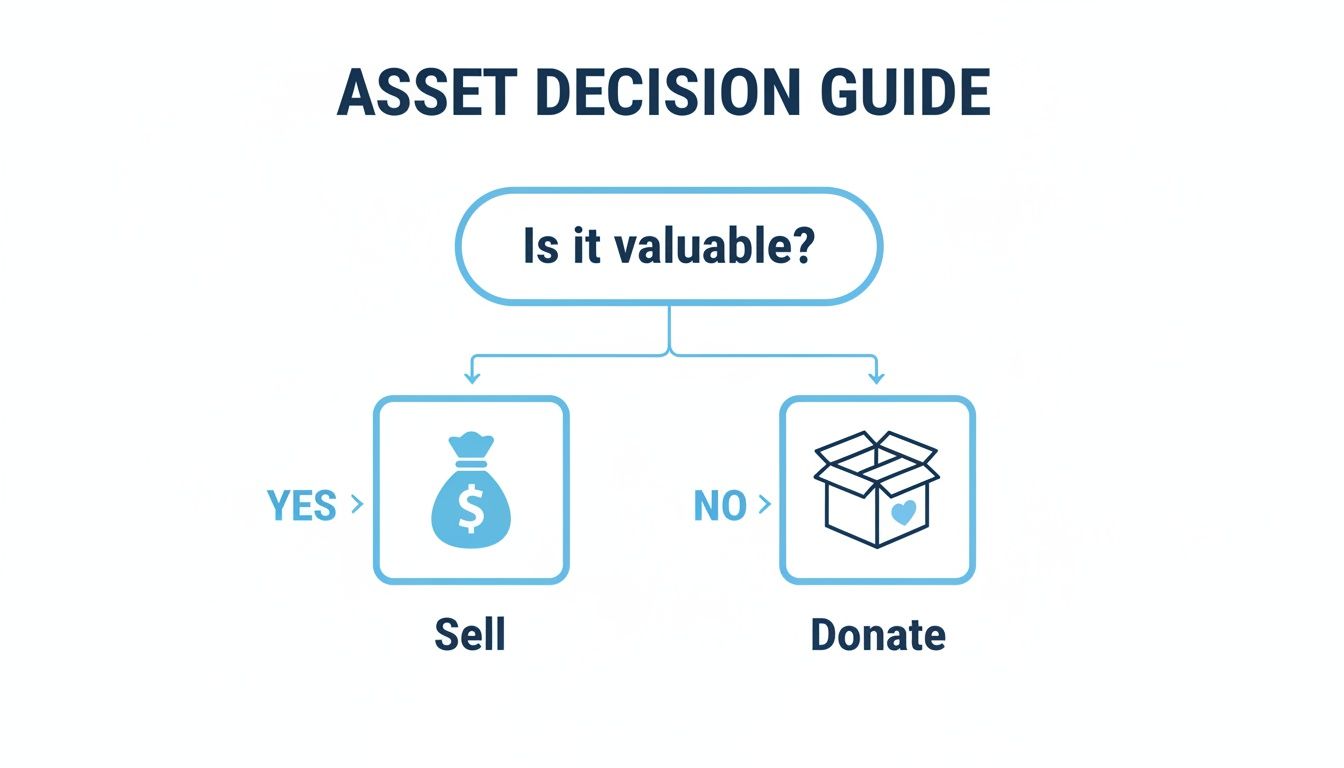
Once you've decided what to keep, you're left with the stuff that's still useful but no longer needed. A simple decision-making flow can cut right through the hesitation.
As you can see, asking one straightforward question—"Is this valuable?"—points you directly to the next step, whether that's selling or donating. No more hemming and hawing.
The secret to keeping this up is to make your new systems feel effortless. When you involve your kids, celebrate the small victories (like a clear kitchen counter!), and rely on simple rules, you build the kind of momentum that lasts.
Your Clutter-Free With Kids Questions Answered
Even with the best systems in place, life with kids throws some curveballs. Let's tackle some of the most common questions I hear from parents who are tired of fighting an uphill battle against all the stuff.
How Do I Handle Gifts From Relatives?
This is a really tricky one. Gifts are given with love, but they can quickly become a major source of clutter and overwhelm your carefully organized spaces. The secret is to get ahead of it with some gentle, proactive communication.
Well before a birthday or holiday, try sharing a list of "clutter-free" gift ideas with well-meaning family and friends.
A few ideas that always go over well:
- Experience Gifts: Think zoo passes, a museum membership, or tickets to a kids' concert. Memories over things, always.
- Consumable Gifts: You can't go wrong with fun art supplies, a cool science kit, or a subscription box tailored to their interests. They get used up and don't take up permanent residence.
- Contributions: Suggest a deposit into a savings account or a contribution toward a bigger, much-wanted item like a new bike.
By framing it this way, you're not rejecting their generosity; you're just guiding it toward things that create joy without creating clutter.
How Can I Get My Partner on Board?
It feels impossible when you and your partner aren't on the same page. The best approach I've found is to stop talking about the mess and start talking about the benefits. What will you both gain? More time for family on the weekends because you're not spending hours tidying up. A calmer, more relaxing space to unwind in after a long day.
My best tip? Start small and start together. Pick a tiny, shared space like the entryway table or one kitchen counter. Tackle it as a team using the "Trash First" method. Getting that quick, satisfying win demonstrates the immediate payoff of a clear space.
That feeling of shared success is often far more convincing than any conversation you could have. Once they experience that quick win, they’re much more likely to see the vision and get on board with the bigger picture. You're no longer just nagging; you're working together toward a more peaceful home.
Ready to turn clutter paralysis into progress? DeclutterNow uses psychology-backed AI to help you cut through decision fatigue. You don't start with "does it spark joy?"; you start with "is this trash?" to build unstoppable momentum. Finally make progress on those boxes that have been sitting for years.