
Before you can even think about how to maximize space in a small closet, let’s talk about the real reason it’s overflowing. It’s not a lack of hangers or fancy organizers. It’s that feeling of paralysis—that wave of exhaustion that hits you just from opening the door. I know that feeling well; I had boxes sitting in my garage for years because I felt too overwhelmed to even start.
Why Your Small Closet Feels So Impossible
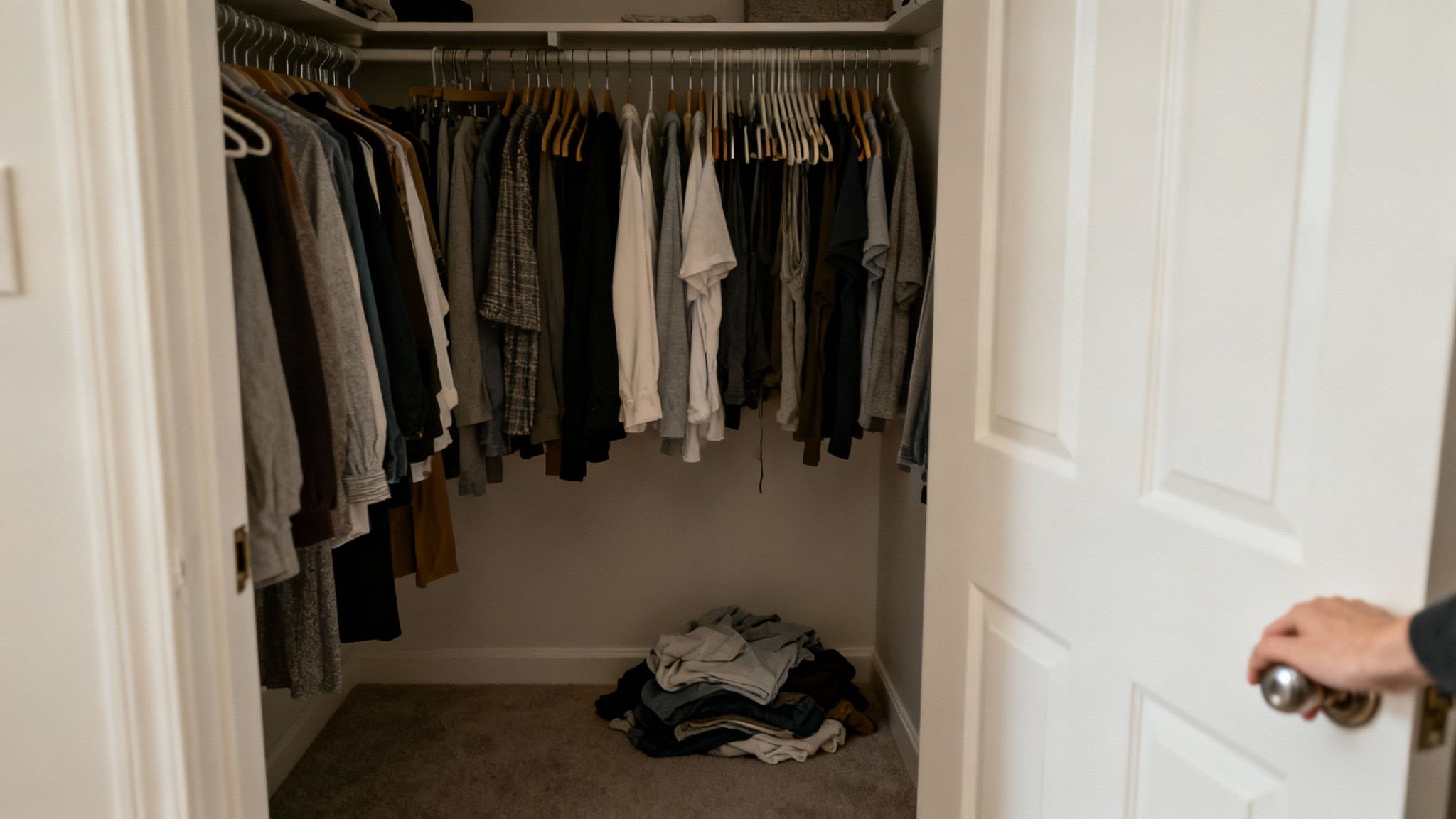
When you open that closet door, it’s not the limited square footage that makes you want to immediately shut it. It’s the sheer volume of silent decisions screaming for your attention. Every single item—that shirt you haven't worn in years, those shoes that pinch, the scarf you forgot you owned—is a choice you've been putting off.
Faced with hundreds of these choices all at once, our brains do what they’re programmed to do to protect us: they freeze. Welcome to "clutter paralysis." It’s the real reason you feel stuck, why those boxes are still sitting there years later, and why getting dressed feels like an archaeological dig every morning.
It's Not Laziness—It's Decision Fatigue
Most organizing advice fails because it skips the most important step. It tells you to buy bins and drawer dividers without addressing the psychological barrier that’s stopping you in the first place. When you’re already overwhelmed, being told to hold up every item and ask if it "sparks joy" just adds another layer of mental gymnastics to an already exhausting task.
The truth is, your brain is tired before you've even touched a single hanger. You're not disorganized; you're just experiencing classic decision fatigue. This mental roadblock is what makes a small space feel completely impossible to manage and is the first thing we need to overcome.
Key Insight: To truly maximize space in a small closet, you first have to create space by defeating the paralysis that stops you from clearing out what doesn't belong.
It’s no wonder the wardrobe organization market is exploding—it’s projected to hit USD 108 billion by 2032. We’re all looking for a solution. But the best strategies don’t start at a store; they start by making progress feel possible. Research shows that an organized closet can cut down decision fatigue by a staggering 40%, giving you back precious time and mental energy. You can dig into more of these wardrobe organization statistics to see the impact.
By shifting our focus from perfection to progress, we can finally break through that feeling of being stuck. That’s the first real step toward a closet that actually works for you.
Decluttering That Actually Builds Momentum
Before you buy a single new hanger to maximize space in a small closet, we need to do the part that feels the hardest: making some actual room. This is where most closet projects stall. Staring at a mountain of clothes and feeling the weight of a thousand decisions is the fastest way to get paralyzed and give up.
So, let's sidestep that paralysis entirely.
Forget starting with emotionally loaded questions. That kind of deep thinking has its place, but it's not where we begin. We’re going to build momentum with the easiest, most objective decision you can possibly make. It's our "Trash First" methodology.
Start with Trash, Build Momentum
Think about it. Deciding the fate of a sentimental dress is tough. But what about that single, ripped sock? The broken plastic hanger? That shopping bag from three years ago crumpled in the corner? That's easy. It's trash.
This isn't just about cleaning; it's a psychology-backed trick. Every time you make one of these quick, obvious decisions—like tossing an old receipt from a pocket—your brain gets a little hit of dopamine. That positive reinforcement makes you feel successful and motivates you to keep going. It turns a dreaded chore into a series of small, satisfying quick wins.
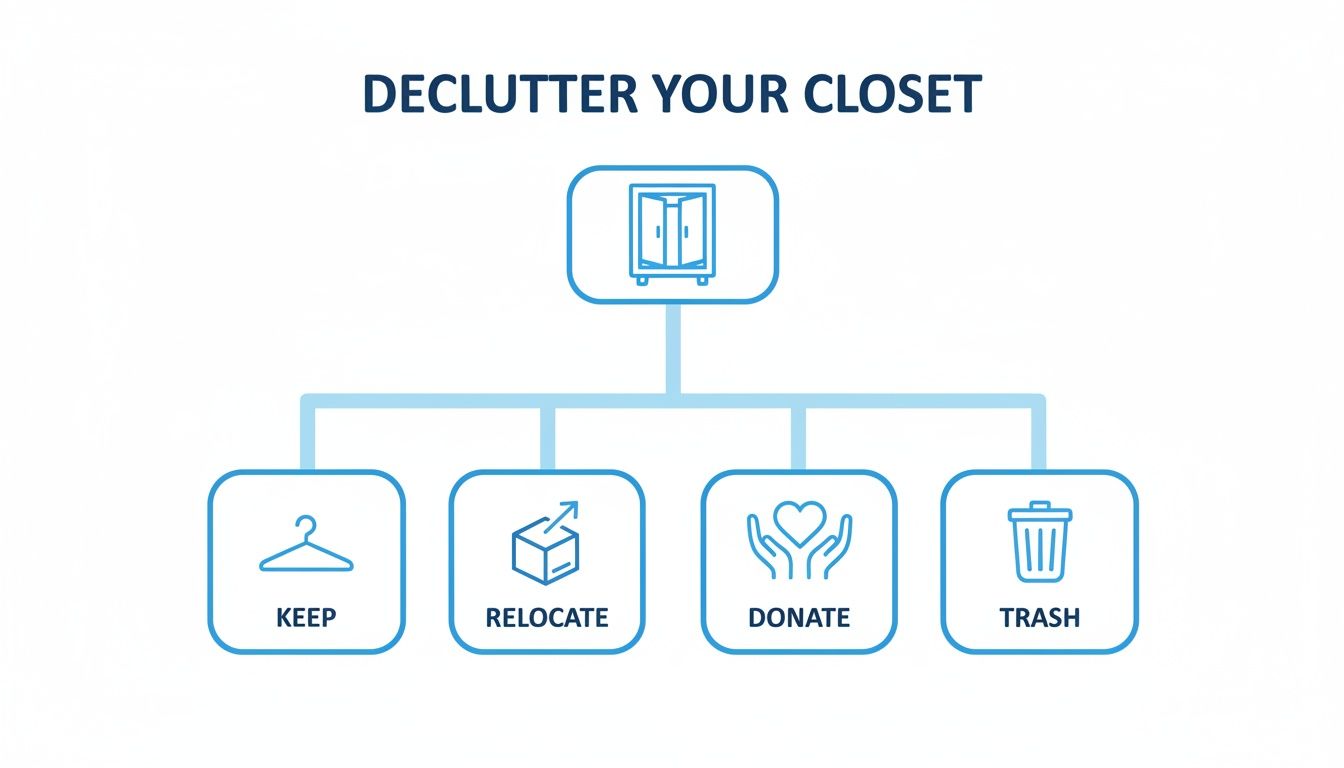
To put this into practice, we’ll use the simple but incredibly effective Four-Box Method. You don’t need anything fancy. Just grab some boxes, laundry baskets, or even just designate four different corners of your room.
The Four-Box Decluttering Method
| Category | What It Means | Examples |
|---|---|---|
| Trash | Anything broken, stained beyond repair, expired, or just plain unusable. | Ripped socks, stretched-out shirts, broken hangers, old receipts. |
| Donate/Sell | Good-condition items you no longer want, wear, or need. | That bridesmaid dress, jeans that don't fit, sweaters you never reach for. |
| Relocate | Items that simply don't belong in your closet. | Books, unopened mail, your kid's toys, spare batteries. |
| Keep | The things you genuinely love, use often, and feel great wearing. | Your favorite jacket, go-to work pants, a dress that fits perfectly. |
This system works because it isolates the hard decisions. You only have to really think about that last "Keep" pile, and by then, you've already built up a ton of momentum from all your easy wins.
Our Promise: You won't achieve a perfect, magazine-worthy closet in an hour, but you will absolutely make real, visible progress. The goal is to turn clutter paralysis into progress, one easy choice at a time.
To start, pull everything out of just one small section—maybe just the shoes on the floor. Then, sort those items into your four zones, always, always starting with the obvious trash first. This simple shift in strategy is the key to finally making progress.
It simplifies your choices down to their core, which is a fundamental part of many minimalist lifestyle tips. By focusing on clear, immediate actions, you build the confidence and energy needed to reclaim your space for good.
Redesign Your Closet Layout Like a Pro
Now that you've made some breathing room, it's time for the fun part—thinking like a space architect. The real secret to maximizing space in a small closet is to redesign its bones. Let's be honest, most closets are horribly inefficient. You usually get a single rod with a high, awkward shelf above it, which leaves a ton of wasted potential.
Your goal is to stop seeing your closet as just a box and start seeing it as a dynamic, customizable system. Take a good look at the empty space. See that giant gap between the bottom of your hanging shirts and the floor? That’s prime real estate. And what about that deep, cavernous space above the top shelf where things go to be forgotten? That’s another golden opportunity.
Go Vertical to Double Your Space
The single biggest win in any small closet comes from using its vertical space. I've seen people instantly double their hanging capacity just by installing a second rod. It's a game-changer.
- Top Rod: This is the perfect spot for your longer items—think dresses, coats, and long skirts.
- Double-Hang Rods: Use a stacked setup for all your shorter items. Put one rod up high for shirts and blouses, and add another one below it for folded pants and skirts. This one simple change reclaims all that dead air.
This kind of smart space utilization is exactly why the global closet organizers market is valued at USD 7.64 billion. In small city apartments where every inch matters, people rely on modular systems to get creative. Just by adding vertical dividers and double-hang racks, you can boost your storage capacity by 40-60% without knocking down a single wall.
Create Functional Zones
Once you’ve tackled the vertical space, start thinking in zones. Grouping similar items together doesn't just look tidier; it makes your morning routine so much faster.
Don't just store your clothes—design a system for them. Your closet should simplify your life, not complicate it. Create dedicated zones for workwear, casual clothes, and workout gear so you can grab what you need without a second thought.
Modular shelving is fantastic for zoning. It lets you create custom-sized cubbies for sweaters, jeans, and shoes, which are often the messiest culprits. I also recommend pull-out drawers for those deep, hard-to-reach corners.
The clever solutions found in smart tips for organizing small bedrooms are a huge source of inspiration here. When you adopt that same mindset of function over simple storage, you can transform even a cramped closet into a surprisingly efficient part of your home.
Find Smart Storage for Shoes and Accessories
Shoes, bags, and belts have a knack for creating chaos, even in a closet you thought was organized. To truly maximize space in a small closet, we have to get strategic with these bulky, awkwardly-shaped items. This isn't about tossing them into a generic bin; it's about giving them a dedicated home that reclaims precious real estate.
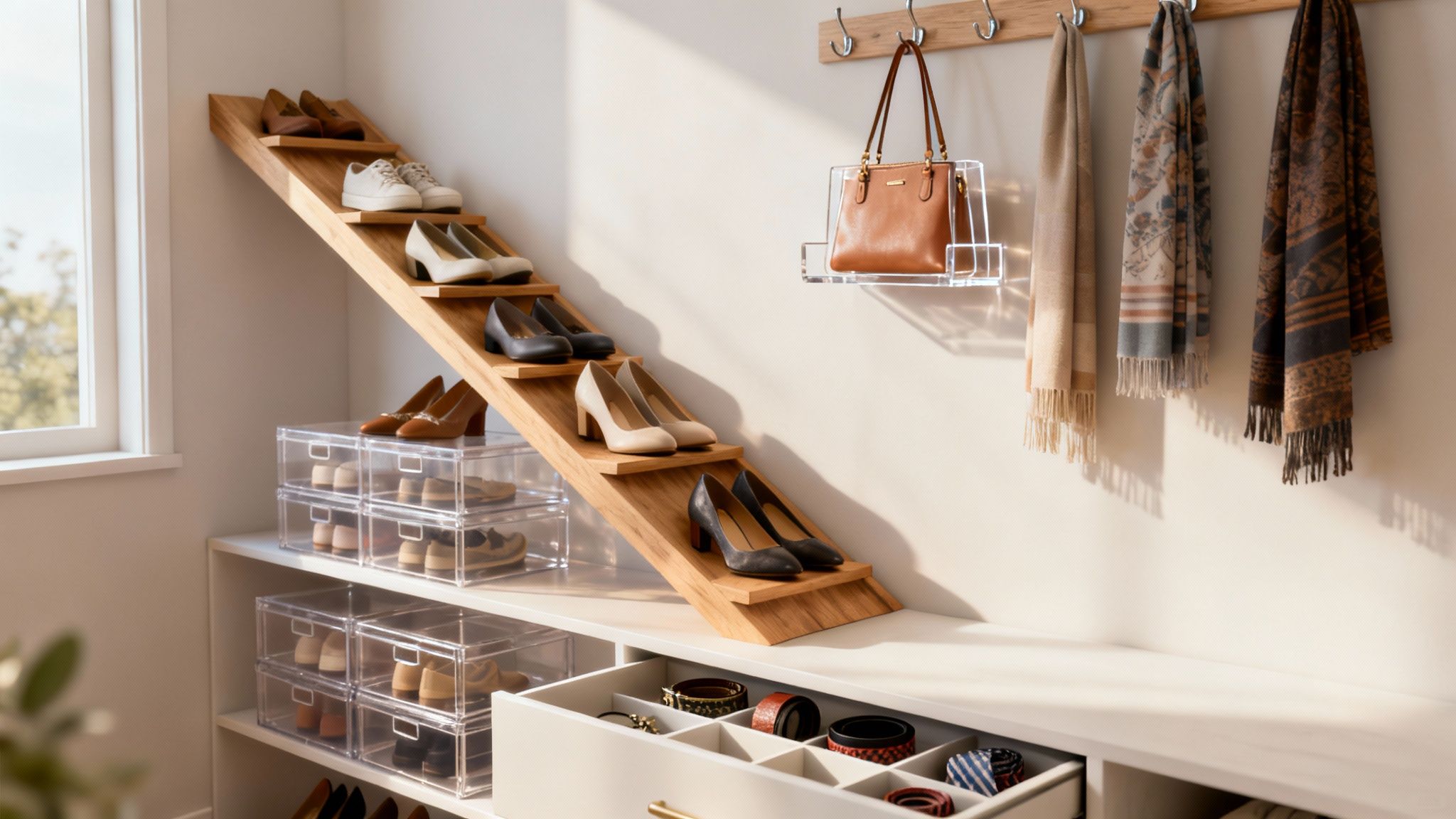
Let's be honest, the floor is usually the first place shoes land, but it's easily the worst. A jumbled pile makes finding a matching pair a frantic morning ritual and makes your whole closet feel cramped. The first rule? Get them off the ground.
Tame Your Shoe Collection
There are a few go-to solutions for shoes that I recommend all the time, each with its own perks.
- Over-the-Door Organizers: This is the MVP for using space you didn't even know you had. The clear pockets let you spot your favorite flats, sandals, or sneakers in a second.
- Clear, Stackable Shoe Boxes: If you’ve got the shelf space, these are a game-changer. They keep your shoes dust-free, you can see what’s inside, and their uniform shape is perfect for stable stacking.
- Angled Shoe Shelves: For a more custom, boutique-like feel, angled shelves display your shoes beautifully and make them easy to grab. It's a fantastic weekend DIY project that instantly elevates your closet.
There's a reason the push for custom storage is so big, especially in cities. North America now claims a 38% share of the global custom closets market. When you consider that urban closets often average just 25-35 square feet, it makes sense that people are investing in modular systems that can increase storage by 50-70%. You can dig deeper into how tailored designs are changing small spaces in this market analysis.
Smart Solutions for Accessories
Accessories like purses, scarves, and belts are just as guilty of creating clutter. A tangled drawer of belts is a source of frustration nobody needs to start their day with.
Instead of hiding them, try displaying them for easy access.
- Acrylic Dividers: Pop these onto a shelf to stand your purses upright. It helps them keep their shape and gives you a clear view of your whole collection.
- Wall-Mounted Hooks: A few simple hooks on an empty wall can hold an entire collection of scarves, hats, and necklaces, turning a cluttered mess into a functional feature wall.
- Drawer Inserts: A honeycomb-style divider is brilliant for giving every belt or tie its own little compartment. No more tangles.
One Simple Swap, Big Results: If you do only one thing, make it this: switch to slim, non-slip velvet hangers. They take up half the space of bulky plastic or wood hangers, and the uniform look alone will make your closet feel ten times more organized.
This single change can free up a surprising amount of hanging space, making room for the clothes you actually want to wear. For more practical ways to manage your wardrobe, check out our guide on essential clothes storage ideas. It’s all about finding those small, strategic upgrades that deliver a huge impact.
Build a System to Keep Your Closet Organized for Good
You’ve put in the hard work—the sorting, the purging, the redesigning. But here's the truth: a perfectly organized closet won't stay that way on its own. The final, most crucial step is building a simple, sustainable system to maintain all your progress.
This isn't about creating rigid, complicated rules. It’s about weaving a few easy habits into your routine so that clutter never gets a chance to creep back in. You're turning a major one-time project into a lasting, low-effort victory.
Master the Seasonal Swap
One of the most impactful things you can do is to start rotating your clothes with the seasons. Seriously, why are your bulky winter coats and thick wool sweaters taking up prime real estate in the middle of July? Storing off-season items is like giving your closet breathing room.
- Vacuum-Sealed Bags: These are a game-changer for bulky items like ski jackets and heavy blankets. They can shrink the volume of these items by up to 75%, which is just incredible.
- Under-Bed Containers: Look for the slim, wheeled ones. They are perfect for neatly folded sweaters, jeans, and boots, keeping everything dust-free and completely out of sight.
Just by moving these items out of your main closet, you immediately free up so much usable space for the clothes you actually need right now. It makes your closet feel more spacious and functional all year.
Adopt Simple Maintenance Habits That Actually Stick
Long-term organization is all about small, consistent actions, not massive, once-a-year clean-outs. These two habits are the foundation for a closet that stays tidy for good.
First, get into the habit of the 'one-in, one-out' rule. It’s beautifully simple: every time you bring a new piece of clothing home, a similar item has to leave. This one little change stops that slow, silent accumulation that leads to a closet bursting at the seams. It makes you a more mindful shopper, too.
The 10-Minute Tidy-Up: This might be the most powerful habit you can build. Just set a timer for 10 minutes, once a week. Use that time to put away the clothes that have piled up on "the chair," straighten your shoes, and re-hang anything that's fallen off. This tiny commitment prevents small messes from turning into an overwhelming disaster.
These small, manageable habits transform closet upkeep from a dreaded chore into a quick, satisfying part of your weekly routine. You'll find that it gets easier over time, ensuring your space stays organized, accessible, and completely stress-free.
How AI Can Help You Turn Overwhelm Into Action
Let’s be honest. The hardest part of decluttering isn't the physical act of moving stuff around. It's the decision fatigue. You stand in front of a pile of clothes, and every single item triggers a debate in your head. Should I keep it? Will I wear it again? Does it even fit? This is where most of us get stuck and feel that familiar sense of paralysis creep in.
What if you had a second opinion on demand, one that could help you cut through all that noise? This is where a smart tool can make a world of difference.
Instead of getting bogged down by "analysis paralysis," you can turn that feeling of being overwhelmed into quick, decisive action. Think of an app like DeclutterNow as your personal AI sidekick, built specifically to break through the decision fatigue that brings so many decluttering projects to a halt.
From Clutter Paralysis to Instant Progress
The whole idea is refreshingly simple. You snap a photo of an item—that sweater you haven't touched in three years, for example—and our AI helps you make a quick decision. It gives you a clear, actionable recommendation based on the Four-Box Method we just covered, starting with the easiest choice: is this trash?
By getting a little help with that initial mental heavy lifting, you’re free to focus on what really matters: building momentum. It’s not about replacing your judgment; it’s about making your effort faster, more focused, and a whole lot more rewarding.
This is a game-changer because it immediately breaks the cycle of indecision. You’re no longer just staring at a shirt, wondering what to do. You have a starting point, a gentle nudge that helps you make real progress in minutes, not hours. It helps you finally make progress.
Gamification That Fuels Your Momentum
Decluttering can feel like a thankless chore, but it doesn’t have to. DeclutterNow cleverly weaves in gamification elements—like earning points for every decision you make and tracking your progress with streaks—to make it feel less like work and more like a game.
These quick wins give you the little dopamine hits your brain craves, which helps reinforce positive habits and keeps you motivated to continue. It’s a common strategy you’ll find in many of the best home organization apps on the market today.
Suddenly, clearing out a shelf isn't just a chore; it’s a level-up. That shift in perspective is exactly what you need to finally tackle those boxes that have been gathering dust for years, turning a daunting project into a series of satisfying wins.
Answering Your Lingering Closet Questions
Even with the best plan in hand, a few questions always seem to pop up when you're in the middle of a closet overhaul. Let's tackle some of the most common ones—clearing these up will help you keep your space organized for good.
How often should I really be decluttering my closet?
Think of it in two parts: the big purge and the daily maintenance. A deep, seasonal declutter once or twice a year is perfect for a major reset. That's when you'll swap out your summer dresses for winter sweaters and really take stock.
But the real secret to a permanently organized closet is the small, consistent effort. Try a quick 15-minute sweep once a month to put things back in their place. Even better, adopt the "one-in, one-out" rule—every time you bring a new shirt home, an old one has to go. This simple habit prevents the slow, creeping return of clutter.
If I can only buy one thing for my small closet, what should it be?
This one's easy. Get a set of slim, non-slip velvet hangers. It's the single best investment you can make, and the results are immediate.
Bulky plastic and wooden hangers are space hogs. Switching to slimline hangers can genuinely free up as much as 50% of your rod space. It's a small change that makes a massive difference, giving everything a clean, uniform look and, more importantly, room to breathe.
I'm struggling to let go of sentimental clothing. What do I do?
This is where so many of us get stuck, and it's completely understandable. The key is to shift your perspective. Instead of asking, "Will I ever wear this again?" ask yourself a more honest question: "If I saw this in a store today, would I buy it?"
If the answer is no, but the item holds a special memory, you don't have to erase that memory. Take a photo of it, or even create a digital scrapbook. This lets you honor the feeling attached to the item without letting it take up precious real estate in your closet.
Remember This: Your goal isn't just to tidy up once. It's to build a functional, supportive space that makes getting dressed every day easier. Don't let guilt over a T-shirt from college sabotage your progress.
What are some things that absolutely should not be in my closet?
Your closet is prime real estate for your wardrobe, period. It's not a catch-all storage unit.
Get rid of anything that isn't part of your daily dressing routine. Things like old photo albums, important paperwork, or that box of miscellaneous electronics have no business being in there. Find a more appropriate home for them—under the bed, in a file cabinet, on a bookshelf—and you'll instantly maximize space in a small closet for the items that actually belong.
Feeling that familiar "clutter paralysis" when you look at your closet? DeclutterNow is your AI-powered companion designed to break through decision fatigue. Snap a photo, get a quick recommendation, and start building momentum.