
If you're trying to figure out how to stop being a hoarder, you might be imagining a massive, whole-house cleanout. That’s a recipe for overwhelm. Instead, let's focus on one small, achievable win. Seriously. Just grab one trash bag and fill it with obvious, no-brainer garbage.
This isn't about organizing an entire room or becoming a minimalist overnight. It's a psychology-backed move to bypass the emotional weight of decision-making. It's about building a tiny bit of momentum—the very thing you need to finally make progress and reclaim your space.
Why It Feels Impossible to Start Decluttering

Staring at rooms full of possessions and feeling completely frozen? You're not alone. I've been there. Those boxes that have been sitting for years aren't a monument to some personal failure. They are the physical result of something I call clutter paralysis.
This happens when your brain is slammed with too many decisions at once. Every single item requires a choice: Keep it? Toss it? Donate it? Where does it even belong? When you multiply that by hundreds or even thousands of items, the mental load becomes completely exhausting.
It's not laziness—it's decision fatigue. Your mind literally shuts down as a protective measure against the sheer volume of choices, leaving you feeling stuck and powerless to even start.
So much of the standard decluttering advice actually makes this worse. Methods that push you to handle sentimental items first or to envision some perfect home feel completely out of reach. They demand huge emotional and mental energy right from the get-go, which is exactly what someone experiencing clutter paralysis just doesn't have.
The Real Reason You're Stuck
At its heart, the struggle to declutter often boils down to a fundamental truth: it’s hard to change. We know why change is hard, and this is no different. It isn't just about physical objects; it’s about breaking long-held patterns, confronting difficult emotions, and stepping into an unknown future.
And this struggle is far more common than people realize. Hoarding disorder affects an estimated 2-6% of the global population, which could be as many as 1 in every 20 people. Millions are grappling with this persistent difficulty, living in spaces that disrupt daily life. The patterns often emerge in the teen years, intensify by the mid-20s, and can become a full-blown disorder by the mid-30s if not addressed.
From Paralysis to Progress: A Better Strategy
The secret to moving forward is to reframe the problem. Instead of blaming yourself for not having some mythical burst of motivation, you need a smarter strategy. Most people get stuck because they believe the wrong things about decluttering.
Many people fall into what I call the "Clutter Paralysis Cycle," where big goals lead to overwhelm and inaction. What you really need is a "Momentum Method"—a system built on small, easy wins that generate the energy needed for bigger tasks.
Here's a look at how these two approaches stack up.
The Clutter Paralysis Cycle vs The Momentum Method
| Challenge | Traditional Approach (Leads to Failure) | The Momentum Method (Builds Success) |
|---|---|---|
| Initial Goal | "Clean the entire living room." | "Fill one trash bag with garbage." |
| First Action | Sort through emotionally charged items like photos or gifts. | Find 10 items that are clearly trash (wrappers, junk mail). |
| Decision-Making | Asks for complex decisions immediately. (Keep? Donate? Sell?) | Focuses on simple, "no-brainer" decisions first. |
| Emotional Impact | Triggers anxiety, guilt, and a sense of being overwhelmed. | Creates a feeling of accomplishment and control. |
| The Result | Burnout. You give up and feel worse than when you started. | A small, visible win that builds confidence to do it again tomorrow. |
This comparison shows why the old ways often fail. The goal isn't to become a minimalist overnight. It's to prove to yourself that progress is possible, starting right now, in the next ten minutes.
This guide won't ask you to tackle your most treasured possessions first. Instead, we’ll start with a simple, psychology-backed method designed to break through that decision fatigue. It begins with the easiest possible choice, proving to yourself that you can do this.
Kickstart Your Progress: The Trash First Method
When you're staring at a mountain of stuff, feeling completely stuck, the last thing you need is a complex organizing system. Forget asking "Does this spark joy?" when every item feels important. We need to sidestep that emotional minefield and change the rules of the game.
That’s where the Trash First Method comes in. It’s a simple, powerful approach designed to break through the paralysis by starting with the easiest possible decisions.
Think about it: when you're overwhelmed, picking up a family photo and deciding its fate is exhausting. Your brain is already overloaded. Instead, we're going to hunt for the no-brainers—the actual, undeniable trash. This isn't about deep emotional work, at least not yet. It's about getting quick, easy wins to build momentum.
Why This Simple Trick Works So Well
This approach is rooted in brain chemistry. Every time you make a successful decision, even one as small as tossing an old junk mail flyer, your brain releases a little bit of dopamine. That's the chemical that makes you feel rewarded and motivated.
It's like scoring the first point in a game. That small victory makes you want to score again. This creates a powerful positive feedback loop:
- You take action: You toss an empty bottle into the recycling bin.
- Your brain responds: You get a small hit of dopamine.
- You feel good: A tiny sense of accomplishment and control washes over you.
- You feel motivated: You're now a little more energized to find the next thing.
This isn't about clearing a room in one afternoon. It's about retraining your brain. The goal is to start associating the act of clearing out with progress and reward, not with stress and failure. You're turning that feeling of being frozen into real, tangible action.
Putting It to the Test: A Home Office Example
Let's see how this works in a real space, like a home office that’s slowly become a catch-all for clutter. Don't even think about sorting papers or organizing your desk drawers right now. Just grab a trash bag and set a timer for 10 minutes.
Your only mission is to find things that are unquestionably trash. No debating. No "but what if…"
Your Trash-Only Hit List:
- Obvious Garbage: Hunt for old food wrappers, dead pens, empty shipping boxes, and dried-up highlighters. These are the easy targets.
- Outdated Paper: Grab the expired coupons, old promotional flyers, opened envelopes, and old utility bills (the ones you don't need for records). If it’s junk, it’s gone.
- Broken & Useless Items: That cracked coffee mug you can't use? The charging cable that stopped working six months ago? The freebie keychain that snapped? Their time is up.
This first sweep isn't about making the office look perfect. It's about creating a little bit of breathing room and, more importantly, proving to yourself that you can make decisions and see results.
After just one 10-minute session, you’ll have a bag full of trash—physical proof of your progress. You’ve taken the first and hardest step: you've started. This small victory builds the foundation you need to keep going.
Sort Smarter, Not Harder: The Four-Box Method
Okay, so you’ve made it through the first pass with the "Trash First" method. That’s a huge win. You've cleared out the easiest stuff and, more importantly, you've built some incredible momentum. It feels good, right? That initial victory proves you can do this.
But what about everything that’s left? This is where the real work begins, and it’s where decision fatigue can creep back in and stop you cold. To keep that from happening, we need a simple, structured system: the Four-Box Method.
This isn't about making agonizing choices. Think of it as a logical framework that gives every single item a clear, non-negotiable destination. It turns a mountain of overwhelming "stuff" into a manageable sorting process. All you need are four boxes, bags, or even just designated corners of the room labeled: Keep, Relocate, Donate/Sell, and Trash.
By doing this, you're simplifying the process immensely. Instead of asking the vague, paralyzing question, "What do I do with this?", you now have a multiple-choice question with only four answers. It makes the next phase feel less like a battle and more like a puzzle you actually know how to solve.
What Goes Where? A Quick Guide
Let's get crystal clear on what belongs in each box. The goal is to touch an item once and immediately know its fate. No second-guessing.
- Keep: This box is reserved only for items you actively use, genuinely love, and that actually belong in the room you’re clearing. That coffee maker you use every single morning? Keep. The book you’re reading right now on your nightstand? Keep. Be brutally honest here—if it doesn’t meet this strict criteria, it doesn't go in this box.
- Relocate: This is your "doesn't live here" box. It’s for things you're definitely keeping, but they're in the wrong room. You found a screwdriver in the kitchen drawer or your kid's toys in the living room? They go in the Relocate box. This simple category is a lifesaver because it stops you from getting sidetracked by running all over the house to put one thing away.
- Donate/Sell: This is for anything in good, usable condition that you just don't need, want, or use anymore. Clothes you haven't touched in over a year, that duplicate can opener, books you've read and won't read again—give them a chance at a new life somewhere else.
- Trash: You already did one sweep, but trust me, you'll find more. This box is the final stop for anything broken, expired, stained, or otherwise unusable. Don't hesitate. If it’s garbage, its journey ends here and now.
This simple flowchart helps visualize that first critical decision, clearing the absolute no-brainers before you dive into the deeper sorting.
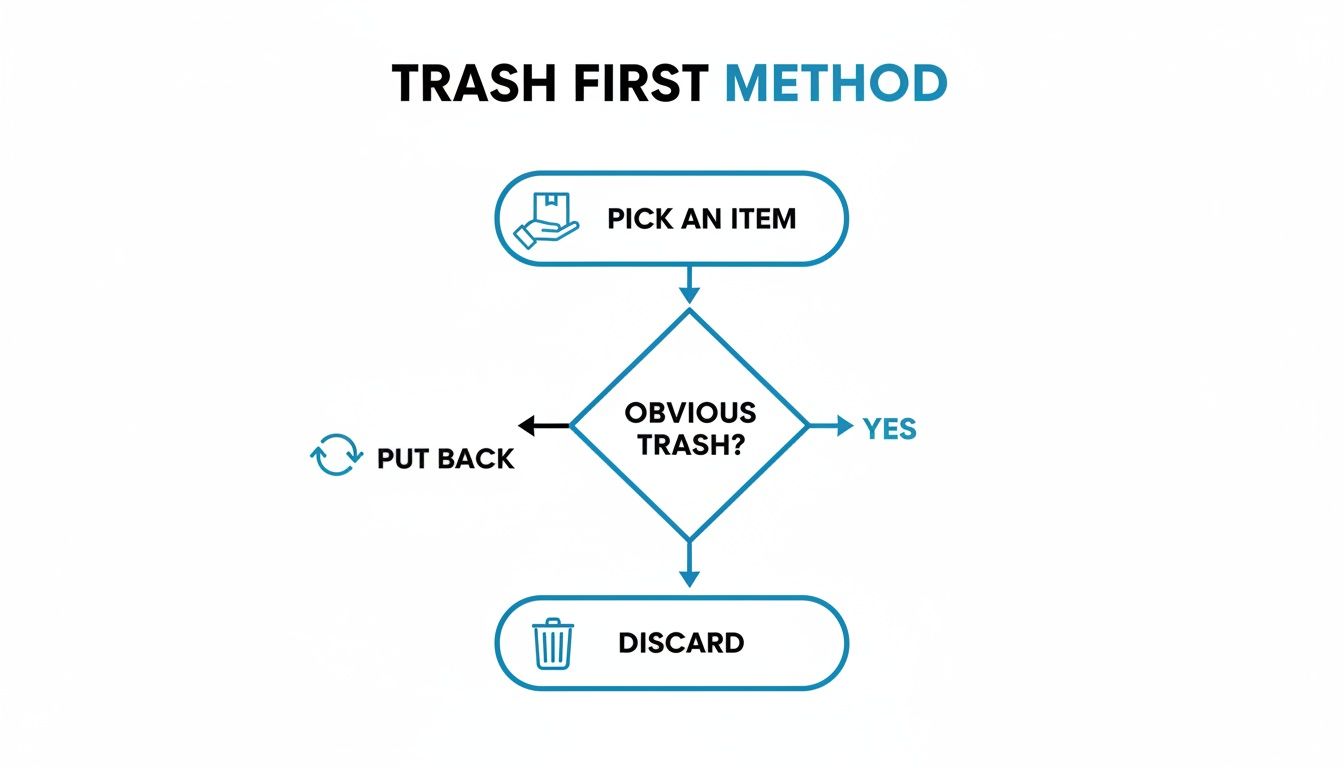
Starting with this basic "yes/no" question about trash builds the mental muscle you need to apply the Four-Box Method to everything else.
Conquering the Dreaded "Maybe" Pile
Even with a great system, you're going to pick up items that make you freeze. Welcome to the "maybe" pile—that collection of things you're not ready to part with but can't quite justify keeping. This is where clutter paralysis stages a comeback.
The "maybe" pile is almost always fueled by two powerful emotions: guilt ("But it was a gift!") or fear ("I might need this someday!"). These feelings are completely valid, but they can bring your progress to a screeching halt. The trick is to not let them win.
When you're stuck on a "maybe," the problem isn't the item; it's the decision-making process itself. A bit of objective clarity can sever the emotional tie and get you moving again.
This is where having an outside perspective can be a game-changer. Sometimes, that means asking a trusted, non-judgmental friend. Other times, a tool like an AI coach can provide that instant, unbiased feedback.
By simply snapping a photo, you can get a quick, logical take. It might point out that the item is easily replaceable for under $20, that you haven't used it in over five years, or that similar items are readily available. This kind of data-driven insight helps you shift from a difficult emotional choice to a much easier logical one, finally clearing out those "maybes" and keeping your momentum strong.
Turning Decluttering Into a Rewarding Habit
Lasting change rarely comes from a single, massive clean-out. I've seen it time and time again—those heroic, weekend-long purges almost always lead to burnout, leaving you right back where you started a few months later.
The real secret to making progress isn't about one giant effort. It’s about shifting your mindset from a one-time project to a series of small, consistent actions. This is how you turn the chore of decluttering into a sustainable—and even rewarding—daily habit.
A major breakthrough happens when you stop seeing decluttering as a project with a finish line and start treating it like a game you can win every day. This is the magic of gamification. By using simple mechanics like points, streaks, and challenges, you can make progress feel fun. Instead of getting overwhelmed by the mountain of stuff, your focus narrows to just scoring your next point.
This approach works because it taps directly into your brain's reward system. Every small win, like keeping a decluttering streak going for three days, gives you a little hit of dopamine. That satisfaction creates a positive feedback loop, and soon, visible progress becomes the very thing that fuels your desire to keep going.
Make Your Progress Visible (and Motivating)
One of the most powerful ways to stay in the game is to see how far you’ve come. When you’re in the thick of it, it's incredibly easy to forget what a room even used to look like. Visual tracking is the perfect antidote to that feeling of being stuck.
Before you touch a thing, snap a quick "before" photo on your phone. Then, after you've spent just a few minutes clearing the area, take an "after" shot. The immediate contrast is so reinforcing. It's hard, tangible evidence that your efforts are making a real difference.
When you can visually compare where you started to where you are now, it silences that inner critic whispering that you’re not making enough progress. That visual proof is often more motivating than any checklist.
This simple act gives you the encouragement you need to tackle the next small area, and the one after that. It's a way to celebrate every single step forward, no matter how small it might seem at the time.
The Power of the 10-Minute Tidy
Building a lasting habit doesn't require hours of grueling work. Actually, the most effective routines are the ones that are so easy, you can't talk yourself out of them. Meet the "10-Minute Tidy"—a practical daily strategy designed to prevent burnout and make maintenance feel almost effortless.
The concept couldn't be simpler:
- Set a timer for just 10 minutes.
- Pick one spot. A single, contained area, like a kitchen counter, one shelf, or the top of your nightstand.
- Just go. For those 10 minutes, your only job is to put things away, wipe the surface, or straighten up that one tiny zone. When the timer dings, you're done. No guilt.
This isn't about deep decluttering; it's about maintenance. This small daily investment stops new clutter from piling up and protects the spaces you've already cleared from backsliding. It makes the whole idea of "staying organized" feel achievable instead of overwhelming. For a little extra structure, some people find that using one of the best apps for home organization can help schedule these short bursts and track progress.
By focusing on consistency over intensity, you're fundamentally rewiring your brain. You’re teaching yourself that maintaining a clear space is a calm, daily ritual, not a stressful, chaotic marathon.
Navigating the Emotional Side of Letting Go
Getting the obvious trash out of the way feels good, but it's often the easy part. Sooner or later, you’ll come face-to-face with the items that carry real weight—the sentimental pieces. This is the moment the physical task of decluttering transforms into a deeply emotional journey.
Picking up a faded photo, a child's school art project, or a gift from someone you loved can unleash a storm of feelings. Anxiety, guilt, and a profound sense of loss are all completely normal reactions. It’s not just "stuff"; it's a collection of memories, identities, and moments from your past.
It's so important to acknowledge these emotions without judgment. You’re not doing anything wrong by feeling this way. In fact, it's the most human part of this whole process. The goal isn’t to stuff those feelings down, but to find ways to honor your past while making room for your present.
Reframe the Process from Loss to Liberation
One of the biggest emotional hurdles is feeling like you’re losing a piece of yourself every time you let go of an item. A powerful way to work through this is to consciously shift your perspective.
Instead of thinking, "I'm throwing away this memory," try this on for size: "I'm making space for new memories." You aren't erasing your history; you're simply choosing not to let it physically crowd out your future.
Letting go of an object does not mean letting go of the memory. The memory lives in you, not in the thing. This mindset shift gives you permission to move forward without the weight of guilt.
This becomes especially true as we get older and accumulate a lifetime of possessions. Research shows that hoarding disorder prevalence is 6.2% for adults aged 55-94, which is nearly three times higher than in younger adults. In a smaller home or retirement community, this clutter can quickly become a safety hazard, but the emotional attachment makes it incredibly difficult to face. You can learn more about how hoarding disorder affects different age groups.
Create Boundaries for Your Memories
Sentimental items need clear, firm boundaries. Without them, they will take over. Here are two practical techniques I’ve seen work wonders for preserving memories without sacrificing your living space.
1. The Memory Box:
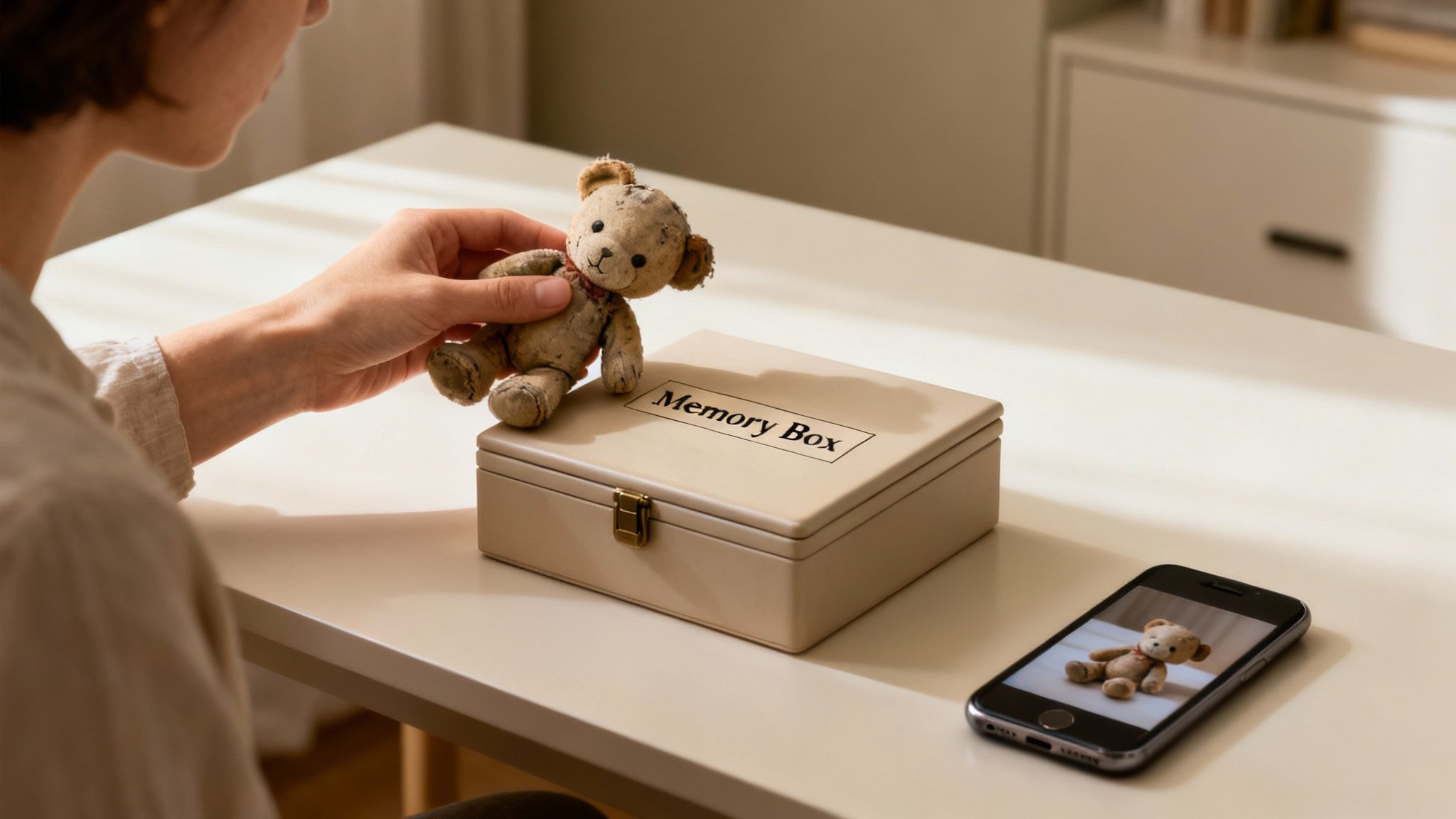
Find one single container—it could be a decorative chest or a sturdy plastic bin—and designate it as your official "Memory Box." This is the only place for your most cherished, irreplaceable keepsakes. The rule is simple: if it doesn't fit in the box, it can't stay. This forces you to really think about what matters most.
2. The Digital Memory Bank:
Your smartphone is your best friend for the items that bring a smile to your face but don't quite make the cut for the Memory Box. Before you donate or discard something, take a high-quality photo of it. Create a special album on your phone or computer and label it "Cherished Memories." You'll be surprised how often a quick visual reminder is all you really need to bring back the feeling an object evokes.
This strategy is all about capturing the essence of the memory, which is the part that truly matters.
Practice Self-Compassion Above All Else
This journey is not a straight line. Some days you'll feel strong and decisive, and other days a single postcard can leave you feeling paralyzed and sad. When that happens, it’s time for radical self-compassion.
Remember, you are not your clutter. The state of your home is not a reflection of your worth as a person. It’s simply the result of habits and circumstances that you now have the power to change. For more on this, you might find this guided meditation on separating your identity from your clutter helpful.
Treat yourself with the same kindness you would offer a friend. Celebrate every small win, whether it’s clearing one shelf or finally letting go of one difficult item. Each decision is a step toward a more peaceful, functional, and present life. Honor your past, and then give yourself the incredible gift of moving forward.
When It's Time to Call for Backup
Let’s be honest: sometimes, this journey is just too much to tackle alone. And that is perfectly okay. Realizing you need a hand isn't a sign of failure—it's a moment of incredible strength and a huge step toward real, lasting change.
But where's the line between having a lot of stuff and needing professional support? The difference really comes down to how much the clutter is impacting your daily life.
Knowing You’ve Reached a Tipping Point
It’s one thing to have a few messy corners. It’s another thing entirely when the clutter starts taking over. If any of these points hit a little too close to home, it might be time to bring in reinforcements:
- You've Lost Your Space: Can you cook a meal in your kitchen? Sleep in your bed? Use your bathtub? When essential parts of your home are no longer usable for their real purpose, that’s a major red flag.
- Safety is a Real Concern: Are doorways or fire exits blocked? Is it hard to walk through a room without tripping? Piles of flammable materials like paper or boxes can also create a serious fire hazard.
- It's Hurting Your Relationships: The state of your home might be causing friction with family or leading you to isolate yourself from friends because you're embarrassed to have anyone over.
- Letting Go Feels Impossible: The very thought of getting rid of things—even items you know have little practical value—triggers intense anxiety, guilt, or emotional distress.
If you found yourself nodding along, it's a strong signal that you could benefit from some outside help.
Finding the Right Professionals for Your Team
Getting help doesn't mean just one thing. There are different kinds of experts who bring unique skills to the table, and you can build a support system that fits your specific needs.
Professional Organizers
These are your hands-on partners. An organizer will physically work alongside you, providing the structure and motivation to sort through everything. They’re fantastic at implementing systems like the Four-Box Method and keeping the momentum going when you feel stuck. If you're curious about the investment, our guide on how much a professional organizer charges breaks it all down.
Therapists and Counselors
This is where you tackle the "why" behind the clutter. A therapist, especially one trained in Cognitive Behavioral Therapy (CBT), can help you uncover the thought patterns and emotional triggers that fuel the hoarding behavior. They equip you with powerful coping strategies to manage the anxiety and change your relationship with your possessions.
Specialized Clean-Out Services
For the sheer physical labor of removing a large volume of items, you don't have to do it all yourself. When the task is overwhelming or you have physical limitations, calling in professional junk removal services can be a game-changer. They handle the heavy lifting, freeing you up to focus on the decision-making and emotional work.
Asking for help isn't giving up. It's like adding a seasoned expert to your team—someone with a map who can guide you when you feel completely lost in the woods.
Modern tools can also be a fantastic support, whether you're going it alone or working with a pro. An app that simplifies decision-making can cut through that feeling of paralysis, making your sessions with an organizer or therapist that much more effective. The goal is to create a support network that empowers you, combining professional expertise with smart technology to make this difficult process feel achievable.
Common Questions About Overcoming Hoarding
When you're ready to reclaim your space, it's natural to have a lot of questions. Over the years, I've heard the same concerns from many people, and a few key challenges always come up. Here are some practical answers to the questions I get asked most often.
I'm So Overwhelmed, I Can't Even Start. What's the First Step?
I hear this all the time, and the feeling of being paralyzed is completely normal. The trick is to bypass the decision-making part of your brain for a little while.
Forget about sorting for now. Just grab a single trash bag and set a timer for 10 minutes. Your only mission is to walk through one room and fill that bag with obvious, undeniable trash—old mail, food wrappers, broken items. That’s it.
This small act is incredibly powerful. It gives you an immediate win without the emotional drain of making tough choices, and that little bit of momentum is often all you need to keep going.
What About Sentimental Things I Can't Bear to Part With?
This is a big one. The key is to honor the memory without letting the object hold you hostage. First, give yourself permission to keep some things. Designate one single container—a nice box or a sturdy bin—as your official "memory box." This is for the truly irreplaceable treasures.
For everything else, try a little trick I’ve seen work wonders: take a beautiful, high-quality photo of the item. Create a digital album for these pictures. You'll often find that what you really want to keep is the memory, not the physical object itself. This lets you preserve what's important while freeing up space to create new memories.
"Being organized isn’t about getting rid of everything you own or trying to become a different person: it’s about living the way you want to live, but better." – Andrew Mellen
How Do I Stop the Clutter from Coming Right Back?
Keeping your home clear is all about shifting your habits, not about endless, exhausting purges. Think maintenance, not marathons.
Two simple rules can make a world of difference:
- One In, One Out: This is non-negotiable. Anytime a new item comes into your house (like a new shirt or book), a similar old one has to leave. It stops accumulation in its tracks.
- The 10-Minute Tidy: Every single day, set a timer for just 10 minutes and focus on one small area. Put things back where they belong, wipe a counter, or sort a small pile of mail.
These aren't drastic changes. They are small, consistent actions that prevent clutter from ever reaching that overwhelming stage again.
Feeling paralyzed by decisions is the biggest barrier to progress. DeClutter Now uses AI to break through that fatigue, turning overwhelming choices into simple, guided actions. Snap a photo and get an instant recommendation, building momentum with every item you sort.
Try DeClutter Now free and start making real progress today →