
If you’re staring at piles of stuff and wondering, “how do I even begin to declutter my home?” you’re not alone. I’ve been there. For years, I had moving boxes that sat unpacked, and every time I walked past them, it felt like a tiny, personal failure. The real first step isn’t some complicated organizing system; it’s understanding the psychological wall in front of you—clutter paralysis—and learning how to break through it with the easiest possible wins.
Why Starting to Declutter Feels So Impossible

If looking at the sheer amount of stuff in your home makes you feel completely stuck, that feeling is real. It’s not laziness. It’s a genuine phenomenon called clutter paralysis. Your brain gets so overloaded by the sheer volume of decisions that it just… short-circuits. Making even one small choice feels monumental.
This is an incredibly common struggle. The home organization industry is booming, hitting USD 8.5 billion in 2023 and projected to reach USD 15.2 billion by 2032. That growth is fueled by a widespread problem: while 54% of Americans feel overwhelmed by their clutter, a whopping 78% have no idea how to start tackling it. You can see the full breakdown in this market analysis report.
This is precisely why so much popular decluttering advice falls flat when you’re already feeling drained.
The Problem With “Sparking Joy” When You’re Drained
Let’s be honest. Methods that ask you to hold every single item and ponder if it “sparks joy” are asking way too much, way too soon. When you’re already buried in decision fatigue, the last thing your brain can handle is a deep, emotional debate over a coffee mug.
It’s like someone telling you to run a marathon when you can barely get out of bed. It’s a recipe for feeling even more defeated, making you less likely to ever try again.
The goal isn’t a perfect, minimalist home overnight. The real goal is to turn that feeling of being paralyzed into a series of small, achievable wins. It’s about building momentum, not aiming for perfection.
This paralysis is why so many of us have those boxes sitting for years or a garage we can no longer park in. Every single item represents a long chain of mental hurdles:
- Do I even need this?
- Where would it even go?
- Is it worth anything?
- Who would I donate it to?
- But what if I need it someday?
Multiply that mental load by hundreds—or thousands—of items, and it’s no wonder our brains just shut down. You’re not failing; the traditional approach is failing you.
The Momentum Approach: A Better Way to Start
When you’re overwhelmed, standard decluttering advice often feels like it was written for people who are already organized. It misses the most important part: the mental barrier. The table below shows why a different strategy is needed.
Traditional Methods vs. The Momentum Approach
| Challenge | Traditional Advice (Why It Fails) | Momentum Approach (Why It Works) |
|---|---|---|
| Decision Fatigue | “Does it spark joy?” Asks for deep, emotional decisions on every item, which is exhausting. | “Is this trash?” Starts with simple, no-brainer decisions (trash, obvious donations) to build confidence. |
| Overwhelm | “Empty the whole closet!” Creates a bigger mess and a point of no return, causing more stress. | “Just find 5 things.” Focuses on small, timed sessions (15 minutes) to make the task feel manageable. |
| Lack of a Plan | “Just start anywhere!” Leads to jumping from room to room with no visible progress, killing motivation. | “Start with the easiest area.” Targets a low-traffic, low-emotion zone first to guarantee a quick win. |
| Perfectionism | “Organize everything perfectly.” The pressure to find the perfect home for every item leads to stalling. | “Progress over perfection.” Focuses on simply getting items into the right box (Keep, Donate, Trash) for now. |
This comparison makes it clear: when you’re stuck, you need a system designed to get you moving, not one that demands perfection from the get-go.
Before you can learn how to declutter, you have to reframe the problem. The real enemy isn’t the stuff; it’s the decision fatigue. We need an approach that works with our brain’s need for quick wins, not against it. Instead of starting with the hardest choices, we’re going to start with the absolute easiest ones to get the ball rolling.
I want this guide to help you feel seen and understood. You’re not broken, and your situation isn’t hopeless. You just need a different starting line—one designed specifically to break through that paralysis and help you finally make progress.
Start with Trash to Build Unstoppable Momentum
Here’s the powerful secret to breaking through clutter paralysis: start with trash, build momentum. Forget sorting, selling, or asking if something “sparks joy.” For now, our only mission is to find the obvious trash.
This is all about getting some quick wins. Walk into any room and just look for the junk. I’m talking about things that require zero mental energy to decide on—expired food, junk mail, empty bottles. Tossing these things feels good.
It’s a small hit of accomplishment that actually rewires your brain. These little victories release dopamine, the brain’s reward chemical, which gives you the fuel to keep going. It’s the perfect, psychology-backed antidote to feeling overwhelmed.
We don’t start with ‘does this spark joy?’ – we start with ‘is this actually trash?’
This small shift is a game-changer. It turns a massive, daunting project into a series of small, manageable tasks you can knock out in the next five minutes. It’s not about perfection; it’s about making real, tangible progress.
Find Your First Quick Wins
Ready? Grab a trash bag and give yourself just 10 minutes. No overthinking allowed. If it’s a clear “yes,” toss it and move on.
Here’s what you’re hunting for:
In the Kitchen:
- Expired Food: Anything in the pantry, fridge, or freezer that’s past its prime. Be ruthless.
- Worn-Out Sponges: Those grimy sponges and sad-looking dishcloths.
- Junk Mail & Old Receipts: That pile on the counter you keep meaning to sort? Now’s the time.
- Empty Jars & Containers: The glass jars you saved “just in case” but haven’t touched in a year.
In the Bathroom:
- Empty Bottles: Shampoo, conditioner, and body wash bottles with just a drop left.
- Expired Meds & Cosmetics: Old prescriptions and makeup that’s seen better days.
- Old Toothbrushes: Any toothbrush that’s frayed or older than three months has to go.
- Product Samples You’ll Never Use: Those tiny tubes of lotion and perfume collecting dust in a drawer.
This first sweep is designed to be fast, easy, and incredibly satisfying. Every single item that lands in that bag is a vote for progress. It’s proof that you can do this. You’re turning clutter paralysis into progress.
The Psychology of Momentum
So why does this work so well, especially when you feel completely stuck? It’s because you’re training your brain to see decluttering not as one giant, impossible mountain, but as a series of small, climbable hills.
The founder of DeclutterNow.ai learned this the hard way. He had boxes that sat, unpacked and untouched, for years. Every time he looked at them, he felt paralyzed. He eventually realized the problem wasn’t laziness—it was the sheer exhaustion of having to make hundreds of decisions.
By starting with trash, you basically eliminate the decision-making. This creates a powerful positive feedback loop:
- You take a small, easy action (like tossing out a pile of junk mail).
- Your brain gets a quick win (hey, the counter is clearer!).
- Dopamine is released, giving you a little jolt of satisfaction and motivation.
- You feel empowered to find the next easy thing to tackle.
That’s how you build real momentum. Before you know it, that initial 10-minute trash hunt turns into 20 minutes of clearing a shelf. That success then gives you the confidence to tackle a whole drawer. You’re systematically taking apart the overwhelm, one piece of trash at a time.
Your Room-by-Room Decluttering Game Plan
Okay, you’ve built some incredible momentum by clearing out all the obvious trash. Let’s channel that energy into a system that works. This is where we go beyond the easy wins and start making real, lasting change. Our tool for the job? The classic Four-Box Method. It’s a beautifully simple way to sort through your stuff.
All you need are four boxes or even just designated piles labeled:
- Keep
- Relocate
- Donate/Sell
- Trash
The magic of this method is that it forces a decision for every single item you touch. It completely avoids that common trap of just moving piles of clutter from one corner to another.
The whole process is designed to get you from “stuck” to “unstoppable.”
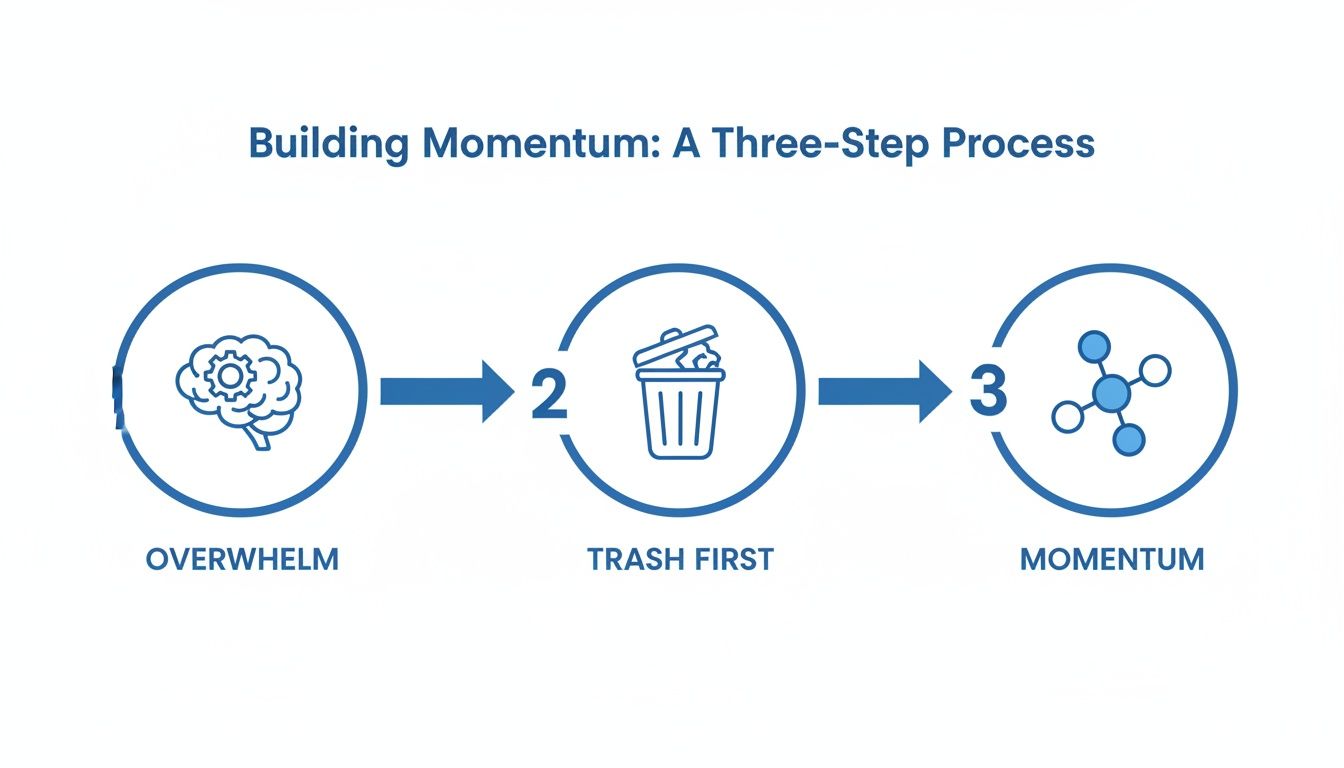
This simple flow is all about psychology. We break through the overwhelm by starting with the easiest task—”Trash First”—which gives you that little dopamine hit you need to keep going.
Conquering the Kitchen
The kitchen is the heart of the home, but let’s be honest, it’s also a total clutter magnet. Duplicate gadgets, appliances you never use, and drawers stuffed to the brim can make the whole space feel chaotic. Time to apply the four-box method.
Start small. Pick one spot, like the utensil drawer. Pull everything out. Now, pick up each item and make a quick, honest call.
- Do you really need three can openers? Keep the best one, and toss the others in the “Donate/Sell” box.
- What about that avocado slicer you bought on a whim and used once? If it’s not part of your actual cooking routine, it’s just taking up precious space. Donate it.
- That collection of mismatched food containers with no lids? If you can’t find a match, it’s trash.
The goal isn’t to get rid of everything you own. It’s to keep only what supports the life you actually live right now. If you haven’t touched that specialty gadget in over a year, give yourself permission to let it go.
This same logic works for every part of the kitchen. Use it on your coffee mugs, your pantry, and that dreaded corner cabinet filled with things you forgot you even had. You’ll be amazed at how much space you find.
Taming the Bedroom Closet
The closet can be an emotional minefield. It holds who we used to be, who we hope to be, and the lingering guilt of purchases we regret. This is where clutter paralysis often hits hardest.
To get through it, you need simple, non-emotional rules. As you sort through your clothes, ask yourself these direct questions:
- Have I worn this in the last 12 months? If the answer is no, it’s a prime candidate for the “Donate/Sell” box. A full year gives you a chance to account for all seasons.
- Does this fit me right now? Hanging onto “someday” clothes is usually more of a source of guilt than motivation. Keep what makes you feel great today.
- Is it damaged or hopelessly stained? If it’s beyond repair, it’s trash.
For items that just don’t belong in the closet—like a spare blanket that should be in the linen closet—use the Relocate box. This simple step is crucial because it keeps you from getting sidetracked and breaking your focus. For a more detailed walkthrough, check out our guide on how to organize your home room by room.
Reclaiming Your Living Areas
Living rooms and family rooms are shared spaces, which means they become a dumping ground for a huge variety of items. Think old magazines, random electronics, kids’ toys, and decorative pieces that no longer fit your style.
Start with a quick surface-level sweep. Go through the obvious piles of paper, DVDs you haven’t watched in years, and any other easy-to-spot clutter. This gives you an immediate visual improvement, which is a fantastic motivator.
Next, it’s time to look a little closer.
- Bookshelves: Are they overflowing? Keep the books you genuinely love or absolutely plan to read soon. The rest can find a new home through donation.
- Decorative Items: Your taste changes over time, and that’s okay. If an item doesn’t bring you joy or fit your current vibe, let it go.
- Cords and Cables: That tangled mess of mystery chargers in a drawer? If you don’t know what it powers, you probably don’t need it.
Be systematic here. Tackle one shelf or one corner at a time. The goal is to create a space that feels relaxing and functional, not like a storage unit for forgotten junk.
Facing the Final Frontier: The Garage
Ah, the garage. It’s often where good intentions go to die. It becomes the landing zone for everything that doesn’t have a clear home inside. This is where the Four-Box Method becomes your most powerful weapon.
The scale might be bigger, but the principles are exactly the same. Start with one section. Seriously, do not try to tackle the whole space at once or you’ll burn out.
- Expired Chemicals and Old Paint: Most of this is trash, but be sure to check your local guidelines for proper, safe disposal.
- Broken Tools or Sporting Equipment: If you haven’t fixed it by now, odds are you won’t. Time to let it go.
- Duplicate Tools: Just like in the kitchen, you only need one good hammer. Donate the extras.
The payoff for all this work is huge. A truly decluttered home can slash housework by up to 40%. Yet, without a real system, most people just end up shuffling their piles around. It’s shocking, but about 25% of homeowners with two-car garages can’t even park a single car inside because of all the stuff.
Your garage doesn’t have to be a source of stress. By applying this simple, box-by-box method, you can transform it from a cluttered storage locker back into a genuinely useful space. It all starts with one box and one decision.
Turning Your Clutter Into Cash

That “Donate/Sell” box is a huge victory. But let’s be honest—it can also feel like a new chore, a fresh pile of decisions that stalls your progress. I’ve seen it happen countless times.
Instead of looking at it as a task, think of it as your reward. This box is an opportunity to get a little money back for all your hard work. It’s not about becoming an e-commerce mogul overnight; it’s about adding a financial win to your decluttering success. That little cash boost is an incredible motivator to keep the momentum going.
Identify Your Quick Wins
You don’t have to research every single item in that box. The key is to avoid getting bogged down. Focus on the low-hanging fruit—the stuff that already has a hungry market waiting for it.
Start by scanning your pile for these high-value categories:
- Brand-Name Clothing & Accessories: That coat you wore twice or the designer handbag collecting dust can sell surprisingly fast.
- Electronics: Old phones, tablets, gaming consoles, and smart gadgets you’ve since upgraded are often easy to offload.
- Collectibles & Hobby Items: Vintage toys, comic books, trading cards, or niche crafting tools are exactly what other enthusiasts are searching for.
- Small Furniture or Decor: A unique lamp, a small side table, or a trendy piece of decor in good shape is always in demand.
Picking these items first gives you the best shot at a quick, satisfying sale.
Your goal isn’t to sell everything. It’s to efficiently convert the most valuable items into cash, which reinforces the positive feeling of decluttering.
Make Your Items Shine Online
Once you’ve cherry-picked your best items, it’s time to create listings that get noticed. You don’t need a pro setup, just a few smart tricks to build trust and make your stuff look great.
Photos That Sell
A good photo is everything. It’s the first thing a buyer sees and it can absolutely make or break a sale.
- Use Natural Light: Set up near a window. Soft, indirect sunlight shows true colors and makes things look appealing. Steer clear of harsh overhead lights that create weird shadows.
- Show Every Angle: Take more photos than you think you need—front, back, sides, and close-ups of details like brand tags or unique features. And be honest! If there’s a small scuff, take a clear picture of it.
- Use a Clean Background: A plain wall, a simple floor, or a clean table works perfectly. You want the focus on your item, not the laundry basket in the corner.
Simple, Effective Descriptions
A good description answers questions before they’re even asked. Be direct and helpful. Put the brand, size, color, and condition right in the title. In the description, you can add a bit more personality or detail. If you’re stuck on what to write, this guide on what sells fast on eBay has some fantastic pointers for crafting listings that grab buyers’ attention.
Following these steps turns what could be a headache into a manageable—and even fun—part of your decluttering journey. It’s the final step in giving your old items a new home while rewarding yourself for a job well done.
Build Simple Habits to Keep Clutter from Coming Back
You’ve done it. You pushed through the clutter paralysis, tackled the trash, and used the Four-Box Method to get your space back. That feeling of relief and clarity is amazing, right? But the real win is making sure it stays this way.
Lasting change isn’t about a single, heroic purge. It’s all about building small, almost unconscious habits that stop clutter from ever getting a foothold again. The idea is to move from reactive cleaning to proactive organizing, so your home feels effortlessly clear, not like a constant project.
Adopt the One In, One Out Rule
This is easily one of the most powerful habits for defending your newly reclaimed space. The rule is brilliantly simple: for every new item you bring into your home, a similar item has to go.
Think of it like keeping things in balance. You buy a new pair of sneakers? An old pair gets donated. A fun new coffee mug makes its way home? You pick an old one to pass along. This isn’t about depriving yourself; it’s about being intentional.
This one little habit forces you to pause before buying. You start asking, “Do I really want this new thing enough to let go of something I already own?” That mindset shift is your best defense against the slow creep of accumulation, ensuring your closets and shelves never get overwhelmed again.
Master the 5-Minute Tidy
That feeling of being overwhelmed doesn’t just appear overnight. It’s the result of dozens of tiny things being left undone day after day. The perfect antidote is what I call a “closing ceremony” for your home: the 5-Minute Tidy.
Every night before bed, just set a timer for five minutes and do a quick reset of your main living space. This is not a deep clean. It’s a lightning-fast straightening session.
- Put remotes back where they belong.
- Fold the blanket on the couch.
- Carry stray cups and plates to the kitchen.
- Tidy the stack of mail on the counter.
Five minutes feels like nothing, but the psychological payoff is huge. You wake up to a sense of order instead of yesterday’s mess, which sets a calm, in-control tone for your entire day. It’s a tiny investment with an incredible return.
This habit essentially short-circuits clutter before it can even start piling up, making your home a more consistently peaceful place to be.
Give Every Item a Home
A core reason clutter happens is homelessness. When an item doesn’t have a designated spot to live, it lands on the nearest flat surface and tends to stay there.
As you finish your big declutter, make a conscious effort to assign a permanent “home” to every single thing you keep. Keys live on a hook by the door. Mail goes into a specific tray. Batteries have their own little section in a utility drawer.
Having a system like this removes the mental load from tidying up. When it’s time to do your 5-Minute Tidy, you’re not wondering where something could go; you already know exactly where it belongs. This makes staying organized faster and much less of a chore. If you need some inspiration, checking out the best home organization apps can give you great ideas for mapping out your spaces.
Schedule Regular Decluttering Check-Ins
Look, even with the best habits, life gets messy. Things get busy, schedules get crazy, and small piles can start to form. To stay ahead of the game, put brief, regular decluttering check-ins on your calendar.
This doesn’t need to be some huge, dreaded event. It can be as simple as blocking off 15 minutes every Sunday afternoon to focus on one small area. One week, it’s the pantry. The next, it’s the medicine cabinet.
These little maintenance sessions prevent minor messes from snowballing into major projects. By treating decluttering as an ongoing practice instead of a one-and-done fix, you ensure your home stays a source of calm, not a source of stress.
Common Questions About Decluttering Your Home
Even with the best plan, you’re going to hit a wall. Certain items and situations can bring your decluttering progress to a screeching halt. It happens to everyone. Let’s walk through some practical answers to the most common roadblocks I see people face.
What If I Get Stuck on an Item and Can’t Decide?
Ah, clutter paralysis. It’s real, and it can kill your momentum faster than anything. Don’t let one tricky item derail an entire productive session.
The trick here is simple: create a “Decide Later” box. Put the item in it, close the lid, and literally walk away. I like to set a calendar reminder for a week or even a month from now to revisit that box. By the time you come back to it, you’ll have so much more confidence from all the other decisions you’ve made that this one will feel much easier. It’s far better to make twenty easy calls and skip one hard one than to get stuck on the very first one.
How Do I Handle Sentimental Items I Don’t Have Space For?
This is where it gets tough. Sentimental items are packed with emotion, not practicality. The goal isn’t to toss your precious memories, but to find a way to honor them without sacrificing your living space to a museum of the past.
I always recommend the “Containment” strategy. Find one single, beautiful box—that’s it. This is now the dedicated home for your most treasured keepsakes. If something new comes along and it doesn’t fit, you have to make a tough choice about what inside is truly the most important. It forces you to curate your memories.
Another great move is to digitize the item. Take a high-quality, well-lit photo of your child’s first art project, that old concert t-shirt, or a piece of inherited china. Create a digital album just for these memories. You get to keep the feeling forever without the physical object taking up space.
This approach gives you the best of both worlds—the memory is preserved, but the physical burden is gone. That’s a huge win.
My Partner or Family Is the Main Source of the Clutter. Help!
This is a delicate one because you can only control your own stuff. That’s the hard truth. But what you can do is influence the environment and lead by example.
Start with your own zones—your side of the closet, your home office, even your car. Let your family see the positive change. When they experience how much calmer and more functional a decluttered space feels, it often becomes its own inspiration. Your progress is your most powerful argument.
When it’s time to tackle shared spaces, frame it as a team effort for a shared reward. Instead of saying, “You need to clean up your mess,” try something like, “Hey, let’s clear off the kitchen counters so we have a better space for cooking our favorite meals together.” Drop the blame. When they see the immediate benefits, they’re much more likely to get on board.
How Long Should I Spend Decluttering at One Time?
Don’t try to be a hero. Marathon decluttering sessions almost always lead to burnout and terrible decision fatigue. The most effective approach is short, focused bursts.
Set a timer for just 15-25 minutes. Seriously, that’s it. When the timer goes off, you’re done for the day. Take a second to admire what you accomplished—you made real progress!—and then walk away. Doing this a few times a week is so much more sustainable than a single, draining eight-hour slog you’ll never want to do again. Short sessions build a lasting habit, not a one-time chore.
Feeling ready to turn clutter paralysis into progress? DeclutterNow is the psychology-backed app that helps you do just that. Our AI breaks through decision fatigue so you can finally make progress on those boxes that have been sitting for years.