
Best way to Declutter a House? Those boxes sitting in your garage for years? That closet you’re afraid to open? If you’ve ever felt completely stuck, you’re not alone. The best way to declutter your house isn’t about finding a sudden burst of energy—it’s about starting with the obvious trash first. This simple shift is a psychology-backed way to build momentum, sidestep the overwhelm that stops most people, and finally turn clutter paralysis into progress.
Why Starting To Declutter Feels Impossible

Let’s be real. You’ve stood in front of that messy room or those mystery boxes, felt a wave of pure exhaustion, and just walked away. I’ve been there. My founder story starts with boxes that sat in my garage for years. That feeling isn’t laziness—it’s clutter paralysis. It’s what happens when the sheer volume of stuff, and the thousands of micro-decisions it represents, makes your brain just… short-circuit. It’s not a character flaw; it’s decision fatigue.
You’re definitely not alone in this. Research shows that 54% of Americans feel overwhelmed by their clutter, and a whopping 78% have no idea where to even begin. This paralysis is more than just a feeling; it’s why the average American wastes 2.5 days every year just looking for lost things. When you’re already stuck, most popular decluttering advice can actually make things worse. You can read more about these staggering clutter statistics on TheSimplicityHabit.com.
The Problem With “Sparking Joy” When You’re Stuck
We don’t start with “does this spark joy?” for a reason. Many traditional methods kick things off with heavy emotional questions. Asking that for every single item forces you into a complex, personal decision right from the start. If you’re already drowning in decision fatigue, that’s like being asked to run a marathon with no training. Your brain is maxed out, and piling on emotional weight just digs you deeper into that paralysis.
The result is predictable. You pull everything out of a closet, get hit with an instant sense of defeat, and just shove it all back in—feeling even worse than when you started. This vicious cycle reinforces the false belief that you’re “bad” at this, when the real issue was the method, not you.
“Clutter paralysis isn’t a sign of being disorganized—it’s a symptom of decision fatigue. The solution isn’t to try harder, but to start smarter by making the decisions easier.”
Shifting From Emotion to Action
The key to breaking free is to change the question entirely. Forget the high-stakes emotional stuff for now. What you need is a process that builds your “decision muscle” one rep at a time. It’s about generating momentum, not achieving perfection with the first thing you touch.
Many well-known decluttering philosophies, while well-intentioned, can inadvertently set you up for failure by front-loading the most difficult emotional decisions. To get a better sense of why a new approach is needed, let’s look at where the old advice falls short.
Why Traditional Methods Fail vs The Momentum Method
| Challenge | Traditional Approach (Leads to Paralysis) | The Momentum Method (Builds Action) |
|---|---|---|
| Starting Point | Asks deep emotional questions first (“Does this spark joy?”) | Starts with easy, obvious wins (trash, expired items). |
| Decision Load | High-stakes emotional choices from the very beginning. | Simple, logical choices first to build confidence. |
| Mental State | Often triggers guilt, nostalgia, and decision fatigue immediately. | Creates a sense of accomplishment and positive feedback. |
| Physical Progress | Can result in making a bigger mess before any real progress is seen. | You see immediate, visible results, which fuels motivation. |
| Pacing | Encourages marathon sessions that are hard to sustain. | Focuses on quick, repeatable actions that fit any schedule. |
This shift from an emotion-first to an action-first mindset is what makes all the difference. It’s not about being ruthless; it’s about being strategic.
To put this into practice, you don’t start by asking what you love. You start by identifying what is undeniably, unequivocally trash.
- Expired food from the back of the pantry.
- That stack of old junk mail on the counter.
- Empty product boxes you were “saving just in case.”
- Broken gadgets you know you’ll never actually fix.
These aren’t emotional choices. They’re logical, fast, and painless. Every single item you toss into the recycling or trash bag is a quick win. It’s a small hit of dopamine that proves you can do this, fueling your motivation for the next round. This is how you turn that overwhelming feeling into tangible action and finally start reclaiming your space.
Start with Trash, Build Momentum
When you’re standing in a room that feels impossibly cluttered, the last thing you should ask is a big, emotional question. The best way to start is actually the simplest: “Is this trash?”
That’s the whole idea behind our “Trash First” methodology. It’s a practical, psychology-backed decluttering approach designed to slice right through that feeling of being completely overwhelmed.
Forget wrestling with sentimental items or things you might use someday. Instead, you’re going on a treasure hunt for the obvious stuff—the easy wins. We’re talking junk mail, empty boxes, expired pantry items, or that broken charger you know is a lost cause. These are no-brainers.
The Psychology of a Quick Win
Every time you toss an empty bottle into the recycling bin or a dried-up pen into the garbage, something cool happens in your brain. You get a little hit of dopamine—a satisfying reward that fuels your motivation. It’s a quick win, and quick wins create momentum.
Think of it like starting a snowball rolling downhill. That first push is small, but it makes the next one easier, and the one after that easier still. Before you know it, you’ve got real momentum, and the whole project starts to feel doable instead of daunting.
You’re not just clearing physical clutter; you’re building your “decision-making muscle.” Each easy choice makes you stronger and more confident for the slightly tougher decisions that lie ahead.
Why Starting with Trash Beats “Sparking Joy”
A lot of popular methods have you start with emotionally loaded categories like clothes or books. The problem? That can trigger decision fatigue almost instantly, shutting you down before you even get started. The “Trash First” approach flips the script by starting with pure logic, not emotion.
- It takes zero emotional energy. You don’t need to ask if an old receipt “sparks joy.”
- You see immediate results. Filling a trash bag in just five minutes is tangible proof that you’re making progress.
- It clears the way. Getting the obvious garbage out of the picture makes it so much easier to see what you actually own.
The goal here isn’t perfection on day one; it’s all about building momentum. By focusing on what is clearly and undeniably trash, you sidestep the paralysis that has kept those boxes sitting there for years. For more foundational advice like this, check out our guide with decluttering tips for beginners.
Putting It into Practice
Ready to give it a shot? Grab a trash bag and a recycling bin. That’s it. Don’t worry about organizing or finding a “home” for anything just yet. For the next 15 minutes, your only mission is to hunt for items that belong in one of those two bags.
Be on the lookout for:
- Old newspapers and magazines
- Empty shampoo bottles or food containers
- Expired coupons and junk mail
- Worn-out kitchen sponges
- Broken pens and dried-up markers
This first sweep is designed to be fast, painless, and incredibly effective. It’s the first real step toward reclaiming your space and turning a massive task into a series of small, satisfying wins. You’re not just taking out the trash—you’re taking back control.
Your Room-by-Room Decluttering Action Plan
It’s one thing to talk about decluttering theory, but progress only happens when you get your hands dirty. Let’s walk through how to apply the “Trash First” principle to the real-world chaos of your home. The goal here isn’t a picture-perfect room makeover in one afternoon. It’s about making tangible progress you can actually see—the kind that fuels you to keep going.
We’ll lean on a simple but powerful tool: the Four-Box Method. Grab four boxes, laundry baskets, or even just designate four clear spots on the floor.
Label them:
- Trash: For anything broken, expired, or just plain junk. This is your primary target.
- Donate/Sell: Good-condition items you don’t need but someone else will value.
- Relocate: Things that have a home… just not in this room.
- Keep: What’s staying put because you use it, love it, and it belongs here.
Starting with the trash first is the key to breaking through that initial feeling of being completely overwhelmed. It gets you moving, making simple decisions that build momentum for the tougher choices ahead.
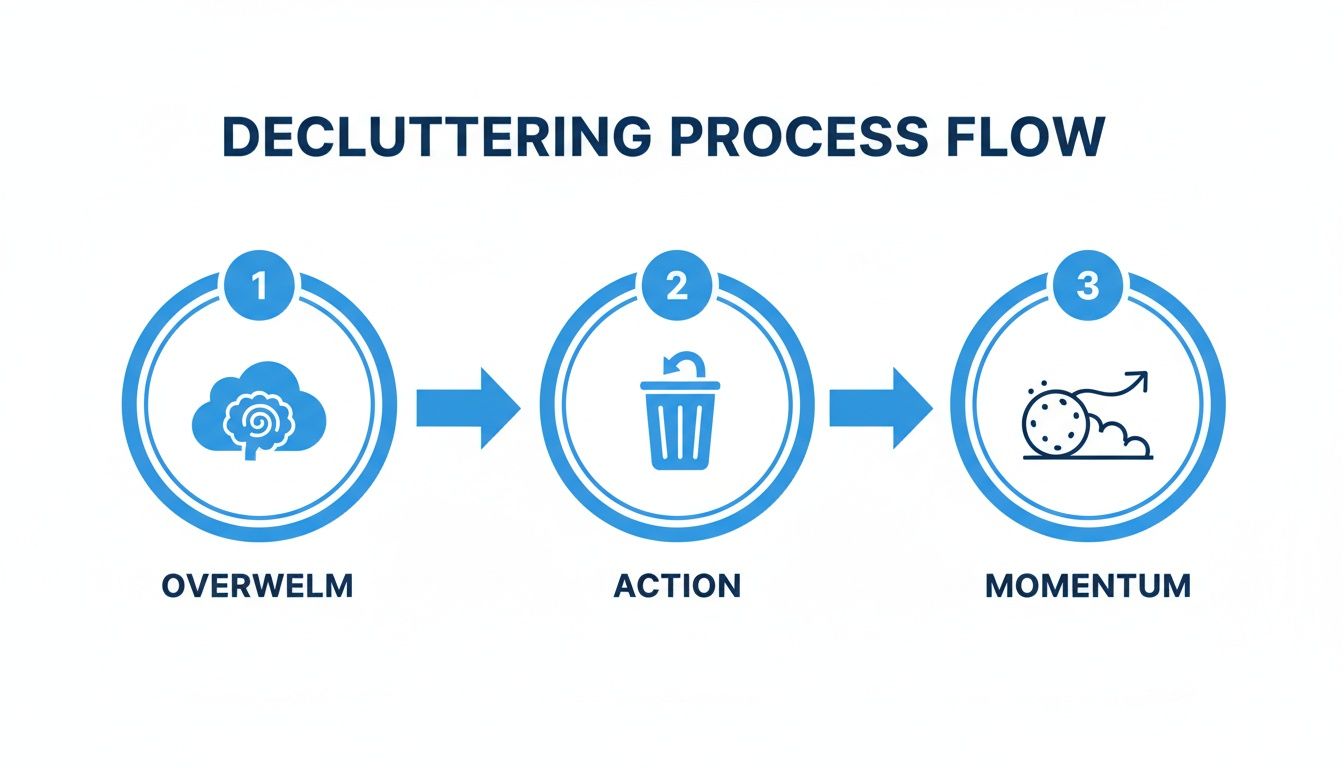
This process is a perfect illustration of the mental shift. You move from “clutter paralysis” to decisive action, which creates a snowball effect of positive momentum.
The Kitchen Quick Start
The kitchen is the heart of the home, which means it’s also a clutter magnet. Forget about reorganizing the entire pantry right now. Instead, grab your trash bag, set a timer for 15 minutes, and just hunt for the obvious junk.
Your First Targets:
- Expired Food: Raid the fridge, freezer, and pantry. If it’s past its prime, it goes. No second guessing.
- Junk Drawer Trash: You know the stuff—dried-up pens, dead batteries, brittle rubber bands, and those mystery sauce packets from last year’s takeout.
- Worn-Out Items: Spot that stained dish towel? The cracked food container with no lid? That one chipped mug you always push to the back of the cupboard? Toss them.
Once you’ve cleared out all the undeniable trash, you’ll be amazed at how much easier it is to then tackle the duplicates, like those five spatulas you somehow accumulated. This is how you build decluttering confidence.
Your goal is to eliminate the easy “no” decisions first. This strengthens your decision-making muscle, getting it ready for the harder “maybe” items you’ll face later on. Always choose progress over perfection.
The Bedroom and Closet Blitz
Your bedroom should feel like a sanctuary, but a stuffed closet can fill the whole space with stress. The “Trash First” approach works wonders here. Before you even think about asking if a shirt “sparks joy,” get rid of the stuff that has no joy left to give.
Start With These Easy Wins:
- Broken Hangers and Orphaned Socks: Go on a mission. Every flimsy wire hanger from the dry cleaner and every single sock whose mate has been missing for months? They’re out. This is an instant win.
- Damaged Goods: Scan for clothes with permanent stains, items that are hopelessly stretched out, or that sweater with a broken zipper you swear you’ll fix but never will.
- Toiletries and Makeup: Check your vanity and bathroom drawers for expired sunscreen, nearly-empty lotion bottles, and those tiny makeup samples you’ll never actually use.
Just doing this initial sweep creates visible space and a real sense of accomplishment. That feeling is what makes it possible to circle back and sort through your clothes, category by category, with a much clearer head.
How Our App Breaks Through Decision Fatigue
What happens when you pick something up and that familiar wave of indecision hits? This is where our AI breaks through decision fatigue. The DeClutter Now app is designed to be your on-demand coach, breaking that mental logjam.
Instead of agonizing, you just snap a photo. Our AI gets to work, helping you categorize the item and suggesting whether it’s a candidate for the Trash, Donate/Sell, or Keep pile. It takes that initial mental burden off your shoulders, short-circuiting the decision fatigue that stops so many people cold.
Let’s say you find an old charger in a drawer. Snap a picture. The app might identify it and ask, “This looks like a Micro-USB cable. Do you still own a device that uses this?” That simple, direct question cuts right through the mental clutter, guiding you to a fast, logical answer. It’s like having a patient expert by your side, helping you turn years of accumulated stuff into progress you can finally see and feel.
Turning Decluttering Drudgery into a Dopamine Hit
Momentum is a beautiful thing. But what happens on day three when the initial burst of motivation fizzles out and you’re staring at a half-finished project? This is the moment most decluttering efforts die. The real secret to success isn’t just starting strong; it’s having a system to keep you going when your energy inevitably dips.
This is where a smart tool can make all the difference. An app like DeClutter Now isn’t just a fancy to-do list; it’s a psychology-backed decision support system. It uses technology to take the mental weight off your shoulders, turning an overwhelming project into a series of small, manageable, and dare I say, fun actions.
Let AI Make the Tough Calls
Here’s a wild number for you: the average American home is hiding around 300,000 items. If you spent just one minute deciding on each one, you’d be at it for over 200 days straight, with no breaks. That statistic, from a fascinating piece on BecomingMinimalist.com, perfectly explains why we all get paralyzed. It’s not a personal failing; it’s a math problem.
Photo Recognition is the perfect cheat code for this. You find that mystery cable tangled in a drawer. Instead of racking your brain, you just snap a picture. The AI takes a look and might say, “This looks like an old camera charger. Do you still own that camera?” Boom. Decision made. It cuts right through the mental fog and saves your precious brainpower for more important things.
And for those items you’re really stuck on, the AI Coach’s “Help Me Decide” feature is like having a non-judgmental friend on call. It gives you gentle, personalized prompts to help you weigh an item’s sentimental value against the physical space it’s costing you, breaking that mental logjam for good.
Gamification: Trick Your Brain into Winning
Anyone who struggles with executive function, like many with ADHD, knows that the promise of a far-off reward (a clean room someday) isn’t enough. Our brains crave immediate feedback. Gamification provides just that.
Instead of one big payoff at the end, you get a little hit of dopamine with every small win. Snapping a photo, clearing a single surface—each action earns you points, extends a streak, or unlocks a cool achievement.
These aren’t just silly extras; they’re neurologically-sound motivators. This system reframes a tedious chore into a game you can actually win. You’re no longer looking at a mountain of stuff; you’re looking at your next chance to level up. For someone who has been staring at the same boxes for years, this shift in perspective is everything. Our complete guide to the best home organization apps digs deeper into how powerful these psychological tools can be.
A Real Story: From Paralyzed to Progress
I’ll never forget talking to Sarah, a mom of two who had three boxes from a move sitting in her guest room for over four years. Just looking at them made her feel exhausted, so she’d just shut the door. She’d tried traditional methods before, but they only made a bigger mess and left her feeling like a failure.
She decided to try DeClutter Now with one tiny goal: find five things to throw away. The photo feature made it quick and impersonal. A few points and a little achievement badge popped up. The next day, she felt a tiny spark and decided to do ten more.
The AI Coach walked her through a couple of “maybe” items, and the satisfying ding of earning points kept her going in five-minute sprints. By the end of the first week, she had cleared an entire box. In less than a month, all three were gone, and she finally had her guest room back.
“It wasn’t about finding some huge burst of energy,” Sarah told me. “It was the little rewards that tricked my brain into doing the work. For the first time, I felt like I was winning against the clutter instead of drowning in it.”
Turning Your Unwanted Items Into Cash

Let’s be honest about the “Donate/Sell” box. For many of us, this is where a great decluttering session grinds to a halt. It’s not just a box; it’s a whole new to-do list: research prices, take perfect photos, write compelling descriptions, and deal with buyers. It feels overwhelming, so the box just sits there, slowly becoming part of the problem.
This is a classic decluttering roadblock. The sheer effort involved often leads to paralysis, turning what should be a victory lap into another source of anxiety. But what if you could flip that script? Imagine that pile of old electronics, unworn designer clothes, or forgotten collectibles as an opportunity, not a chore.
When you see it that way, the whole process changes. Decluttering stops being just about clearing space and becomes a way to make some extra money. That’s a powerful motivator.
Removing the Friction from Selling
The trick is to make selling easy. That’s exactly why we built an eBay Selling Assistant right into the DeClutter Now app. We wanted to get rid of the friction that turns a “sell” pile into a “deal with it later” pile.
Instead of a mountain of work, the process is dead simple. You’ve already done the hard part by deciding to sell the item. Now, just snap a few clear photos of it with your phone, right inside the app. That’s pretty much it for you.
Our AI handles the rest. It generates an optimized title to grab a buyer’s attention and a detailed description that highlights all the important features. No more staring at a blank screen, trying to sound like a salesperson.
Turning clutter into cash shouldn’t feel like starting a second job. By automating the most tedious parts of selling, you can focus on what matters most: making progress and seeing a tangible reward for your efforts.
The home organization market is projected to hit $15.3 billion by 2028. It’s no wonder, considering Americans spend a staggering $1.2 trillion a year on nonessential goods. Instead of paying to store all that extra stuff, turning it into cash is a much smarter financial move.
Smart Pricing Without the Guesswork
One of the biggest hurdles people face is pricing. Ask too much, and your item will sit there forever. Ask too little, and you’re leaving cash on the table. This is where most people give up.
Our Selling Assistant eliminates that guesswork by suggesting a price based on what similar items are actually selling for right now. It gives you the confidence to list your item at a competitive price. If you want to get into the nitty-gritty, we have a complete guide on how to price items for resale that breaks it all down.
The table below shows just how much time and energy this saves.
Effort Comparison Selling Items Manually vs Using the App
| Selling Task | Manual Method (High Effort) | DeClutter Now Assistant (Low Effort) |
|---|---|---|
| Market Research | 10-15 min browsing eBay/Google to find comparable sold listings. | Instant price suggestions based on real-time data. |
| Photo Session | 5-10 min taking photos, transferring them, editing them. | 1-2 min snapping photos directly in the app. |
| Listing Creation | 10-15 min writing an engaging title and a detailed description. | AI generates an optimized title and description in seconds. |
| Total Time/Effort | 25-40 min of focused, often frustrating, work per item. | 2-3 min of simple, guided steps per item. |
With just a few taps, you can have a professional-looking, competitively priced listing ready to go. The app transforms a process that used to take half an hour into a simple two-minute task, making sure your “sell” pile actually gets sold and puts money back in your pocket.
Got Questions? Let’s Untangle Them
Even the best-laid decluttering plans can hit a snag. It’s totally normal for questions and “what-if” scenarios to pop up, and they can really kill your momentum if you let them. So, let’s get ahead of some of the most common sticking points. Knowing what to do when you get stuck is half the battle.
“What if I Hit a Sentimental Item and Just… Freeze?”
This is probably the number one fear I hear, and it’s a valid one. It’s also exactly why we never start with the sentimental stuff. Think of the “Trash First” method as your decluttering warm-up. You’re building your decision-making muscle on the easy, obvious junk first.
By the time you get to that box of old concert t-shirts or your grandmother’s teapot, you’ve already racked up dozens, maybe hundreds, of small victories. You’ve proven to yourself, over and over, that you’re good at this.
But if you do get stuck? Don’t panic. It just means it’s time to switch up your strategy, not throw in the towel.
- Lean on the AI Coach: Inside the DeClutter Now app, the “Help Me Decide” feature is a game-changer for these moments. It’s not about telling you what to do. Instead, the AI asks gentle, guiding questions that help you weigh the item’s emotional significance against the physical space it’s taking up. It’s like having a patient, unbiased friend right there with you.
- The “Decide Later” Box is Your Friend: Remember, our mantra is progress over perfection. It is 100% okay to have one small, clearly labeled box for the few things you’re genuinely torn about. Put a reminder on your calendar to look at it in a month. You’d be surprised how much clearer the right answer becomes with a little time and distance.
“How Is This Any Different From the KonMari Method?”
That’s a great question, and the difference is fundamental: it all comes down to the starting point. The KonMari method famously begins by asking, “Does this spark joy?” While that works wonders for some, for many people who are already overwhelmed, it’s an incredibly high-stakes emotional question to start with. It can be paralyzing right out of the gate.
Our approach, which is grounded in behavioral psychology, flips that script. We start with the simplest, lowest-stakes logical question there is: “Is this actual trash?” We build momentum and confidence with dead-simple “yes” or “no” decisions—like expired coupons or broken pens—so you have the energy to tackle the tougher categories later. It’s about action first, emotion later.
“I Have ADHD. Will This System Actually Work for My Brain?”
Yes! In fact, this system was built with neurodivergent brains in mind. Executive function challenges like task initiation and decision fatigue are at the very core of what we call “clutter paralysis.” The “Trash First” method is designed to cut through that mental fog by giving you an incredibly clear and simple place to begin. No ambiguity, no complex choices.
The app’s gamification elements—earning points, building streaks, and unlocking achievements—are there for a reason. They provide those small, consistent dopamine hits that are so crucial for staying focused and motivated. We’re turning a huge, overwhelming project (“declutter the entire house”) into a series of tiny, rewarding actions (“snap a photo of this old magazine”). It’s a proven strategy for brains that thrive on immediate feedback, making the whole process feel less like a dreaded chore and more like a game you can win.
Ready to finally turn that feeling of being stuck into visible, satisfying progress? You don’t need to wait for a burst of energy or the “perfect” weekend to get started. All it takes is one small decision.
Try DeclutterNow.ai for free and see how our AI companion can help you build momentum, not chase perfection. Take your first photo today →