
How to DeClutter Quickly? Those boxes in the garage have been sitting there for years. They aren’t there because you’re lazy. The secret to decluttering quickly is to sidestep the overwhelm that stops you cold. It’s about building momentum, not aiming for perfection. The strategy is simple: start with the absolute easiest decisions—the obvious trash—to build the confidence and energy you need to tackle the rest. This isn’t just about cleaning; it’s a psychology-backed approach to turn clutter paralysis into real progress.
Why You Feel Paralyzed by Clutter

If you have boxes that have been sitting there for years or a room you actively avoid, I get it. I’ve been there. That feeling of being completely stuck isn’t a character flaw. It’s a very real thing called clutter paralysis, and it’s caused by decision fatigue. It’s not laziness—it’s your brain’s natural reaction to being overloaded with too many choices.
Think about it: every single item in your home represents a decision. Keep it? Toss it? Donate? Sell? Is it sentimental? This endless barrage of questions is mentally exhausting. When your brain is so fried that making even one more choice feels impossible, you shut down.
This is exactly why so many traditional decluttering methods fail. Telling someone who feels paralyzed by decisions to start with their most emotionally-charged possessions—like old family photos—is like trying to run a marathon with zero training. You exhaust your decision-making muscle almost immediately, leaving you more stuck than when you began.
It’s not a lack of desire for a clear space. It’s the mental exhaustion from a thousand tiny decisions that stops you from acting. This is a battle of psychology, not willpower.
Understanding the Mental Roadblock
Our brains are wired to conserve energy. When faced with a monumental task like clearing out an entire room, your brain sees an overwhelming number of steps and potential dead ends. This can trigger a freeze response, making it far easier to just shut the door and tell yourself you’ll deal with it “later.”
This cycle is what keeps you feeling paralyzed by your own belongings. Here’s a peek at what’s really going on under the surface:
- Emotional Weight: Many of our possessions are tangled up with memories, guilt (“I paid good money for that!”), or hopes for the future (“I’ll fit into this again someday”). These aren’t just logistical choices; they’re deeply emotional ones.
- Perfectionism Pressure: The pressure to create a flawless, magazine-worthy home can be so intimidating that it prevents you from even starting. You get caught in the trap of thinking if you can’t do it perfectly, it’s not worth doing at all.
- No Obvious Starting Point: When everything feels important and urgent, just figuring out where to begin is half the battle. This uncertainty is a massive contributor to clutter paralysis.
Breaking through this requires a new game plan—one that doesn’t depend on you magically finding a huge burst of motivation. Instead, the trick is to make the first step so ridiculously easy that it feels effortless. Our guide on decluttering tips for beginners goes much deeper into building this crucial foundation. The goal is to turn that paralysis into progress, one quick win at a time.
Build Momentum by Starting With Obvious Trash
The biggest secret to breaking through that feeling of being completely stuck isn’t some massive, weekend-long purge. It’s all about building momentum. We don’t start by asking if an item “sparks joy”—that question takes way too much mental energy when you’re already feeling overwhelmed.
Instead, we start with the easiest possible decisions. This is the “Trash First” methodology.
Think of it as a warm-up for your decision-making muscle. You’re just scanning your space for things that are undeniably, without a shadow of a doubt, trash. Every time you toss an old receipt or a broken pen, your brain registers a quick win. It’s a tiny hit of dopamine that makes you feel good and, more importantly, creates the momentum to keep going.
This isn’t just about cleaning. It’s a strategic first move. Each piece of trash you get rid of is a small victory proving that you can make progress, which fuels your energy for the tougher decisions ahead.
Your First 15-Minute Sweep
Ready to finally make some progress? Set a timer for just 15 minutes. Your only mission is to hunt down and bag up items from the checklist below. Don’t overthink it. Don’t analyze. Just grab a bag and move fast.
The goal is purely to make as many easy “yes/no” decisions as you can in a short burst. You’re not trying to organize your entire life right now; you’re just taking out the trash. It’s amazing how this one simple act can finally get those boxes moving that have been sitting idle for years. You’ll be surprised how much lighter the room feels after just one session.
If you want to speed this up even more, an app like DeClutter Now can be a real help. Our AI breaks through decision fatigue by helping you quickly confirm what’s trash versus what might be worth selling later, keeping you focused and in motion.
Your ‘Trash First’ Quick Win Checklist
To get you started, here’s a simple list of no-brainer items to target in your first session. Finding and tossing these things gives you that instant motivation boost you need.
| Category | Examples of ‘No-Brainer’ Trash |
|---|---|
| Paper Clutter | Junk mail, old magazines, expired coupons, outdated receipts, old newspapers. |
| Kitchen & Pantry | Expired food, empty containers, broken utensils, single-use sauce packets. |
| Office & Desk | Dried-up pens, broken electronics, old charging cables, scraps of paper. |
| Bathroom | Empty product bottles, expired makeup or medications, old toothbrushes. |
| General Household | Worn-out cleaning sponges, dead batteries, broken hangers, old shopping bags. |
Think of this sweep as clearing the runway. By getting the obvious junk out of the way, you create the physical and mental space to tackle the items that actually require some thought. Start with trash, build momentum, and prove to yourself that you can turn paralysis into real progress.
A Rapid Sorting System for Everything Else
You’ve cleared the obvious trash, and you can already feel the space opening up. That initial momentum is gold, but now comes the hard part: the stuff that isn’t so clear-cut. This is exactly where most people get stuck and decision fatigue sets in. To keep the ball rolling, you need a simple, fast-paced sorting system.
This is where the classic Four-Box Method shines, but we’re going to use a version built for speed. Your job isn’t to agonize over every little thing. It’s about making a quick, gut-level decision and moving on. We’re aiming for progress, not perfection.
The Four Boxes, Simplified
Get four boxes, bags, or just designated spots on the floor and label them: Keep, Relocate, Donate/Sell, and Trash. The trick is to have non-negotiable rules for each pile to take the guesswork out of the equation.
- Keep: This is exclusively for things you actually use and genuinely love. My rule of thumb? If you haven’t touched it in the last six months, it doesn’t get an automatic pass to stay.
- Relocate: This is your “put-away” pile. It’s for anything that has simply wandered into the wrong room—the scissors that belong in the kitchen, the coffee mug from your nightstand.
- Donate/Sell: For items that are perfectly fine but just don’t serve you anymore. Don’t get hung up on how much it might be worth right now; just make the call that it needs a new home.
- Trash: You’ve already done one pass, but you’ll find more. This is for anything broken, expired, or just plain unusable.
This decision-making flow helps you filter items by starting with the easiest choices first. It’s all about preserving your mental energy for the tougher calls.
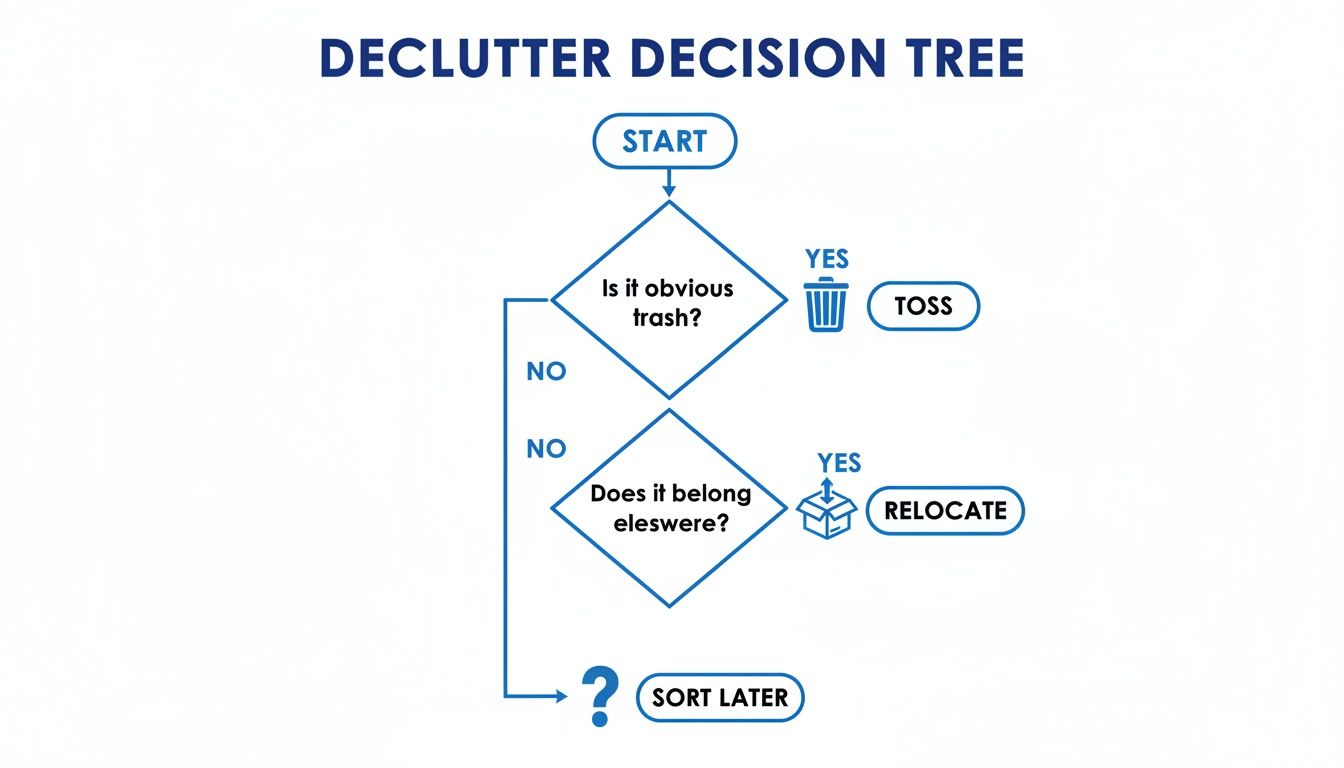
This “Trash First” approach is critical. You clear the no-brainers before you even have to think about the items you have an emotional connection to.
When you stick to quick, decisive actions, the Four-Box Method absolutely works. The numbers don’t lie: people spend, on average, 4.3 hours per week just managing their clutter. Imagine getting that time back. The emotional payoff is even bigger, with 89% of women and 77% of men reporting they feel significantly better after tackling their space. If you’re curious, you can learn more about the psychology behind the decluttering trend and its real-world benefits.
Your AI Assistant for Tough Decisions
Even with a great system, you’re going to hit a wall. What about that old blender you got as a wedding gift? Or the craft supplies you swear you’ll use one day? For those moments when you’re truly stuck, a tool like the DeClutter Now app can be a game-changer. It’s like having a decluttering coach in your pocket.
Instead of getting paralyzed, you get a suggestion. This is how you maintain momentum when your willpower starts to fade. The goal isn’t to get rid of everything, but to finally make a decision.
You just snap a photo of the item, and its AI companion instantly gives you a recommended action. It turns an overwhelming choice into a simple tap on your screen. Better yet, it gamifies the whole process with points and streaks for every item you sort, which makes the work feel less like a chore and more like a win. This clever, psychology-backed approach keeps you from burning out and turns potential clutter paralysis into consistent, rewarding progress.
How to Make Progress in Just 15 Minutes a Day
The very idea of decluttering your entire home is exhausting, isn’t it? It feels like a project that demands a long, free weekend you just don’t have. But here’s the secret I’ve learned from my own struggle: the key isn’t finding more time. It’s about using the small pockets you already have more effectively.
You can absolutely get your space back without blowing up your entire schedule. The trick is to switch from a marathon mindset to a series of short, targeted sprints. This is often called time-boxing, and it turns a monumental task into a chain of small, satisfying wins. Always remember: progress over perfection.
This whole approach is designed to sidestep that paralyzing feeling of overwhelm. Instead of staring at a chaotic room and not knowing where to even start, you give yourself a tiny, achievable mission. The goal is to prove to yourself that small, consistent efforts really do add up to big, visible change.
The 15-Minute Micro-Zone Blitz
Let’s get started with your first mission. It’s simple: pick one small, contained area. I’m talking about a single drawer, one cluttered shelf, or just the top of your nightstand. We’re not trying to conquer the whole kitchen today; we’re just liberating the junk drawer.
Set a timer for 15 minutes. That’s it. Go.
For that quarter-hour, your only job is to sort everything in that tiny zone. Grab your boxes for the Four-Box Method (Keep, Relocate, Donate/Sell, Trash) and just make quick decisions. When the timer dings, you stop. You will be genuinely surprised by the rush of accomplishment that comes from clearing even one small space completely.
This is where having the right tools can be a game-changer. The best home organization apps are built for these exact kinds of quick sessions, helping you make faster decisions and keeping you on track. If you’re curious, we’ve put together a guide on the best home organization apps out there.
Visualize Your Wins to Stay Motivated
Actually seeing your progress is an incredible psychological boost. After each 15-minute blitz, take a second to really look at what you’ve done. That newly cleared counter or tidy drawer is a real, tangible victory.
That’s why features like progress trackers and before-and-after sliders in decluttering apps are so powerful. They provide concrete proof that your small efforts are paying off, which builds the momentum you need to tackle the next session.
It’s a tough pill to swallow, but studies show 47% of people suffer daily decision fatigue from clutter. Our homes have ballooned in size, yet a quarter of us with two-car garages still can’t fit a car inside. It’s no wonder we’re exhausted. AI-powered coaching in apps like DeClutter Now is designed specifically to cut through that fatigue by delivering visible achievements and clear before-and-after results, turning a dreaded chore into a rewarding routine.
These small, visualized wins are what make decluttering a sustainable habit instead of a one-time, burnout-inducing event. Every completed session reinforces that feeling of control and accomplishment, making it that much easier to start the next one.
Turn Your ‘Sell’ Pile Into Instant Cash
We’ve all been there. You power through a big decluttering session and end up with a box labeled “Donate/Sell.” The problem is, that box often just becomes a new form of clutter—a task you’ll get to… someday. It’s one more decision to make, and it can bring your hard-earned momentum to a dead stop.
But what if that pile of stuff could become a rewarding final step instead of another hurdle? Turning those items into cash doesn’t have to be a complicated, drawn-out project. With the right strategy, you can quickly convert that pile into a tangible reward, reinforcing the great feeling that comes with reclaiming your space.
The key is to cut out all the usual friction. Forget spending hours researching what something is worth, writing long descriptions, and wrestling with confusing listing forms. Today’s tools can make this process almost as fast as tossing something in the trash.
That “sell” box isn’t a chore; it’s an opportunity. Each item you list quickly is another win, turning a source of stress into proof that your decluttering efforts are literally paying off.
A Faster Way to List and Sell
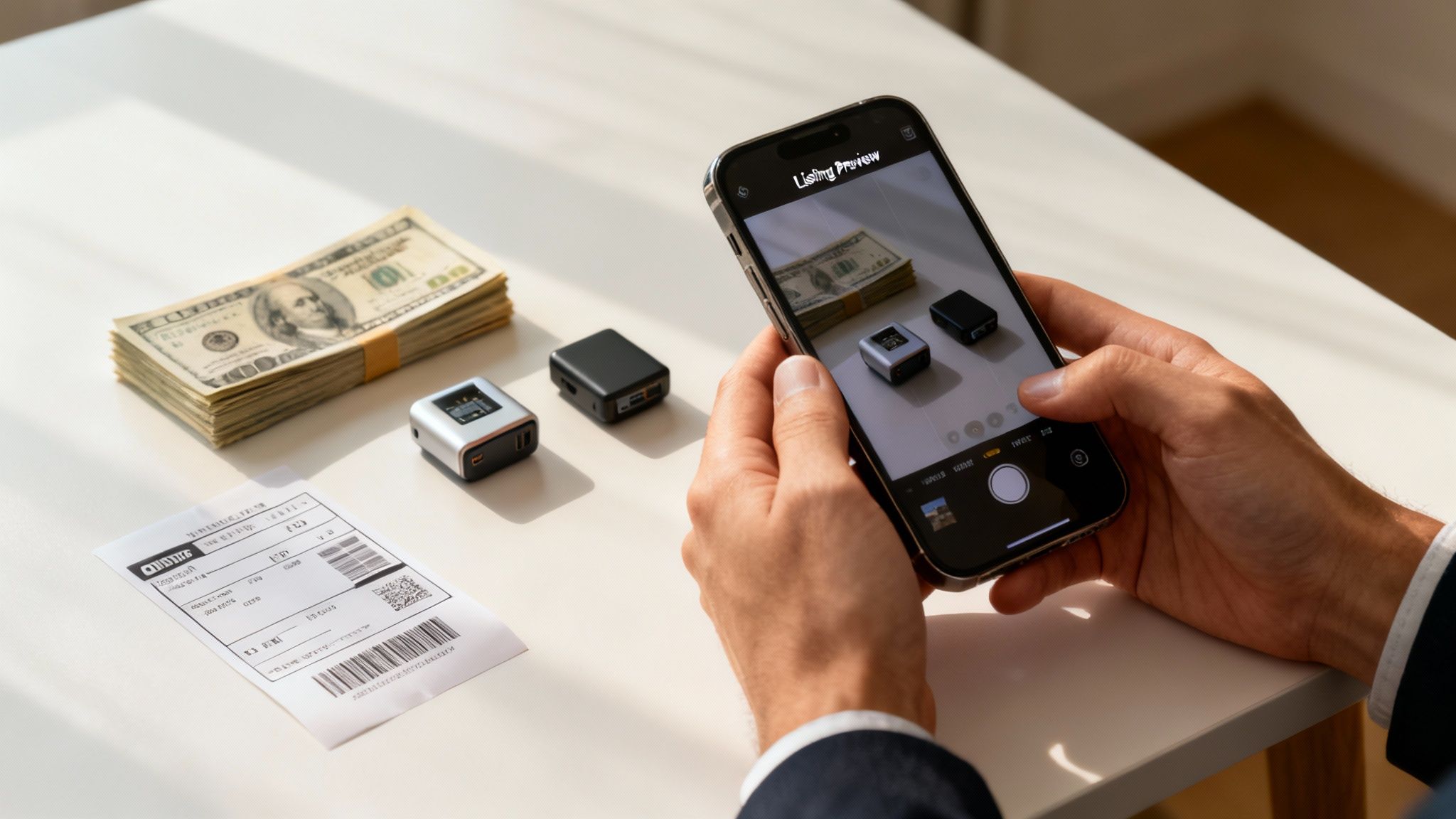
Imagine how much time you’d save if the hardest parts of selling online were just… done for you. That’s exactly what the built-in eBay assistant in the DeClutter Now app does. You just snap a few photos of an item, and the AI gets to work.
It instantly creates an optimized title and a compelling description designed to grab a buyer’s attention. This completely bypasses the writer’s block that stops so many people from ever listing their stuff in the first place. You get a pre-filled listing in minutes, not hours.
The Four-Box Method is perfect for fast sorting, and this technology is the ideal partner for your “Sell” pile. This kind of efficiency is why the professional organizer market is exploding—it’s expected to hit $21.16 billion by 2032. People are desperate for systems that actually work. When you know you can convert items to cash without a huge hassle, letting go becomes so much easier.
From Old Gadgets to a Quick Payday
One of our users, Sarah, had a box of old electronics sitting in her closet for years. It was a graveyard of old phones, cameras, and a mess of tangled chargers. Just thinking about selling them one by one was exhausting.
Using the eBay assistant, she tackled the entire box in a single afternoon. She took a few quick pictures of each gadget, let the AI write the descriptions, and had everything listed in under an hour. A week later, she’d made a few hundred dollars from stuff that was previously just collecting dust. If you need some ideas, check out our guide on what sells fast on eBay to get inspired.
This isn’t just about making a little money. It’s about closing the loop on your clutter for good and actually rewarding yourself for the progress you’ve made.
Common Decluttering Roadblocks (And How to Get Past Them)
Even the most straightforward plan can hit a snag. It’s completely normal to get stuck, especially when you’re staring down years of accumulated stuff. Let’s walk through some of the most common hurdles I see people face—and how to clear them so you can keep making progress.
“But… Everything Feels Important!”
This is probably the single biggest reason people give up. When every object feels tied to a person, a place, or a memory, trying to decide what to keep feels impossible.
My advice? Don’t even try to tackle those sentimental items first. Put them aside. Seriously. Start with the easy, unemotional stuff—the junk drawer in the kitchen, that stack of expired coupons, the duplicate spatulas.
By clearing the obvious clutter first, you build momentum. Those quick wins give you the confidence and mental clarity to later approach the tougher, more emotional decisions. When you do get to those sentimental boxes, ask yourself a different question: “Can I preserve the memory without keeping the object?” Often, a quick photo is more than enough to capture the feeling, and it doesn’t take up any physical space.
Remember, the goal isn’t to erase your past. It’s to stop letting it physically crowd out your present. You can honor your memories without being buried by them.
“How Do I Stop the Clutter from Creeping Back?”
Decluttering is not a one-time event; it’s a shift in how you live. The only way to maintain a clear space is to build a few simple habits that become second nature.
- The “One-In, One-Out” Rule: This is a classic for a reason—it works. For every new t-shirt, book, or coffee mug that comes into your home, a similar one has to go. It’s a simple gut check that stops mindless accumulation.
- Give Everything a Home: This is non-negotiable. Every single item you keep must have a designated spot. When you know exactly where something belongs, putting it away takes two seconds instead of becoming part of a “doom pile” on the counter.
- The 5-Minute Tidy: Before bed each night, spend just five minutes walking through your main living area and putting things back in their homes. This tiny ritual prevents small messes from turning into overwhelming chaos.
“I Just Don’t Have the Time for This.”
I hear you. The idea of dedicating an entire weekend to decluttering is daunting, and for most of us, completely unrealistic. That’s why you shouldn’t wait for that magical block of free time to appear.
Embrace the power of 15 minutes. You would be shocked by what you can accomplish in a short, focused burst of activity. Think of it as a small, daily habit, not a massive project.
Pick one tiny, manageable zone—a single kitchen drawer, one shelf of the bookcase, that pile of shoes by the door—and set a timer. When the timer goes off, you’re done for the day. That small hit of accomplishment is incredibly motivating and makes it easier to show up for another 15 minutes tomorrow. Consistent, small steps will always beat a single, overwhelming marathon session that leaves you exhausted.
Ready to finally turn clutter paralysis into progress and see real, tangible results? DeClutter Now acts as your personal decluttering coach, helping you make fast decisions and turning your unwanted items into momentum you can feel.