
How to Price Items for Resale. Figuring out how to price your used items can feel like a guessing game, but it really comes down to a simple process: figure out what you have, see what it’s actually sold for, and then factor in your costs.
A solid rule of thumb for everyday items is to aim for 30-50% of the original retail price. This is a great starting point if your goal is to make progress and get that quick win.
From Clutter Paralysis to Profitable Action
Ever stare at a pile of stuff you know you should sell and just… freeze? If you have boxes that have been sitting for years, you’re not alone. This isn’t laziness; it’s a very real thing called decision fatigue. The sheer number of choices—what to sell, where to list, and especially how to price it all—is enough to make anyone feel stuck.
But this guide is designed to help you break through that paralysis. We’re going to walk through how to price your items with confidence, turning those forgotten things into cash. The first move is a simple mental shift: Stop thinking of it as “getting rid of junk” and start seeing it as “cashing in on assets.”
The Mindset of a Smart Reseller
Before you even touch a single item, let’s put on a detective hat. You’re about to learn how to look at an old purse or a gadget and see its potential value to someone else. It all starts with a quick and honest assessment based on three key things:
- Condition: Be brutally honest here. Is it new with tags (NWT), like-new, or does it have a few scuffs? Pointing out flaws upfront builds trust and prevents headaches later.
- Brand Recognition: A recognizable brand name usually has a built-in audience. It’s simply easier to research and sell a brand people already know and search for.
- Current Market Demand: Is this item a hot trend, a timeless classic, or something for a niche collector? Things like seasonality and current styles can make a huge difference in what someone is willing to pay.
This whole process—from that first look to setting your final price—can be broken down into three straightforward stages.
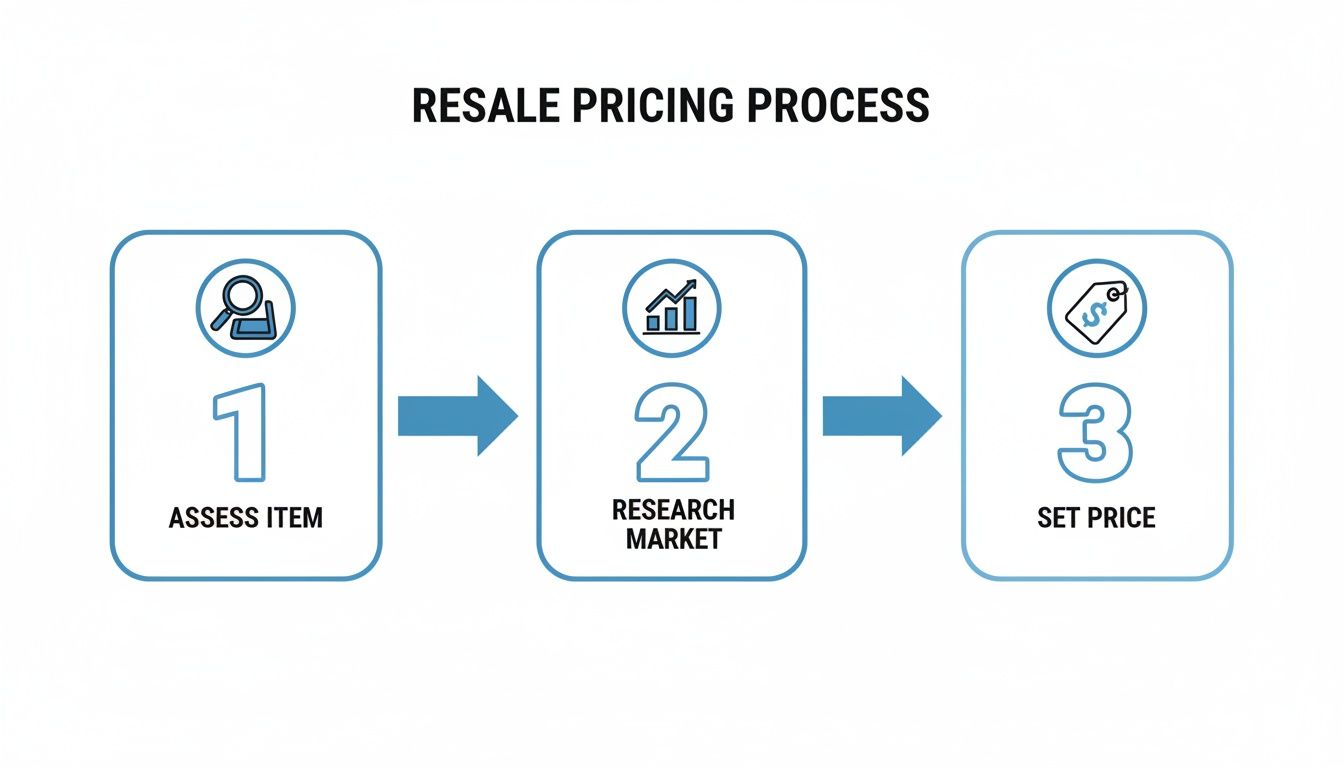
Following this flow turns a daunting task into a series of small, manageable steps. It’s a great way to overcome that initial feeling of being overwhelmed, which is a big hurdle we talk about in our guide on the five steps to finally start decluttering.
Don’t underestimate what you have sitting around. The resale market is absolutely exploding. Projections show the U.S. secondhand apparel market alone could hit $74 billion by 2029. This is where making progress on your clutter stops feeling like a chore and starts feeling like a treasure hunt.
Figuring Out What Your Stuff is Actually Worth

Pricing an item without any research is just guessing. It’s the fastest way to either leave money on the table or list something that just sits there for months, collecting dust and adding to your mental clutter. To price with confidence, you need to find “comps”—that is, comparable sold listings. This is hands-down the most important step in the entire process.
Think of yourself as a market detective. Your mission is to find out what someone actually paid for an item just like yours. This is a critical distinction: we’re not interested in what other sellers are asking for right now. Active listings can be priced way too high and might never sell. We only care about what’s already sold.
Getting Good at the “Sold” Search
Every major resale platform has a game-changing feature: the ability to filter your search to show only “Sold” or “Completed” items. This little checkbox is your new best friend. Forgetting to use it is like trying to drive with a blindfold on—you have no idea what’s really happening out there.
To get you started, here’s a quick rundown of how to find this crucial filter on the big three platforms.
Platform-Specific Research Tactics
Finding sold comps isn’t one-size-fits-all. Each platform has its own quirks for digging up that vital sales data. This table breaks down where to look and what to pay attention to on each major marketplace.
| Platform | How to Find Sold Listings | Key Data Points to Note |
|---|---|---|
| eBay | Perform a search, then scroll down the filter menu on the left and check the “Sold Items” box. | Look for the final sale price (in green), the date of sale, and whether it was an auction or a “Buy It Now.” |
| Poshmark | Search for your item, tap the “Filter” button, and under “Availability,” select “Sold Items.” | Note the sale price and how many “likes” it had. Lots of likes can signal high demand for that particular item. |
| Facebook Marketplace | In the app, search and tap “Filters.” Scroll down and toggle on “Sold Listings.” | Check the final price. Keep in mind that Marketplace prices are often local and can vary wildly by region. |
Knowing where to find this info is the key to unlocking what real buyers are willing to pay, taking the guesswork out of your pricing strategy.
Searching Smarter, Not Harder
Once you know how to find sold listings, the next step is getting good at searching. A generic search like “Nike shoes” is way too broad and won’t give you an accurate picture. You need to get specific.
Try combining keywords to zero in on your exact item:
- Brand + Style Name: “J.Crew” becomes “J.Crew Tippi Sweater”
- Add Material or Color: “J.Crew Tippi Sweater” becomes “J.Crew Merino Wool Tippi Sweater Gray”
- Include Condition: If your item is brand new, add “NWT” (New With Tags) to the search. If it has flaws, you can even search for terms like “for parts” on electronics.
This level of detail is just as important when you’re dealing with smaller collectibles or heirlooms. For instance, if you’re trying to price family jewelry, you can uncover a surprising amount of information with the right search terms. Our guide to jewelry organization and storage touches on how properly identifying pieces is the first step to understanding their true value.
Making Sense of the Market Data
After a few good searches, you’ll have a list of sold comps. So, now what? You’ll probably see a range of prices, which is completely normal. Your job is to figure out where your item fits on that spectrum.
Key Takeaway: The goal isn’t just to find one magic price. It’s to understand the range of prices and what factors push an item toward the higher or lower end.
Take a look at the highest-priced sold items. What do they all have in common? It almost always boils down to a few key things:
- Exceptional Condition: Items listed as “new with tags” or in “excellent used condition” consistently sell for more.
- Great Photos: Listings with bright, clear photos from multiple angles attract more buyers and command better prices.
- Detailed Descriptions: The best listings include measurements, materials, and an honest account of any flaws.
- Completeness: For things like electronics or games, having the original box, manuals, and all the accessories makes a huge difference in the final sale price.
By gathering this real-world market intelligence, your pricing is no longer a guess—it’s a strategy. You now have a repeatable, fact-based process that will help you sell your stuff quickly and for the right price, turning that feeling of overwhelm into the satisfying feeling of progress.
Calculating Your Actual Profit Margin

Selling an item for $50 feels great, but that’s almost never the amount that lands in your bank account. The real math of reselling can be a wake-up call, and ignoring it is the fastest way to feel like you’re doing a ton of work for just a few bucks.
If you want to turn making progress on clutter into a real side hustle, you have to understand your actual profit margin before you list. This is where a lot of people get stuck and give up. Let’s break down the hidden costs—platform fees, payment processing, and shipping—so you can price with confidence.
The Simple Formula for Real Profit
Before we dive into the weeds, let’s start with a basic formula. Think of this as your North Star for figuring out if selling something is actually worth your time.
Sale Price – Platform Fees – Shipping Costs – Your Original Cost = Your Net Profit
For most decluttering, your original cost is $0 since you’ve owned the item for years—that’s a huge advantage! But those other two variables, fees and shipping, can take a serious bite out of your sale price.
Decoding Platform Fees
Every online marketplace takes a cut. It’s their fee for connecting you with millions of buyers, and you have to factor it in. These fees vary wildly between platforms, but they usually fall into a few buckets.
- Final Value Fee: This is the big one. It’s a percentage of the total sale amount, which often includes the item price, what the buyer paid for shipping, and sometimes even sales tax. For example, eBay’s final value fee for most categories hovers around 13.25%.
- Listing Fee: Some platforms charge a small fee just to create the listing. This is less common for casual sellers on most sites, but it’s something to watch out for.
- Payment Processing Fee: This is the cost of handling the credit card transaction. It’s often bundled into the final value fee, but some platforms list it separately.
Poshmark keeps it simple: a flat fee of $2.95 for sales under $15 and a straight 20% for sales of $15 or more. Mercari charges a seller fee plus a payment processing fee that adds up to about 13%. The takeaway? Always, always check the platform’s current fee structure before you list.
Conquering Shipping Costs
Shipping is the other profit-killer if you’re not careful. And it’s not just about the postage; you have to think about the cost of boxes, tape, and bubble wrap, too.
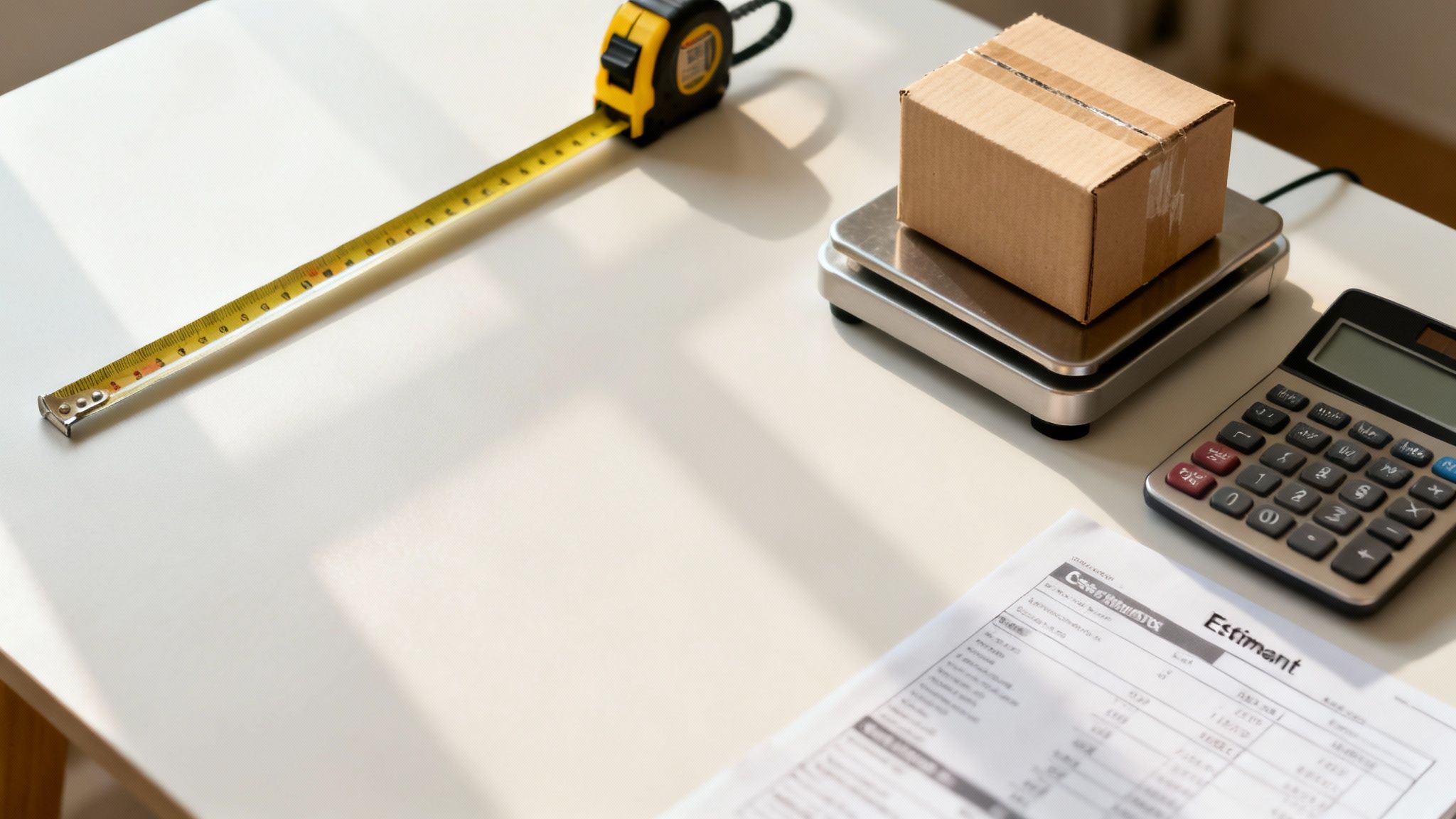
First, you absolutely need to weigh and measure your item after it’s been properly packaged for shipping. A cheap kitchen scale and a tape measure are your best friends here. Don’t guess! Being off by a single ounce or inch can easily bump you into a much more expensive shipping tier.
Once you have the final weight and dimensions, use the platform’s built-in shipping calculator to get an accurate cost. This lets you decide whether to charge the buyer for that exact amount or to roll the cost into your item price and offer that ever-so-tempting “free shipping.”
Here are a few tricks I’ve learned to keep shipping costs down:
- Use Free Supplies: Carriers like USPS, UPS, and FedEx offer free boxes and mailers for their priority services. You can order them online and get them delivered right to your door. It’s a game-changer.
- Recycle Packaging: Don’t throw away those Amazon boxes! Reuse them and the packing materials inside. Just make sure you cover up or remove all the old labels so there’s no confusion.
- Choose the Right Service: For lighter items (under a pound), USPS Ground Advantage is almost always your cheapest bet. For heavier, bulkier stuff, UPS Ground or FedEx Home Delivery will usually save you money over Priority Mail.
When you get a handle on these costs upfront, pricing stops being a guess and starts being a strategy. You can set a price that not only gets buyers to click but also ensures you’re actually making money for your effort.
Finding Your Ideal Pricing Strategy
Before you slap a price tag on anything, you need to ask yourself a simple question: What’s my real goal here?
Are you trying to reclaim your living room from the clutter monster by the end of the week? Or are you determined to get top dollar for that designer handbag you’ve hardly used? Your answer changes everything. It’s the compass that guides your entire pricing approach.
There’s no single “right” way to price, but most sellers fall into one of two camps. Figuring out which one you’re in will cut through the noise and help you finally make progress.
The “Build Momentum” Approach: Pricing for a Quick Sale
This is your go-to strategy when your main objective is just to clear space and build momentum. If you’re feeling that all-too-familiar “clutter paralysis,” this method is a lifesaver. The point isn’t to squeeze every last cent out of an item; it’s to turn it into cash fast so you can move on to the next thing. That quick win gives you a dopamine hit that fuels more action.
This approach works best for:
- Common items where you’re up against tons of other sellers.
- Lower-priced goods where an extra dollar or two isn’t worth waiting weeks for.
- Your first few sales when you just need the confidence boost of a quick win.
To price for a fast flip, you’ll want to look at the sold comps you researched and price your item at the lower end of that range. Tactics like auction-style listings on eBay can create a sense of urgency for in-demand items. I also highly recommend enabling the “Make an Offer” feature—it’s a clear signal to buyers that you’re ready to make a deal.
The “Hold the Line” Method: Pricing for Maximum Profit
Sometimes you have an item you know is special. Maybe it’s rare, vintage, or a high-demand brand. This is where patience becomes your greatest asset. The “maximum profit” strategy is all about setting a firm, confident price and being willing to wait for the right buyer who understands its true value.
This strategy is perfect for:
- Rare, vintage, or collectible items.
- Designer goods and high-end electronics.
- Items that are new-with-tags (NWT).
For these items, you’ll set your price at the higher end of the sold comps range, usually with a fixed-price or “Buy It Now” listing. A little bit of pricing psychology goes a long way here, too. For instance, pricing something at $49.99 instead of a flat $50 just feels like a better deal to the human brain.
Luxury goods are a prime example where this strategy pays off big. If DeclutterNow flags a designer bag while you’re sorting your closet, it’s a sign to slow down and do it right. The global secondhand market is booming, and these items hold their value incredibly well. Pricing them at 50-65% of the original retail price is a solid starting point.
Key Takeaway: Pricing for a quick sale creates momentum and clears clutter fast. Pricing for maximum profit takes patience but can significantly increase your earnings on high-value items. Choose your strategy based on the item and your personal goal.
Understanding these different approaches also makes you a savvier shopper. If you love the thrill of the hunt, check out our guide on how to shop for secondhand gifts to find some amazing deals. At the end of the day, matching the right strategy to the right item is the secret to turning your clutter into a rewarding—and profitable—side hustle.
Putting Your Pricing and Listing on Autopilot
So, you’ve got the pricing principles down. But let’s be honest—all that research, number crunching, and manual data entry can start to feel like a second job. It’s exactly that kind of friction that leads straight back to clutter paralysis, where the thought of selling feels just as daunting as the mess itself.
This is where the right tool stops being a nice-to-have and becomes your secret weapon. All those tedious steps, from digging up comps to calculating fees, can be automated. This AI breaks through decision fatigue and frees you up to focus on what actually matters: seeing real progress.
How AI Can Break Through Decision Fatigue
What if that 20-minute listing chore could become a simple, two-minute task? That’s what happens when you put the process on autopilot. Instead of getting lost in a dozen browser tabs and shipping calculators, you can let an AI do the heavy lifting.
The DeclutterNow app was born from personal experience—from staring at boxes that sat for years, stuck in that exact cycle of indecision. That’s why we built an eBay selling assistant directly into our “Trash First” method. Once you decide an item is worth selling, the hardest part of the job is already over.
Take a look at how the app gives you an instant, data-backed price suggestion the moment you snap a photo.
The real magic here is gaining speed and confidence. The AI provides a clear price range based on what’s actually selling, which cuts out the guesswork and second-guessing that so often leads to doing nothing at all.
From Photo to For Sale in Minutes
Here’s a glimpse of how this turns overwhelming tasks into simple actions. You just snap a picture of your item within the DeclutterNow app, and our AI immediately gets to work.
- It scans the market: The system instantly analyzes current and sold listings on eBay to find your item’s real-time market value.
- It suggests a price range: Using that data, it recommends a smart price range. It even gives you options based on your goal, whether you want a fast sale to build momentum or you’re aiming for maximum profit.
- It writes your listing: The assistant then drafts an eBay listing for you, complete with a keyword-optimized title and a solid description designed to attract the right buyers.
The Goal: This isn’t about replacing your judgment; it’s about giving it a powerful starting point with instant, reliable data. You always have the final say, but you’re no longer starting from scratch. You’re starting from a place of knowledge.
This approach is grounded in psychology. It’s designed to create quick wins. Each item you list in just a couple of minutes gives you a little dopamine boost, building the momentum you need to keep clearing things out. It’s the perfect tool to finally get those valuable items out of the “to-sell” pile, listed on eBay, and sold—turning clutter paralysis into progress.
Smart Tactics for Closing the Sale
Getting your item listed is a huge step forward—a genuine win against clutter paralysis. But the work doesn’t stop there. Once your item is live, the next phase begins: managing the listing to make sure it actually sells.
This is where you shift from just listing things to actively managing your little online shop. It’s all about engaging with potential buyers, knowing when to negotiate, and having a solid plan for the items that don’t fly off the shelves right away.
Handling Offers and Negotiations
One of the first things you’ll see are offers, especially if you turned that feature on. Some will be reasonable, but you’ll definitely get some lowball offers that can feel a bit insulting. My advice? Don’t take it personally.
Think of a lowball offer as someone starting a conversation, not insulting your item. You can always decline it outright, but I usually send a counteroffer. A good rule of thumb is to meet them somewhere in the middle. If your item is listed for $40 and they offer $20, countering at $30 is a fair move that shows you’re willing to make a deal.
Pro Tip: Never ignore an offer, even a really low one. A simple, polite “Thanks for the offer, but my price is firm right now” keeps things professional. If you’re open to a deal, something like “I can’t go that low, but I could do [your counteroffer price]” opens the door for a real negotiation.
Reviving Stale Listings
So, what do you do when an item sits for 30 days with no bites? It happens to everyone. This isn’t a dead end; it’s just a signal that your listing needs a little refresh.
Instead of letting it get buried, run through this quick checklist to breathe new life into an underperforming listing:
- Rethink Your Photos: Are they bright, clear, and showing every angle? I find that taking new pictures in natural light against a plain background can make a world of difference. A better main photo is often all it takes.
- Tweak Your Title: Did you use the best keywords? Try adding the brand, style name, color, and size right into the title to make sure it pops up in the right searches.
- Adjust Your Price: Go back and check the latest sold comps for your item. Has the market value shifted in the last month? Dropping the price by just 10-15% can attract a whole new wave of interested buyers.
Sometimes, the best move is to simply end the listing and create a brand new one from scratch. This makes it appear as a “newly listed” item, which bumps it to the top of search results and gives it fresh visibility.
Here’s a quick guide to help you decide whether to simply update your listing or relist it completely.
When to Relist vs. When to Revise
| Situation | Recommended Action | Why It Works |
|---|---|---|
| Item has many “watchers” but no offers. | Revise: Send “Offer to Watchers.” | This targets an already interested audience directly with a small discount, often closing the sale without a full relist. |
| Listing is over 60 days old with zero activity. | Relist: End the listing and create a new one. | A fresh listing gets a “newly listed” boost in the platform’s algorithm, showing it to a new audience. |
| You just need to add more photos or details. | Revise: Simply edit the existing listing. | No need to lose your listing’s history or watchers. A quick update is all you need to provide more info. |
| The market price for the item has dropped. | Revise: Update the price. | A simple price drop can trigger notifications to watchers and make your item competitive again. |
| The platform is running a “free listing” promotion. | Relist: End old listings and relist them. | This is a great time to refresh your entire inventory, taking advantage of promotions to maximize visibility at no cost. |
Making this small strategic choice can make a big difference in getting an older item sold.
The Power of Bundling
For smaller, lower-priced items, you should seriously consider bundling. Let’s be real—selling a single $5 t-shirt might not feel worth the effort after you factor in fees and shipping.
But what if you bundled three similar shirts together as a “$15 Lot“?
Bundling instantly increases the perceived value for the buyer—they feel like they’re getting a great deal. It also makes the shipping cost much more justifiable for them. It’s a fantastic strategy for moving inventory that might be tough to sell individually, helping you clear out clutter faster and boost your profit per package.
Tackling Those Tricky Pricing Questions
Even with a great pricing plan, you’re bound to run into a few tricky situations that leave you scratching your head. I’ve seen it all, and these are the questions that come up time and time again. Let’s get them sorted so you can price your items with confidence.
What’s a Fair Discount for Minor Flaws?
So you’ve found a great shirt, but it’s missing a button. Or maybe there’s a tiny, faint stain on the cuff. First things first: always be upfront. Mention and photograph every single flaw, no matter how small it seems. Trust me, buyers appreciate honesty.
For small, fixable issues like these, I generally start by knocking 15-25% off what I’d ask for a perfect version. This discount acknowledges the imperfection, builds trust, and helps prevent any headaches after the sale. You’re still getting a good price, and your buyer knows exactly what they’re getting.
Auction vs. Fixed Price: Which One Do I Choose?
This is a classic dilemma, and the right answer really depends on what you’re selling. One size does not fit all here.
- Go with an auction when you have something hot on your hands. Think rare, collectible, or super in-demand items—like a vintage concert tee or a limited-run designer bag. An auction creates a sense of urgency and lets motivated buyers bid the price up for you.
- Stick to a fixed price (or “Buy It Now”) for more everyday items. If you can easily find plenty of sold listings for the exact same thing at a pretty consistent price, there’s no need to complicate things. A fixed-price listing is the most direct route to a sale.
Should I Really Offer Free Shipping?
Let’s be real: buyers love seeing the words “free shipping.” It’s a powerful psychological trigger that can make your listing much more attractive than a competitor’s. But we both know there’s no such thing as free shipping—the cost has to come from somewhere.
If you want to offer it, you absolutely have to bake the shipping cost into your asking price. Before you even think about listing, get your item packed, weighed, and measured so you know exactly what it will cost to ship. Add that number to your price. If you don’t, you’re just eating into your own profits.
Help! My Item Has Zero Sold Comps.
Every now and then, you’ll find something so unique you can’t find a single sold example anywhere. It’s a fun challenge, but it can also be a bit nerve-wracking. This is when you have to put on your detective hat.
Start by looking for sold items that are similar. Search for the same brand, a similar style, or items from the same era. This will give you a ballpark to start from. Then, list your item with a fixed price on the higher end of that range and—this is the most important part—turn on the “Make an Offer” feature. This is a brilliant way to let the market do the work. The offers you get will tell you exactly what people are willing to pay for your one-of-a-kind find.
Feeling stuck is normal, but you don’t have to do it alone. DeclutterNow turns the overwhelming task of pricing and listing into a few simple taps, helping you finally turn that clutter paralysis into progress.