
Before you even think about buying a single new hanger, let's talk about what's really holding you back. The secret to maximizing your wardrobe space isn't about fancy organizers; it’s about conquering clutter paralysis. If you’ve ever stared at boxes that have been sitting there for years, feeling completely stuck, you know the feeling. The breakthrough comes from making one small, easy decision at a time. This way, you build real momentum instead of getting paralyzed by the impossible goal of a perfect closet overnight.
Breaking Through Your Wardrobe Overwhelm
If you've ever opened your closet doors, felt a wave of exhaustion, and just walked away, you get it. I’ve been there too, staring at clothes I hadn't worn in a decade, paralyzed by the sheer volume of stuff.
That feeling isn't laziness—it's decision fatigue. Your brain is literally overwhelmed by the hundreds of choices you have to make. What stays? What goes? What if I need it someday? It's a mental logjam, and it's why so many of us feel completely stuck.

Unfortunately, a lot of traditional decluttering advice just makes it worse. You're told to pull everything out at once or to ask deep, emotional questions like, "Does this spark joy?" right out of the gate. For someone already struggling with decision fatigue, that’s a recipe for disaster, reinforcing the feeling that the project is just too big to handle.
The Power of Progress Over Perfection
The real breakthrough happens when you change the goal. Stop aiming for a perfect closet in one afternoon. Instead, just try to make one easy decision right now. This is the simple but psychology-backed idea behind the "Trash First" method.
We don't start by asking 'Does this spark joy?' We start by asking, 'Is this actually trash?' This simple question requires almost no emotional energy and gives you an instant quick win.
This is all about building momentum. Every easy win—tossing a broken hanger, a sock with a hole, or a hopelessly stained t-shirt—gives your brain a little hit of dopamine. It’s a reward that makes you feel accomplished and motivates you to keep going. It's one of the most practical decluttering tips for beginners because it builds the confidence you need for the tougher decisions later on.
To really see the difference, let’s compare the two mindsets.
Mindset Shift for Wardrobe Decluttering
| Frustrating Old Way | Effective New Way (Progress over Perfection) |
|---|---|
| Goal: A perfectly organized closet, now! | Goal: Make one easy decision today. |
| First Action: Pull everything out at once. | First Action: Find one obvious piece of trash. |
| Key Question: "Does this spark joy?" | Key Question: "Is this broken, stained, or useless?" |
| Emotional State: Overwhelmed, anxious, paralyzed by decisions. | Emotional State: Accomplished, motivated, in control. |
| Result: A bigger mess and abandoned project. | Result: Small wins that build momentum. |
Adopting the "Progress over Perfection" mindset is what turns a dreaded chore into a manageable, and even rewarding, project.
It's a shift that reflects a much larger trend. The market for closet organizers is booming, projected to jump from $7.64 billion to $11.15 billion by 2029. As our living spaces shrink, people are catching on that turning overwhelm into action starts with a clear mind, not just a cart full of containers. You can dig into more closet organization market trends if you're curious.
Your Decluttering Game Plan
Alright, let's get down to business. It's time to turn that feeling of being stuck into actual, visible progress. Forget the old method of dumping everything you own onto your bed—that just creates a bigger mess and more decision fatigue. Instead, we’re going to use a psychology-backed approach called the "Trash First" method, designed to sidestep clutter paralysis completely.
It’s surprisingly straightforward when you have a tool like the DeClutter Now app in your corner. You don’t have to confront the entire wardrobe at once. Just pick up a single item you’re unsure about and snap a quick photo.
The app's AI helps break through the decision fatigue, guiding you through sorting your stuff into the classic Four-Box Method: Keep, Relocate, Donate/Sell, or Trash. The real magic, though, is in starting with the easiest possible wins to build momentum.
Start with Trash, Build Momentum
Seriously, don't even think about that sentimental jacket from college or your favorite, slightly-too-small jeans just yet. We're going straight for the low-hanging fruit. This is the secret to making real, lasting progress.
We’re talking about the no-brainers:
- The lone sock: Its mate has been MIA for months. Let it go.
- The stained t-shirt: The one you keep meaning to treat but never do.
- The broken hanger: It snags everything and is more trouble than it's worth.
- The worn-out leggings: You know the pair—they’re more sheer than fabric now.
Each of these decisions is a tiny, satisfying quick win. It’s a little dopamine hit that proves you can do this and fuels you to keep going. The app leans into this by turning the chore into a game, rewarding you with points and streaks for every item you sort.
The Growing Demand for Smart Space
If you feel like everyone is suddenly obsessed with organization, you’re not wrong. The desire for a maximized, functional wardrobe is a massive global movement. The market for wardrobes and smart storage solutions has already soared to $66.31 billion worldwide and is projected to hit a staggering $108 billion by 2032.
What’s driving this? Mostly, it’s urbanization. As more of us live in smaller spaces, getting clever with storage isn't a luxury; it's a necessity. In the U.S. alone, the market is expected to reach $17.10 billion by 2032. You can dig into the numbers yourself and check out the latest wardrobe market insights to see the full picture.
This huge demand just goes to show you're definitely not alone in craving a more functional space.
By starting with the easy stuff—the actual trash—you’re not just clearing out junk. You’re building the mental muscle you'll need for the tougher decisions ahead, turning that feeling of being stuck into real forward motion, one photo at a time.
Turning Unwanted Clothes Into Cash
Let’s be honest. One of the biggest things that stops us from decluttering is guilt. You look at that pile of clothes—some of them expensive, many of them perfectly fine—and you just can't bring yourself to toss them. The thought of it feels wasteful, and that feeling is exactly why those items end up squatting in your closet for years.
But what if you flipped the script? Instead of a loss, think of it as a gain. That pile of unworn clothes isn't just dead weight; it’s a pile of cash waiting to be claimed. This shift in thinking can be the exact motivation you need to finally turn clutter paralysis into progress.
This decision tree gives you a simple way to process each item, helping you move from a quick photo to a final, confident decision.
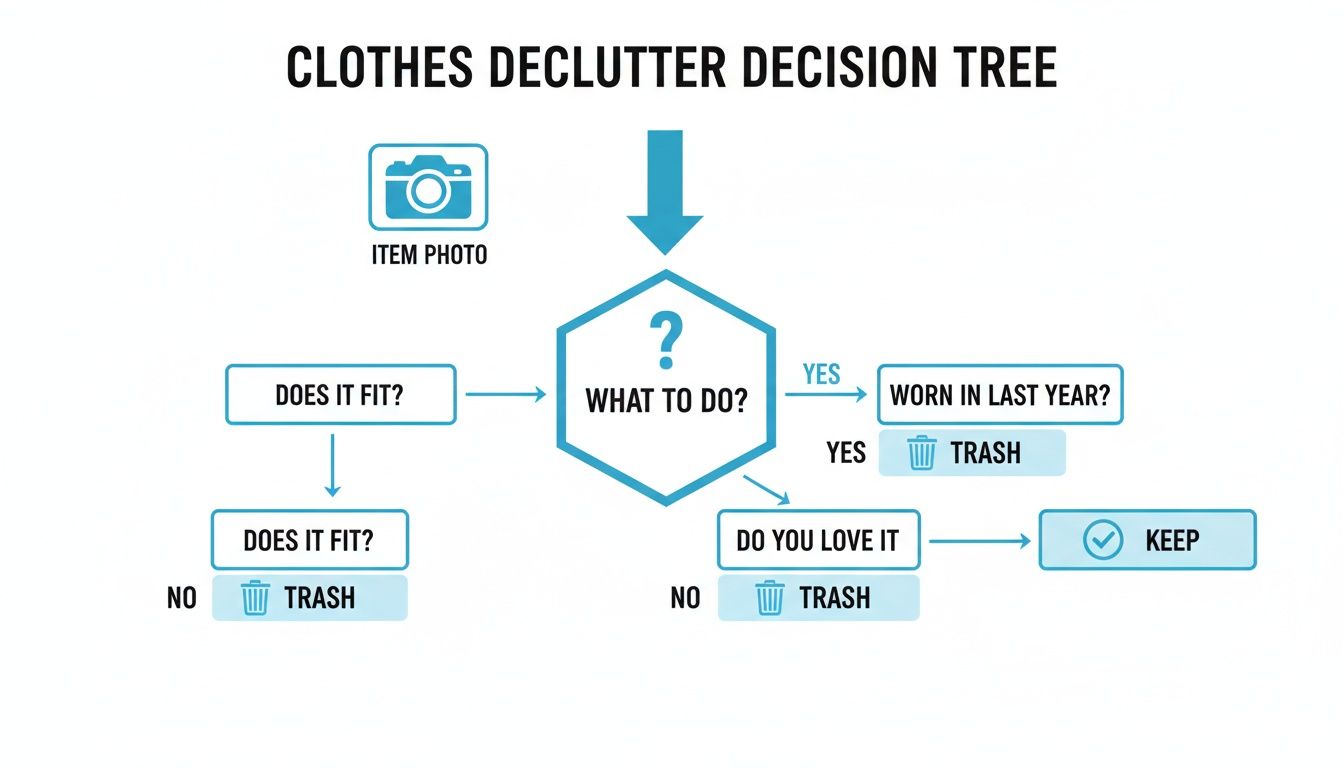
The real magic here is taking a huge, overwhelming project and breaking it down into a series of small, easy "yes or no" questions. That's how you build momentum.
From Closet Clutter To Profitable Side Hustle
The biggest reason most of us never get around to selling our clothes online is the sheer hassle. Taking good pictures, writing descriptions that sell, figuring out how much to ask for it… it’s a massive time sink. More often than not, it just doesn't feel worth the effort.
This is where a tool like DeClutter Now can completely change your perspective. Its built-in AI assistant takes care of all the tedious work, turning a dreaded chore into a few quick taps on your phone.
Here’s a look at how it streamlines the process:
- Snap a Photo: Just like you did when you were sorting, you start by taking a quick picture of the item you're ready to sell.
- Get Instant Help: The AI immediately identifies the item—say, a "J.Crew navy blue blazer, size 8"—and whips up a title and detailed description optimized for what buyers are actually searching for.
- Receive Pricing Guidance: No more guessing games. The tool analyzes what similar items have sold for recently and suggests a competitive price.
- Publish in Minutes: With the listing basically written for you, you can push it live to your eBay account in a couple of minutes.
What used to take me an hour for a single item now takes less than five minutes. This kind of efficiency means you can finally tackle that "sell" pile without giving up your entire weekend.
The Momentum of Making Money
When you start thinking of decluttering as "cashing in on my assets" instead of "getting rid of stuff," something powerful clicks. Every sale becomes a small victory, a tangible reward that fuels you to keep going.
This approach is a game-changer for those high-quality pieces you’ve been struggling to part with. That designer dress you wore to one wedding? Those amazing shoes that never quite fit right? They’re no longer a sunk cost collecting dust. They're an opportunity.
By making the selling process practically effortless, you remove the last excuse standing between you and a closet you love. You can finally make progress on those boxes that have been sitting in the corner for years.
Smart Storage and Organization That Works
With the excess gone, it's time for the fun part—thoughtfully organizing what you've decided to keep. This isn’t about running out to buy a hundred matching bins. The real goal is to maximize your wardrobe space with strategies that make your closet work for you, not against you.
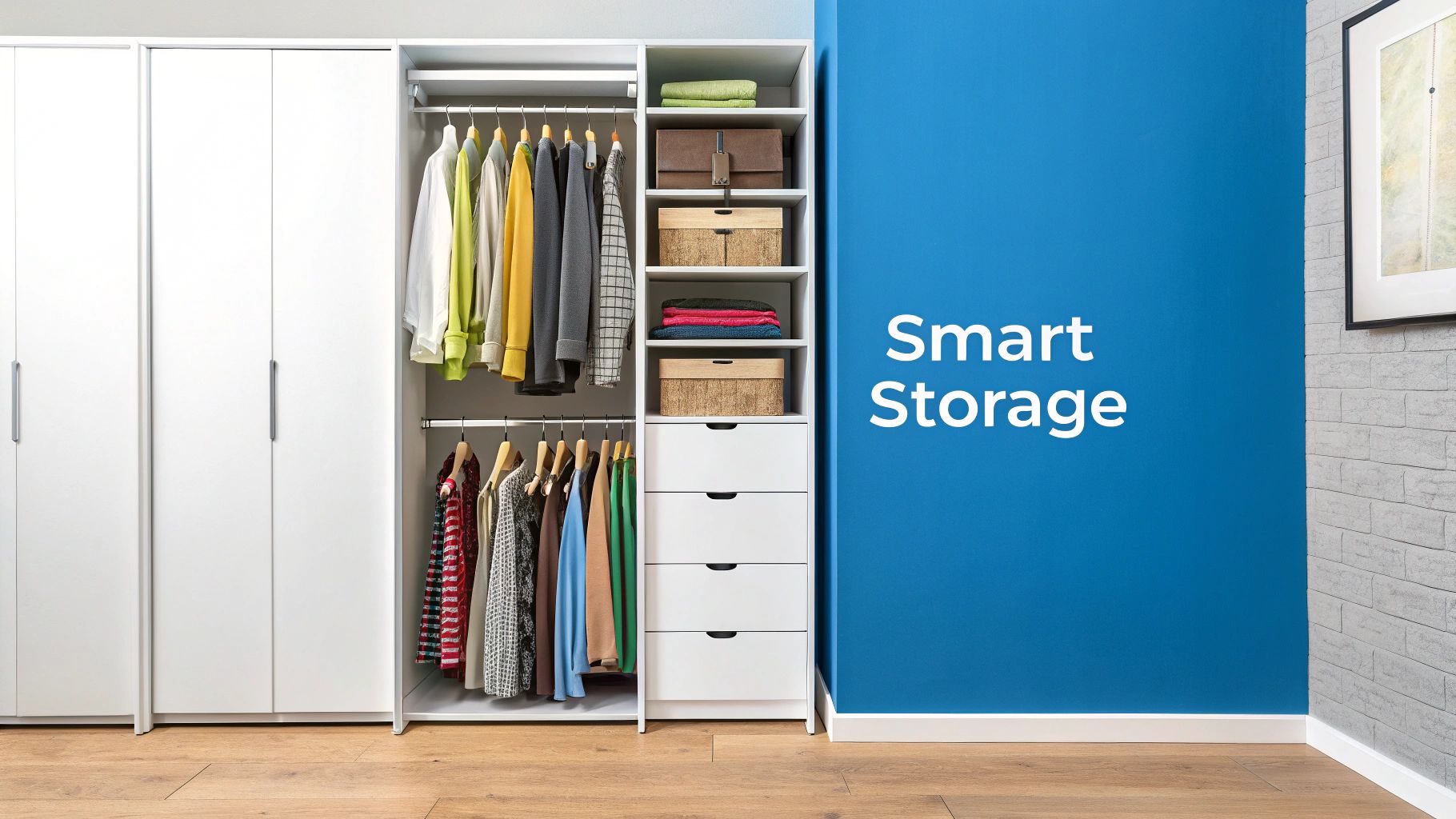
Real organization comes down to two things: visibility and accessibility. If you can see an item, you're much more likely to wear it. It’s that simple. This principle alone can break the cycle of wearing the same 20% of your clothes 80% of the time.
Rethink Your Hanging Space
Your closet rod is prime real estate. If you want to make a big impact fast, start by switching to uniform, slimline hangers. You’d be shocked at how much room those bulky plastic and wooden hangers are stealing.
- Slim Velvet Hangers: These are a true game-changer. Their thin profile can instantly free up as much as 30% more rod space. Plus, the non-slip surface means your clothes actually stay on the hanger.
- Tiered Hangers: Ideal for pants or skirts, these let you hang multiple items vertically, using the space of just one hanger.
This one swap is a high-impact, low-effort quick win that makes your entire closet feel more spacious and look more polished. It’s one of the easiest clothes storage ideas you can tackle in under an hour.
Go Vertical in Every Zone
Most closets are full of wasted vertical space—that dead air above the rod, the empty area below your hanging clothes, and the back of the door. It's time to put that space to work.
Start by thinking about your clothes in categories, not just by type (like shirts and pants), but by function. Group them into "work," "weekend," "gym," and "formal." This not only makes finding what you need a breeze but also instantly highlights where you have duplicates.
The goal is to create a system where you can grab what you need without disturbing anything else. Shelf dividers, for example, are brilliant for stopping those sweater piles from toppling over. Over-the-door organizers are perfect for shoes, belts, or scarves.
This need for smarter, space-saving solutions isn't just a personal struggle; it’s a global trend. Urban living is changing how we store everything. In fact, the Asia-Pacific region now commands 42.7% of the entire wardrobe market. In densely populated cities like Seoul and Bangkok, where homes are smaller, stackable boxes and adjustable rails aren't just a nice-to-have—they're essential.
This demand is what's driving the closet organizer market, which is projected to more than double from $4.03 billion to $8.53 billion by 2035. It's a clear sign that clever storage is the future.
By putting these practical methods into practice, you’re not just tidying up. You're building a functional system that makes getting dressed easier and more enjoyable every single day.
Building a Maintenance Routine That Sticks
You’ve done it. You've made progress. The donation bags are gone, the trash is out, and you can actually see the back of your closet. But now for the real test: how do you keep that hard-won space from slowly getting buried all over again?
The secret isn’t another marathon decluttering session a few months from now. It's all about building a few simple, sustainable habits that prevent the chaos from ever coming back. This is how you lock in your progress and make that feeling of calm a permanent part of your life.
Adopt the One-In, One-Out Rule
If you only adopt one new habit, make it this one. The One-In, One-Out Rule is hands-down the most effective way to keep your wardrobe in check for the long haul. It's incredibly simple: every time a new piece of clothing comes in, a similar item has to go out.
- Scored a new pair of jeans? Awesome. Now pick an older pair to donate or sell.
- Bought that sweater you've had your eye on? Great, now find one you didn't touch all last season and let it go.
This little rule forces you to be intentional with every purchase. It’s the perfect antidote to the mindless accumulation that led to the clutter in the first place. You stop being a passive consumer and start becoming an active curator of your own closet.
This isn't about deprivation. It's about being deliberate. You're no longer just collecting clothes; you're thoughtfully maintaining a wardrobe filled only with things you genuinely love and wear.
The 10-Minute Weekly Reset
We all know about the "chair-drobe"—that pile of once-worn clothes that seems to grow on its own. To keep that and other minor messes from taking over, block out just 10 minutes once a week for a quick reset. I find Sunday evenings work perfectly for this.
This isn’t about deep cleaning. It's a quick, focused tidy-up to hit the reset button before the week begins.
Here’s what to tackle in your 10 minutes:
- Put everything back in its home. That jacket on the chair? Hang it up. Those shoes by the door? Back in the closet they go.
- Make immediate decisions. Wore something this week and realized it has a stain you can't get out or it just doesn't fit right anymore? Don't put it back in the closet. It goes straight into your donation bag.
- Spot redundancies. While putting away clean laundry, you might notice you have five black t-shirts when you only ever wear two. This is a great time to make a mental note and learn how to get more wear out of a piece of clothing to get the most from what you decide to keep.
This quick, proactive habit stops tiny messes from turning into a weekend-destroying project. Think of it less as another chore and more as a small investment in preserving the peace and order you worked so hard to create.
Got Questions? We’ve Got Answers.
Even with the best plan in hand, you're bound to hit a few snags when tackling a packed closet. It's totally normal. Here are some of the most common questions we get from people who feel stuck, along with some practical advice to get you moving again.
"I'm Too Overwhelmed to Start. What's the Absolute First Thing I Should Do?"
Forget the clothes for a minute. Seriously. Just grab a trash bag.
Walk over to your closet and pull out the obvious, undeniable garbage. I’m talking about the empty hangers, the plastic from the dry cleaner, old receipts stuffed in pockets, and those shopping bags you crumpled up in the corner.
This takes zero emotional effort. You don't have to make a single hard decision.
But what it does do is give you an immediate quick win. It breaks that feeling of being paralyzed and proves you can take action. It's the tiny bit of momentum you need to build on.
How Is This "Trash First" Idea Different from the KonMari Method?
It all comes down to the starting point. The KonMari Method is wonderful, but it asks you to begin by holding every single item and asking a deep, personal question: "Does this spark joy?" For someone who's already overwhelmed, that's a huge emotional ask. It can be draining before you've even really begun.
Our psychology-backed approach is different. We deliberately sidestep that emotional hurdle by starting with the easiest question imaginable: "Is this actual trash?"
We focus on building momentum first. By clearing the junk, you build confidence and create physical space, which makes the tougher, more emotional decisions about your clothes feel much more manageable later on. It’s a practical first step designed to turn that feeling of "I can't" into "Okay, what's next?"
"What If I Get Rid of Something and Regret It Later?"
This is probably the number one fear that keeps people from making progress. It's why so many of us have boxes that haven't been opened in years. The good news is, our process is built to minimize this risk. You start with things that are broken, stained, or don't fit, so you aren't making high-stakes choices right out of the gate.
For anything you're genuinely on the fence about, create a "decide later" box.
- Put all those "maybe" items inside.
- Seal it up and write a date on it—say, six months from now.
- Stick it in the garage, a storage closet, or somewhere else out of sight.
If you haven't even thought about opening that box by the date you wrote on it, you can donate the whole thing with confidence, without even looking inside again. It’s a safety net that lets you move forward without being haunted by the fear of making a mistake.
"Any Specific Storage Hacks for a Really Small Closet?"
Absolutely. When you're working with a tiny closet, you have to think vertically. The goal is to use every single inch, from the floor all the way up to the ceiling.
A few game-changers we always recommend:
- Slim Velvet Hangers: This is the fastest, easiest way to magically create more space. Their thin profile can seriously increase how much you can fit on the rod.
- A Second Closet Rod: If you have the vertical height, adding a second rod for double-hanging shirts, skirts, and folded pants is a no-brainer.
- Over-the-Door Organizers: Don't forget the back of the door! It's prime real estate for shoes, scarves, belts, and other accessories.
- Under-Shelf Baskets: These slide right onto your existing shelves, creating a new layer of storage for folded sweaters, jeans, or T-shirts.
Ready to finally turn clutter paralysis into progress? DeClutter Now uses these kinds of psychology-backed methods to turn overwhelming projects into simple, rewarding steps.