
How to organize a cluttered home. My journey with clutter didn’t start with a desire for a minimalist home. It started with boxes. Boxes that had been sitting in my garage for years, filled with things I couldn’t decide what to do with. Every time I looked at them, I felt completely frozen. The best way I found to organize my cluttered home wasn’t to start organizing at all. It was to grab a single trash bag and just find the obvious, no-brainer garbage. This tiny step was the only thing that shattered that feeling of being completely overwhelmed and finally helped me make progress.
Why You Feel Stuck: It’s Clutter Paralysis, Not Laziness
Have you ever stood at the doorway of a room, looked at the chaos, and felt completely frozen? You’re not alone. Those boxes that have been sitting there for years aren’t a sign that you’re lazy; they’re a symptom of a very real phenomenon called clutter paralysis. It’s that awful sensation of being so swamped by the sheer number of things that your brain just hits the brakes, making it feel impossible to even begin.
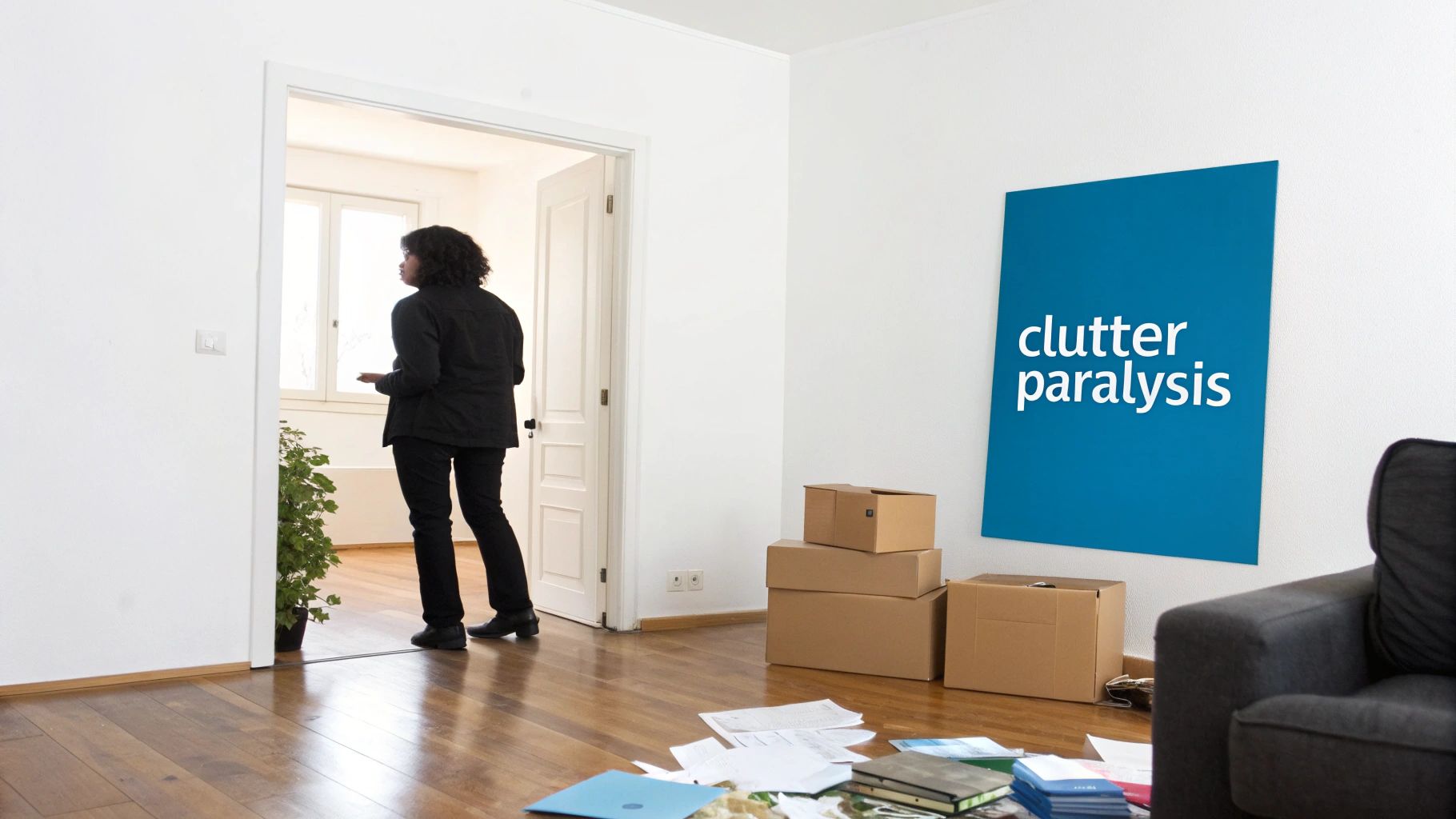
This mental gridlock is caused by something called decision fatigue. Every single item in a cluttered room represents a question. Should I keep this? Where does it even go? Is it valuable? Will I ever need it again? When you multiply that by hundreds—or thousands—of items, it’s genuinely exhausting for your brain.
The core problem isn’t a lack of desire to get organized; it’s the mental energy required to make countless decisions. It’s not a character flaw—it’s cognitive overload.
The True Cost of Clutter
This feeling of being stuck has real-world consequences. The constant visual noise can be a major source of stress. In fact, research shows a link between clutter and higher levels of cortisol, the body’s main stress hormone. This gets even tougher in modern life. With over half the world’s population living in urban areas, our homes are getting smaller, which only magnifies the pressure of owning too much stuff.
This mental burden is about more than just stress, though. It can drain your ability to focus, make it hard to relax, and steal your sense of peace in what should be your sanctuary. The first real step to breaking free is to understand that you are not your clutter. If you’d like to explore this mindset shift further, check out this guided meditation to clear your mind and your space.
Shifting from Shame to Strategy
A lot of common organizing advice fails because it pushes you to tackle the hardest decisions first, like sorting through a box of sentimental photos. That approach completely misses the point: your decision-making battery is already drained.
To finally make progress, you need a different game plan—one that works with your brain’s need for momentum, not against it. Instead of trying to scale the entire mountain in one go, the goal is to find the smallest, easiest pebble to move first. This is where a psychology-backed decluttering strategy changes everything. By starting with “quick wins,” you build a positive feedback loop that turns clutter paralysis into progress.
Start with Trash, Build Momentum
When you’re standing in a room that feels like a disaster zone, the last thing you want to hear is some well-meaning advice to ask yourself, “Does this spark joy?”
That question requires serious mental and emotional energy—the very things you don’t have when you’re paralyzed by clutter. This is exactly why so many traditional methods fail before they even begin. They make you tackle the hardest decisions first.
We’re going to flip the script entirely.
We don’t start with “does this spark joy?” We start with a much simpler question: “Is this actually trash?” This is the core of the “Trash First” methodology, a strategy grounded in psychology that’s designed to help you break through decision fatigue with quick wins.
Forget about sorting your entire life’s possessions right now. For the next 15 minutes, your only mission is to grab a trash bag and hunt for the obvious, undeniable garbage. That’s it. No agonizing choices, no trips down memory lane. Just trash.
Why This Simple Trick Actually Works
Every single decision you make, big or small, taps into a limited supply of mental energy. When you’re surrounded by clutter, that energy reserve is already running on fumes. The “Trash First” approach works so well because it requires almost no decision-making power. You already know that a crumpled fast-food bag or an expired coupon is trash; you don’t need to debate its future.
Each piece of trash you toss is a completed task—a tiny victory. This simple act triggers a little hit of dopamine in your brain, the chemical messenger linked to pleasure and motivation. It’s a small reward that says, “Hey, you did something! Let’s do it again.” This is how you build real momentum, not by aiming for perfection right out of the gate.
Think of it like this: Instead of trying to push a stalled car up a steep hill, you’re just clearing the small rocks from in front of the tires. It’s the easiest first step, and it makes the next, bigger push feel possible.
Your 15-Minute Trash Hunt Checklist
Not sure what qualifies as a no-brainer item to toss? Grab a bag, set a timer for 15 minutes, and just go. Your only goal is to fill that bag.
Here’s what to look for:
- Paper & Mail: Junk mail, old receipts you don’t need for taxes, expired coupons, outdated magazines, and used envelopes.
- Kitchen & Pantry: Empty food boxes, old condiment packets from takeout, product packaging from new gadgets, and expired spice jars.
- Office & Desk: Broken pens that have run out of ink, dried-up markers, old sticky notes with scribbles, and empty ink cartridges.
- Bathroom & Vanity: Empty shampoo bottles, expired makeup or sunscreen, old toothbrushes, and used-up cotton balls.
- Living Areas: Dead batteries, worn-out coasters that are falling apart, and packaging from electronics you bought years ago.
Remember, this isn’t about deep cleaning or organizing. It’s a treasure hunt for the obvious stuff. You will be absolutely amazed at how much you can clear in just 15 minutes and, more importantly, how much lighter the space (and your mind) will feel afterward.
By focusing only on trash, you completely sidestep the emotional weight of decluttering. You’re not deciding the fate of family heirlooms; you’re just throwing away an old grocery list. This small, repeatable action is the most powerful way to turn that overwhelming feeling of paralysis into the tangible feeling of progress. You’re proving to yourself that you can do this, one piece of trash at a time.
Using The Four-Box System To Sort Without Stress
Once you’ve cleared out the obvious rubbish, you’ve created a small but powerful wave of momentum. It’s time to ride that wave with a simple, structured sorting system that takes the guesswork out of what to do with everything else.
I’m talking about the Four-Box Method. This isn’t about agonizing over every little thing; it’s about giving every item you touch a clear, immediate destination. This simple framework is the key to bypassing that “I don’t know what to do with this, so I’ll just put it back down” problem that absolutely kills progress.
Setting Up Your Sorting Station
Before you touch a single item, get your workspace ready. Grab four containers—cardboard boxes, laundry baskets, or even just designated spots on a tarp will do. Label them clearly:
- Keep
- Donate / Sell
- Relocate
- Recycle
Place them in the room you’re working on to create a central sorting hub. This simple setup transforms the vague idea of “decluttering” into a concrete, physical process.
This visual guide shows just how simple the decision-making process can be when you’re just getting started.
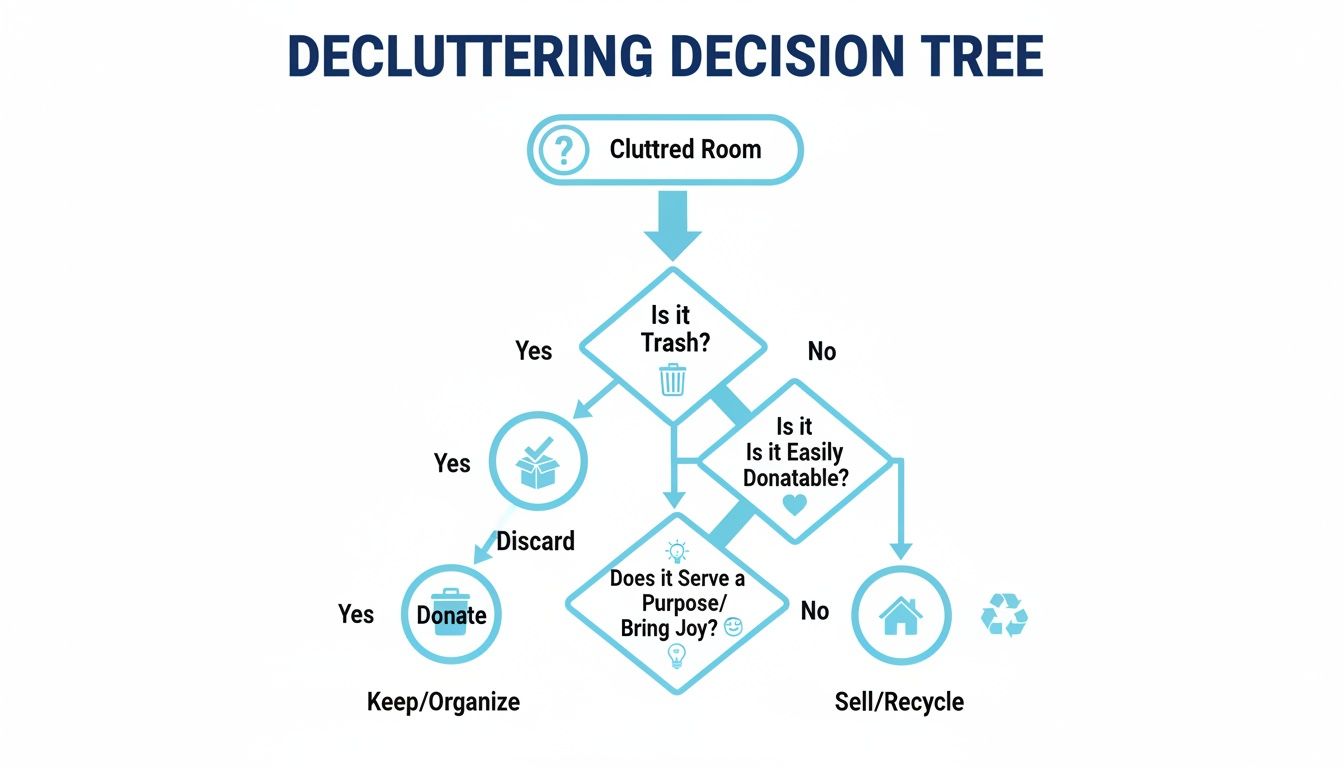
The key takeaway here is that momentum starts with the easiest possible choice—identifying trash. That alone clears the path for the slightly tougher decisions to come.
Making Quick Sorting Decisions
With your boxes ready, pick up one item at a time. Seriously, just one. Resist the urge to tackle an entire shelf or drawer at once. Your only job is to decide which of the four boxes it belongs in right now.
Below is a quick-reference guide to help you make fast, effective sorting decisions for every item in your home.
The Four-Box Decluttering Method
| Box Name | What Goes Inside | Actionable Next Step |
|---|---|---|
| Keep | Items you actively use, genuinely love, and that belong in the room you are currently sorting. | Find a permanent, designated “home” for the item in this room once your sorting session is complete. |
| Donate/Sell | Things that are in good condition but no longer serve a purpose for you. Think clothes, unused gadgets, books. | Place in your car for the next donation run or use our eBay assistant to list valuable items for sale. |
| Relocate | The unsung hero! Anything you are keeping but that belongs in a different room (e.g., mugs in the bedroom). | At the end of your session, take this box around the house and put everything back where it actually belongs. |
| Recycle | Items that can’t be donated but shouldn’t go to a landfill, like old electronics, paper, glass, or certain plastics. | Check your local municipality’s guidelines and schedule a drop-off or place in the correct curbside bin. |
This system provides a clear path forward for every single item, eliminating the indecision that drains your mental energy and stalls progress.
A useful variation I’ve seen work well is the ‘5-box method,’ which adds an ‘undecided’ box for those tricky items. Interestingly, research shows that households using this slightly modified system tend to donate 22% more items, freeing up an average of 15 square feet of space.
The “Relocate” box is especially important. It’s for all the things you want to keep, but that have migrated to the wrong part of the house. A coffee mug from the bedroom, your kid’s toys from the living room, a screwdriver from the kitchen junk drawer—they all go in here.
Whatever you do, don’t leave the room to put them away one by one! That completely breaks your focus and kills your momentum. Just toss them in the box and deal with them all at once when your sorting session is over.
If you find this approach helpful and are curious about other structured systems, we’ve compiled a guide on various decluttering methods that build momentum. By giving each object an immediate, logical destination, you can finally sort through your home without getting stuck.
Your Room-By-Room Action Plan for Tangible Progress
This is where the theory ends and the real work begins. You’ve got the “Trash First” mindset and the Four-Box Method in your back pocket. Now, it’s time to unleash that system on the clutter hotspots that have been driving you crazy.
The secret is to stop thinking big. You’re not “decluttering the kitchen” today. You’re just tackling the junk drawer.
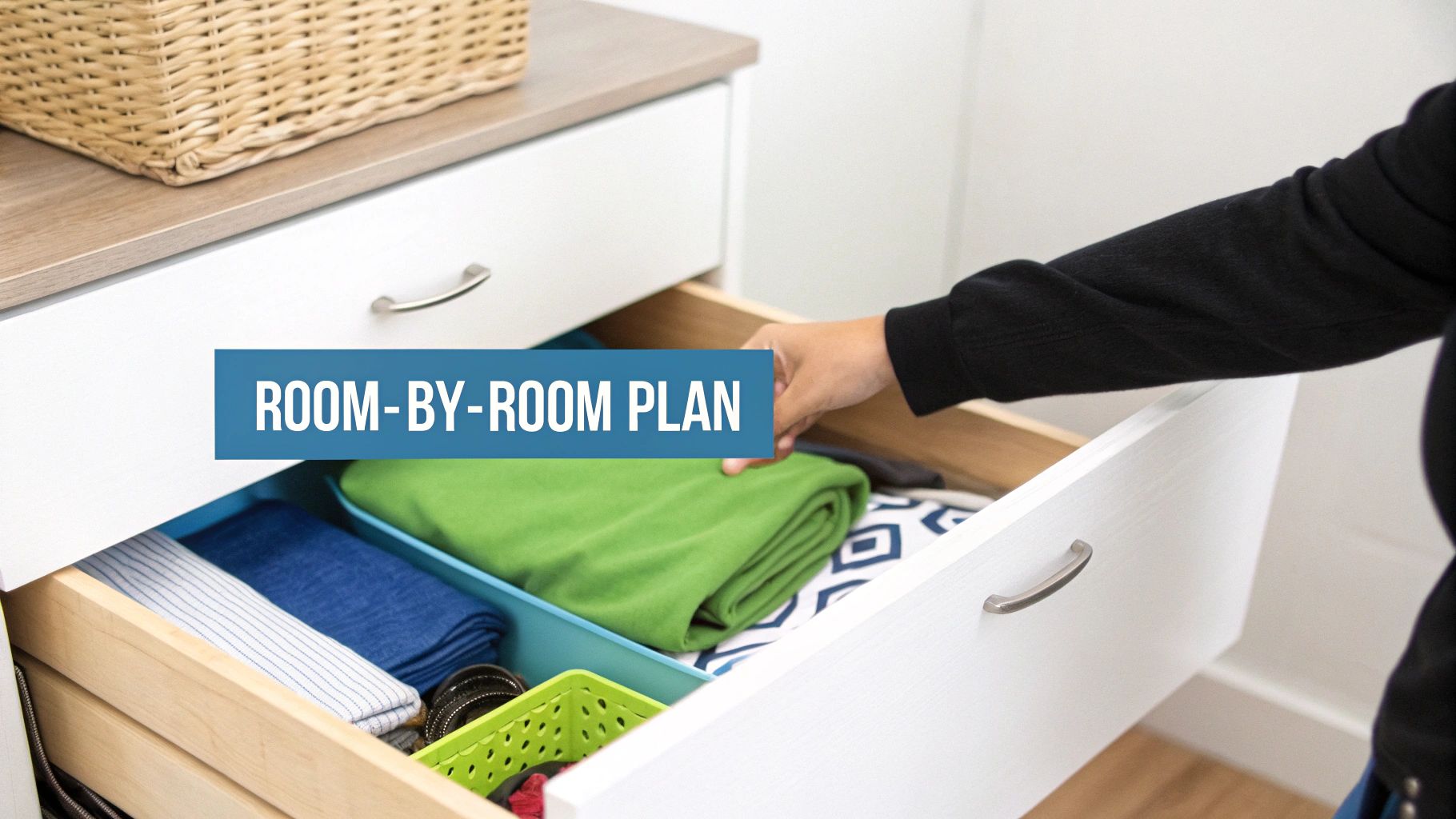
This simple shift breaks overwhelming spaces down into a series of small, manageable tasks—most of which you can knock out in 15 minutes or less. Every small win builds the confidence and energy you need to keep going.
Start with the Kitchen: The Heart of Clutter
The kitchen is the command center of most homes, which unfortunately means it’s a magnet for things that have no business being there. Mail, keys, half-finished homework, and stray gadgets all seem to land on the counters.
- First Target: The Junk Drawer. We all have one. Set a timer for 15 minutes, pull everything out, and unleash your Four-Box Method. You’ll be shocked at how many dried-up pens, single-use sauce packets, and mystery keys you can clear out in no time.
- Next: Conquer One Counter. Pick the counter that bugs you the most. Take everything off it. Give it a good wipe down. Now, only put back the absolute essentials you use every single day, like the coffee maker or toaster. Everything else gets sorted into your boxes.
- Then: One Cabinet at a Time. Start with an easy win. Maybe it’s the food storage container cabinet where mismatched lids and bottoms go to die. Pair them up, recycle the orphans, and enjoy that immediate hit of satisfaction.
Your goal isn’t a perfect, magazine-worthy kitchen in a single afternoon. The goal is to make one small part of your kitchen visibly, undeniably better. That tangible progress is the fuel that keeps you going.
Tackle the Bedroom: Your Sanctuary
Your bedroom should be a retreat, but it often ends up as a holding cell for clothes and random belongings. Let’s focus on the two biggest culprits that are stealing your peace.
- The “Chair-drobe.” You know the one—that chair in the corner buried under a pile of clothes. It’s time for an intervention. Pick up one item at a time. If it’s dirty, it goes in the hamper. If it’s clean, hang it up or put it away. This one act can change the entire feel of the room in less than 10 minutes.
- The Closet Floor. The floor of a closet can quickly become a black hole for shoes, bags, and discarded outfits. Again, focus on one item at a time. Put shoes on a rack, hang up belts, and put fallen clothes back on their hangers. You don’t have to reorganize the whole closet right now—just clear the floor.
Move to the Living Room: The Public Face
This is the space where clutter impacts everyone—your family, your guests, and you. The main offender here is almost always surface clutter. Flat surfaces are practically begging for stuff to be put on them.
- The Coffee Table Reset. Clear it completely. Sort through the old magazines, scattered remotes, and random papers. Only put back a few intentional items, like a couple of books or a decorative tray.
- Media Center Mayhem. That shelf is a goldmine for quick wins. DVDs you haven’t watched in a decade? Old video game controllers? Expired warranties for electronics you no longer own? This is a prime spot to fill up your “Trash” and “Donate/Sell” boxes.
Conquer the Garage: The Final Frontier
The garage often feels like the most intimidating space of all. It’s a dumping ground for tools, sports gear, seasonal decorations, and those boxes that haven’t been opened in years.
- Start with One Zone. Don’t even think about tackling the whole garage at once. Pick one corner, one workbench, or one shelf. That’s your entire focus.
- Consolidate Similar Items. Gather all the gardening tools into one pile. All the car-cleaning supplies in another. Just seeing everything you have in one place is a huge, eye-opening step. This simple category-based approach is incredibly effective; the home organization market is projected to hit $13.27 billion in 2025, partly because methods like this can reduce clutter by 40% in the very first session. If you’re curious, you can learn more about these powerful market trends and how they’re helping people reclaim their space.
- Handle Seasonal Items. Group holiday decorations, camping gear, or beach toys together and store them in clearly labeled bins.
By breaking each room down into these tiny, actionable steps, you’re doing more than just cleaning. You’re systematically dismantling the overwhelm, proving to yourself with each cleared drawer and empty counter that you absolutely can do this. This is how you organize a cluttered home—not with one giant leap, but with a series of small, steady steps forward.
How to Keep Clutter from Coming Back
You’ve done it. You’ve faced down the piles, filled the bags, and carved out a space you can finally breathe in. The feeling is incredible, but a quiet fear often creeps in right behind it: How do I stop this from happening all over again?
Let’s be real: maintaining an organized home isn’t about another marathon weekend of sorting. It’s about building small, sustainable habits that prevent clutter from ever getting a foothold again. This is where you shift from a one-time project to a new way of living, making sure your hard-earned progress sticks. It’s about building momentum, not chasing some impossible ideal of perfection.
Adopt the One-In, One-Out Rule
One of the sneakiest ways clutter reappears is through seemingly innocent, everyday accumulation. A new shirt here, a new book there—before you know it, you’re right back where you started. The one-in, one-out rule is your secret weapon, a simple pact you make with yourself to stop this cycle dead in its tracks.
The concept couldn’t be easier: every time a new, non-consumable item crosses your threshold, a similar item must leave.
- Buy a new pair of jeans? Great! An old pair goes directly into the donation box.
- Get a new coffee mug as a gift? Time to choose one you no longer love to pass along.
- Kids get a haul of new toys for their birthday? Part of the fun is having them pick out an equal number of old toys to give to someone else.
This isn’t about depriving yourself; it’s about becoming a mindful consumer. It forces you to pause and really assess what you need and value, turning your home into a curated space rather than just a storage unit.
This single habit completely changes your relationship with your belongings. Instead of passively accumulating stuff, you become an active gatekeeper of your space, making conscious decisions that protect your hard-won peace.
Master the 15-Minute Nightly Reset
The end of the day is when a home often looks its most chaotic—mail on the counter, shoes kicked off by the door, a stray glass on the coffee table. The temptation is to leave it for tomorrow, but that’s exactly how small messes snowball into overwhelming clutter paralysis.
Your defense is the 15-minute nightly reset. Before you totally clock out for the evening, set a timer and do a quick sweep of the main living areas.
- Put mail and papers in their designated spot.
- Toss any stray dishes into the dishwasher.
- Fluff the couch pillows and fold the throw blanket.
- Do a quick scan and return items to their proper rooms.
We’re not talking deep cleaning here. This is a simple tidying routine that resets your environment for a fresh start the next morning. It’s a quick win that has a massive impact on your mental state, preventing that slow, insidious buildup that leads back to chaos.
Tame the Paper Tiger
Paper is a relentless source of clutter. Mail, school flyers, receipts, and magazines can conquer any flat surface in record time. The only way to win is to have an immediate action plan for every single piece of paper that enters your home.
Create a simple “command center” near your entryway with three trays:
- Action: For bills to pay or forms to fill out.
- To File: For important documents you need to keep long-term.
- To Shred/Recycle: For junk mail and everything else.
Get in the habit of processing your mail the moment you bring it inside. By sorting it on the spot, you stop the dreaded paper piles from ever forming in the first place. If you’re just starting to build these kinds of habits, we’ve gathered more practical advice in our guide to decluttering tips for beginners that can help solidify your new routines.
Schedule Regular Declutter Blasts
Even with the best daily habits, certain areas will try to creep back toward clutter. That’s why scheduling quick, focused “declutter blasts” is so effective. This isn’t about redoing an entire room; it’s just preventative maintenance.
Once a month, or even every other month, pick one small, contained area and give it 20 minutes of your undivided attention.
- This month: Tackle the pantry and toss any expired items.
- Next month: Do a quick sort through your medicine cabinet.
- After that: Go through the junk drawer one more time.
These mini-sessions keep your systems in check and stop small issues from mushrooming into big problems. It’s about making progress a regular part of your routine, not just a frantic response to a crisis. By weaving these simple habits into your daily and weekly life, you’ll ensure your home remains the peaceful, functional sanctuary you worked so hard to create.
Common Questions About Overcoming Clutter
So, you’ve made some incredible progress. You’ve turned piles of chaos into organized, functional spaces. But it’s right about now that the really tricky stuff starts to surface. Lingering questions pop up, and emotional hurdles can feel surprisingly high.
Trust me, we’ve all been there—staring at a box of old photos, feeling that same old paralysis creep back in. Let’s walk through some of the most common roadblocks I see and how to get past them for good.
What About Sentimental Items That Don’t Have a Use?
This is, without a doubt, the toughest category for just about everyone. These things aren’t about function; they’re heavy with memories, making them feel impossible to part with. This is exactly why we saved your decision-making energy earlier—for moments like this.
Instead of getting stuck on whether to keep the item, try asking a different question: “How can I preserve the memory without keeping the object?” This simple reframe can break the stalemate and open up new possibilities.
- Take a high-quality photo. Seriously, just digitize the memory. You can create a special album on your phone or computer just for these sentimental snapshots. This way, you can revisit the feeling anytime without sacrificing an inch of physical space.
- Keep just one representative piece. You don’t need all 12 of your grandmother’s teacups to remember her love of hosting. Pick your absolute favorite one—the one that brings back the clearest memories—and let the rest go to a new home where someone will actually use and appreciate them.
- Create a single memory box. Designate one, and only one, container for your most precious keepsakes. If it doesn’t fit in the box, it forces a tough but necessary decision.
The goal isn’t to erase your past. It’s to stop your past from cluttering your present. By preserving the memory, not the thing itself, you can honor your history while reclaiming your home.
How Do I Get My Family on Board?
Clutter is rarely a solo sport, and getting a partner, kids, or roommates on the same page can feel like an uphill battle. The secret is to stop telling and start showing. Nagging just builds resentment, but shared goals create a sense of teamwork.
Start with a communal area that affects everyone, like the living room or kitchen. Frame the project around a shared benefit. A simple, “Hey, wouldn’t it be amazing if we could actually relax and watch a movie in here without tripping over stuff?” works wonders.
Lead by example, not by decree. When others see the positive changes in the spaces you control, and how much calmer and happier it makes you, they’re far more likely to get curious and want to join in.
Bring them into the process in a low-stakes way. Ask for their input on shared items and try to respect their attachments, even if you don’t personally get it. You could even set up a central “donation station” where anyone can easily add things they’re ready to let go of. The motto here is progress over perfection. Celebrate every little contribution and do your best to keep it from becoming a source of conflict.
My Motivation Is Fading. What Should I Do?
It happens to the best of us. That initial burst of decluttering energy starts to fizzle out. Decluttering is a marathon, not a sprint, and your motivation is a resource that needs to be refilled along the way. When you feel it slipping, the worst thing you can do is try to force a massive, multi-hour session. That’s a one-way ticket to burnout.
Instead, take it all the way back to the beginning. Remember the psychology of those quick wins that got you started in the first place?
- Do a 10-minute “trash hunt.” Just like day one, grab a bag and walk around looking for obvious trash. It’s an incredibly easy way to score a quick win and get a little dopamine hit.
- Look at your “before” photos. Seeing how far you’ve come is one of the most powerful ways to reignite your drive. Take a moment to acknowledge your hard work and celebrate it.
- Tackle one tiny, visible area. Forget about the entire garage for now. Just clear off the top of your nightstand. That one small, visible improvement can be just the thing to remind you how good progress feels.
Losing steam isn’t a sign of failure. It’s a signal to scale back and focus on the smallest possible step forward. That’s how you build momentum that lasts.
Feeling paralyzed by the next decision? Let technology give you a gentle nudge. DeclutterNow uses psychology-backed AI to break through decision fatigue, turning your overwhelm into actionable, rewarding steps. Snap a photo, get a recommendation, and finally make progress.
Try DeClutterNow free and see how simple the next step can be →