
How to DeClutter Your Home. If you want to learn how to declutter your home, the secret isn’t about becoming a minimalist overnight. The most effective method—the one that actually works—is to start with the easiest decisions first to build momentum. It’s a simple, psychology-backed strategy: tackle the obvious trash before you even think about the hard stuff. This turns a monumental task into a series of quick wins.
Why Starting to Declutter Feels Impossible

If you’re staring at boxes that have been sitting in the garage for years, you’re not alone. I’ve been there. For the longest time, I had boxes from a move that I just couldn’t bring myself to touch. Every time I looked at them, a wave of exhaustion washed over me before I even started.
It’s a feeling many of us know all too well. This isn’t laziness. It’s a very real phenomenon called clutter paralysis—the state of being so overwhelmed by the sheer volume of stuff, and the number of decisions you have to make, that you simply shut down. You’re paralyzed by decision fatigue.
The Real Reason You Feel Stuck
So much of the traditional decluttering advice actually makes the problem worse. You’ve probably heard the famous question, “Does this spark joy?” While well-intentioned, asking yourself a deeply philosophical question for every single item in your home is mentally draining, especially when you’re already exhausted.
When you’re faced with hundreds of these tiny, emotional decisions, your brain does what it’s designed to do: it conserves energy by avoiding the task altogether. This is why so many decluttering projects stall before they even begin, creating a vicious cycle of guilt and inaction that makes the problem feel even bigger than it is.
The truth is, your inability to start isn’t a character flaw. It’s a biological response. It’s not laziness—it’s decision fatigue.
This constant state of overwhelm has a measurable impact. In fact, a staggering 80% of Americans feel overwhelmed by the clutter in their homes, with over half reporting anxiety or stress because of it. On average, people spend more than four hours a week just dealing with their clutter. Thankfully, taking action can reduce stress hormone levels by 20%, proving that making progress has direct benefits for your well-being. Discover more insights about the psychology of clutter on BecomingMinimalist.com.
Shifting Your Mindset From Shame to Action
The first step is to give yourself a little grace. Recognizing that you’re experiencing clutter paralysis—not some personal failing—is the key to unlocking real progress.
Let’s reframe the challenge. Instead of seeing a mountain of things to sort, we need to find the smallest possible first step. What if you didn’t have to decide the fate of every sentimental item today? What if you could just find one thing that is undeniably trash?
This tiny shift in perspective is the foundation for turning overwhelm into action. It’s about building momentum, not achieving perfection in a single weekend. By understanding the psychology that’s holding you back, you can adopt a strategy that works with your brain, not against it. That’s how you finally make progress on those boxes that have been sitting there for years.
The “Trash First” Method: How to Build Decluttering Momentum
Let’s be honest, most decluttering projects crash and burn before they even really start. We get a burst of motivation and set some massive goal, like completely overhauling the garage by Sunday. But when you’re already staring at years of accumulated stuff, that all-or-nothing approach is just a fast track to feeling defeated.
The secret isn’t a perfectly organized home. It’s about building unstoppable momentum, one quick win at a time.
This is where our simple, psychology-backed “Trash First” method comes into play. We don’t start with “does this spark joy?”—we start with “is this actually trash?”
That tiny shift is a complete game-changer. It cleverly sidesteps decision fatigue by zeroing in on items that take almost no brainpower to deal with. I’m talking about expired pantry items, old receipts, junk mail, and that broken gadget you swore you’d fix three years ago. These aren’t cherished heirlooms; they’re obvious, clear-cut decisions just waiting to be made.
Why Starting With Trash Works So Well
Every single time you make a decision—even one as simple as tossing an old catalog—your brain gives you a little hit of dopamine. It’s the same chemical that makes you feel good when you check something off a to-do list. That little buzz of satisfaction creates a powerful urge to do it again, creating a positive feedback loop from the very first minute.
This is the polar opposite of staring at a box of old family photos, which is emotionally heavy and practically invites procrastination. By starting with trash, you build momentum.
- You immediately clear out physical space.
- You see a quick, tangible result.
- You get that dopamine hit that fuels your motivation.
- You build the confidence to tackle slightly harder decisions next.
It’s a powerful snowball effect. That first small action makes the next one feel easier, and the one after that easier still. You’re turning that stuck, paralyzed feeling into real, visible progress—one trash bag at a time.
We don’t start with ‘does this spark joy?’—we start with ‘is this actually trash?’ This simple shift is the key to breaking through the paralysis and finally making progress on those boxes that have been sitting for years.
How This Compares to Other Methods
It’s worth seeing how this practical, psychology-backed approach stacks up against some of the more well-known decluttering philosophies. While other methods absolutely have their merits, they often fail the very people who are already stuck in a cycle of overwhelm because they demand too much emotional energy right from the start.
To put it in perspective, let’s look at a quick comparison.
Traditional Decluttering vs The Trash First Method
This table breaks down why starting with the easiest decisions first is so effective for anyone feeling stuck.
| Feature | Traditional Methods (e.g., KonMari) | The ‘Trash First’ Method |
|---|---|---|
| Starting Point | High-emotion decisions (“spark joy”) | Low-emotion decisions (obvious trash) |
| Initial Feeling | Often overwhelming, requires deep thought | Empowering, provides instant gratification |
| Psychological Impact | Can increase decision fatigue | Reduces decision fatigue, builds momentum |
| Best For | People ready for a philosophical shift | People feeling stuck and paralyzed by choice |
The goal here isn’t to force a new philosophy on you. It’s simply about creating forward motion.
By focusing on the easiest wins first, you give yourself the psychological fuel you need to keep going. This is how you learn how to declutter your home in a way that feels manageable and, most importantly, sustainable. You’re not just clearing clutter; you’re retraining your brain to see progress as an achievable, rewarding activity.
Your Room-by-Room Action Plan
Alright, we’ve talked about the psychology of why starting is the hardest part. Now, let’s roll up our sleeves and get to work. This is your practical, step-by-step game plan for tackling your home, one space at a time, in a way that builds confidence instead of stress.
The strategy is simple but powerful: we’ll start in the low-emotion, functional areas first. Think of it as building up your decision-making muscle. By the time we get to the sentimental stuff, you’ll be a decluttering pro.
To keep you from getting stuck, each room has a “Trash First” checklist. This gives you those quick, satisfying wins right from the get-go.
Mission 1: The Bathroom (Estimated Time: 30-45 Minutes)
The bathroom is the perfect place to start. Why? Because nearly everything in there is functional, which strips away the emotional baggage. You’re not debating whether to keep Grandma’s china; you’re deciding if that crusty, half-empty bottle of sunscreen from three years ago is worth keeping. (Hint: it’s not.)
Your only goal here is to get moving and build some momentum. So, set a timer and let’s go.
Your ‘Trash First’ Bathroom Checklist:
- Expired Medications: Go through that medicine cabinet and be ruthless with dates.
- Old Toiletries & Makeup: Anything that’s dried up, separated, or smells off has to go.
- Empty Bottles & Containers: Those last few drops of shampoo are just taking up space. Toss them.
- Worn-Out Items: Frayed towels, old toothbrushes, rusty razors—get them out.
Once the obvious junk is gone, you’ll feel an immediate shift. Now, you can bring in your Four Boxes for what’s left. The “Relocate” box is your best friend in here—it’s the perfect spot for all the bobby pins, kids’ bath toys, and random things that have migrated to the bathroom but don’t actually belong there.
Mission 2: The Kitchen Pantry & Fridge (Estimated Time: 45-60 Minutes)
Just like the bathroom, the kitchen is another fantastic area to build momentum. Most of your decisions will be guided by simple logic and expiration dates, not feelings. Since kitchen clutter directly messes with your daily routine, clearing it out offers an immediate, tangible reward.
We’ll start with the fridge and pantry. This is where you’ll find the easiest “Trash First” targets.
Your ‘Trash First’ Kitchen Checklist:
- Expired Food: Dig through those canned goods, spices, sauces, and anything in the fridge that’s seen better days.
- Stale or Unwanted Food: That bag of chips everyone hated? The crackers that went soft? Gone.
- Junk Mail & Old Papers: The kitchen counter is a magnet for paper clutter. Clear it off.
- Broken Gadgets & Utensils: That cracked spatula or the toaster that only toasts one side? It’s time to say goodbye.
After the trash run, start grouping similar items. Put all the baking supplies in one spot, all the pasta together, all the snacks in a row. This simple act of “zoning” lets you see exactly what you have, preventing you from buying a fifth bottle of soy sauce when you already have four hiding in the back.
Tackling functional spaces first isn’t just about clearing a room; it’s about training your brain. Each easy decision you make strengthens your ability to handle the more complex, emotional ones waiting in other parts of your home.
This proactive mindset is catching on. A recent study found that seven in 10 Americans believe a clutter-free home is key to a successful year, and 75% are actively planning to get rid of unwanted stuff. The biggest targets? Old clothing (66%) and papers (51%), showing a clear desire to reclaim their living spaces. You can read the full research on this growing trend.
The process of turning that feeling of overwhelm into real action is surprisingly simple.
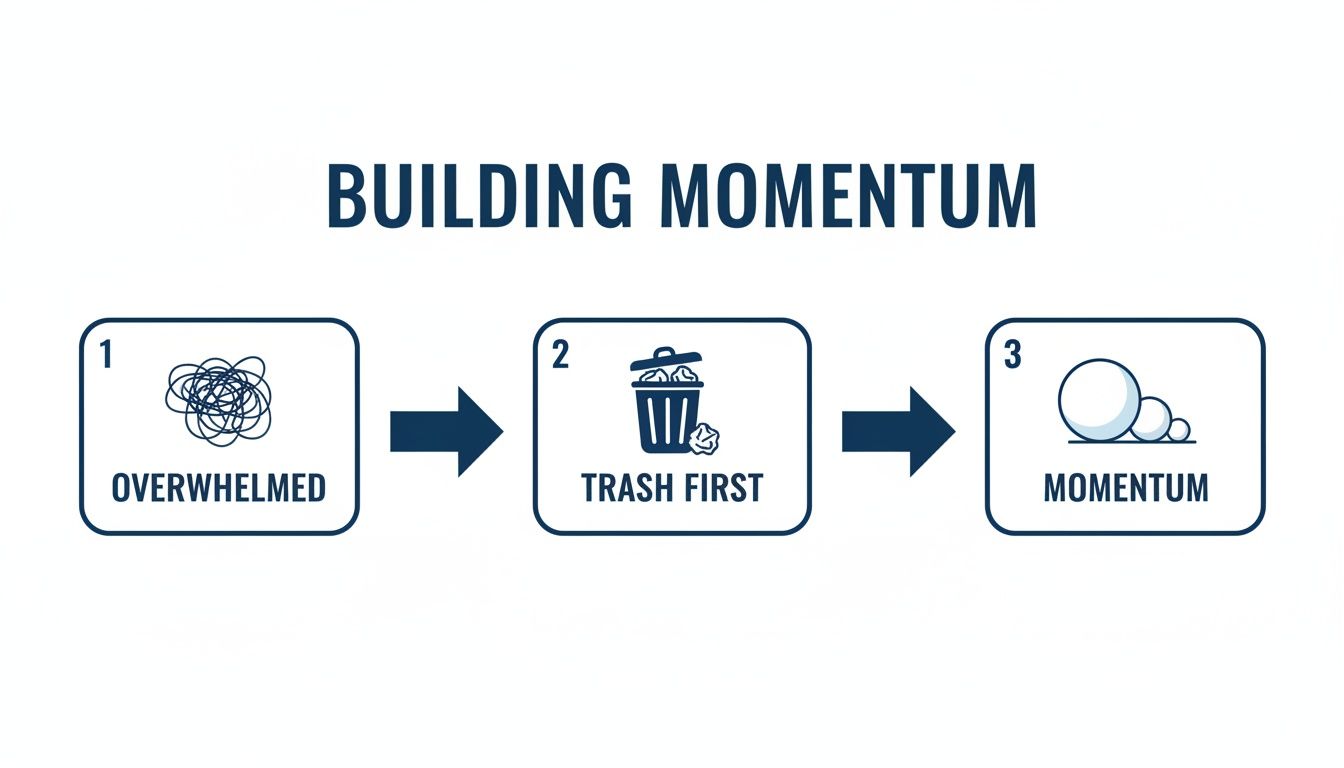
As you can see, just starting with the trash is the catalyst. It creates the momentum you need to make real, lasting progress.
Mission 3: The Bedroom Closet (Estimated Time: 1-3 Hours)
You’ve got a couple of solid wins under your belt. Now it’s time to face a more personal, and often more challenging, space: the closet. The decisions get a little tougher in here, but you’ve been warming up for this. The trick is to be brutally honest with yourself about the life you live today, not the one you fantasize about having “someday.”
If the whole closet feels like too much, break it down. You don’t have to do it all at once. Start with just your shoes. Next time, tackle your shirts. Small, focused bursts are just as effective.
Your ‘Trash First’ Closet Checklist:
- Damaged Items: Anything stained, ripped, or broken beyond a reasonable repair.
- Single Socks & Worn-Out Undergarments: This is the easiest stuff to part with. Don’t overthink it.
- Dry Cleaning Bags & Wire Hangers: These just create visual noise and take up space.
- Old Shopping Bags & Shoe Boxes: Unless you’re actively using them for organized storage, they’re just clutter.
With the trash out of the way, grab your four boxes and start sorting. For every single piece of clothing, ask yourself these questions:
- Does it fit me right now? Not after I lose ten pounds. Today.
- Have I worn it in the last year? If not, what’s the real reason why?
- Is it comfortable, and does it make me feel good? Life’s too short for clothes that make you feel bad.
- If I saw this in a store today, would I buy it again?
When you get stuck on an item, the DeclutterNow app can be a huge help. Snap a quick photo to get an objective look or to see what other people have done with similar pieces. You can even check out our gallery of user transformations for a serious dose of motivation. Sometimes, that little external nudge is exactly what you need to break through a tough decision and keep things moving.
Using AI to Break Through Decision Fatigue
Even the most organized, room-by-room plan has a weak spot. It’s that moment you get stuck. You’re holding up some forgotten gift, a dusty old gadget, or that jacket you swear you’ll wear again (but haven’t in five years), and your brain just… stops.
That’s decision fatigue, and it’s the number one killer of decluttering projects. It’s why that “weekend project” is still sitting in boxes six months later.
But what if you had a friendly coach in your pocket, ready to give you a gentle nudge without any judgment? This is where AI breaks through decision fatigue. An app like DeClutter Now isn’t just a fancy checklist. It’s a tool built specifically to break that mental paralysis that keeps you from making real progress.
The idea is surprisingly simple: let technology do the initial heavy lifting. Instead of spiraling into a vortex of “what ifs” and “should I’s,” you do one simple thing. You take a picture. That’s it. This tiny action breaks the cycle of indecision and passes the first part of the problem to an unbiased assistant.
How a Single Photo Unlocks Progress
The moment you snap a photo with the DeClutter Now app, its AI gets to work. It doesn’t just see a random object; it identifies exactly what you’re holding. Is it a vintage Polaroid camera? A designer handbag? A set of ceramic bowls from the 80s?
The app recognizes the item and instantly gives you objective information you can’t always see when you’re emotionally attached or just plain tired. It provides that crucial outside perspective. It might flag a potential resale value, find a local charity that desperately needs that specific item, or just categorize it, helping you see it for what it is—not what you feel it represents.
This isn’t about replacing your decision; it’s about arming you with the right information to make it. The AI provides the data and suggestions, turning a tough choice into a simple, informed one.
Instead of staring at something and feeling that familiar wave of overwhelm, you suddenly have clear, actionable paths. The vague, stressful question, “What on earth do I do with this?” becomes a simple choice between a few good options.
Gamification: Turning a Chore Into a Challenge
Let’s be honest, decluttering can be a grind. One of the best ways I’ve found to fight through the slog is to make it feel less like work and more like a game. Our brains are wired to love positive feedback, and that’s where gamification is a game-changer.
Great decluttering apps build these psychological tricks right in to keep you moving forward:
- Points and Streaks: You earn points for every item you process. Make decisions a few days in a row, and you build a “streak.” It sounds silly, but these small wins create a powerful feedback loop, giving you those little dopamine hits that make you want to tackle just one more thing.
- Visual Progress Tracking: Seeing your progress in a tangible way—like a progress bar filling up or a before-and-after photo slider—is a huge motivator. It’s solid proof that your hard work is paying off, especially on days when it feels like you’re not making a dent.
- Levels and Achievements: Earning a badge for clearing your first room or donating 50 items creates a real sense of accomplishment. It turns a marathon project into a series of achievable sprints.
This whole approach basically hacks your brain’s reward system. It reframes a draining task into a series of small, satisfying wins, making it so much easier to build and keep the momentum you need to finish the job.
Your AI Assistant for Selling Clutter
So you’ve decided to sell something. Great! But now you have to take good photos, write a catchy description, figure out a fair price… suddenly it feels like a whole new project. This is another spot where the friction can bring everything to a halt.
This is where an AI-powered selling assistant, like the one built into DeClutter Now for eBay, is incredibly helpful. It automates the most tedious parts of the selling process.
You just snap a few photos of the item. From there, the AI can generate an optimized title, write a compelling description highlighting the best features, and even suggest a competitive price based on what similar items are actually selling for right now.
What used to take me 20 minutes of research and writing now takes about two. It completely removes a major barrier and helps you turn your unwanted stuff into cash with almost no effort. That “Sell” box is suddenly looking a lot less intimidating and a lot more profitable.
What to Do with Everything You’ve Decided to Let Go

You’ve done the hard part. You’ve sorted through your stuff, and now you have piles—or boxes—labeled Trash, Donate/Sell, and Relocate. This is where so many people get stuck. Those carefully sorted boxes can sit for weeks, slowly becoming part of the landscape again.
Let’s make sure that doesn’t happen. Here’s how you get everything out of your home for good, crossing the real finish line.
Processing the Trash Box
This one should be quick and satisfying. Don’t overthink it. If you already decided it was trash, trust your past self and get it out.
The goal is momentum. Gather all the bags and haul them out to your garage or outdoor bins immediately. For anything bulky or potentially hazardous—like old paint cans or dead electronics—a quick search for your local waste management rules will tell you how to dispose of them responsibly. The feeling of seeing all that stuff gone is a huge motivator.
Smart Strategies for Donating and Selling
The Donate/Sell box is full of potential, both for cash and for a good cause. But it can also become a massive roadblock if you’re not realistic about your time and energy.
Here’s the most important rule for this step: Don’t let the hope of making a few bucks stop your progress. It is so much better to donate something and have it gone today than to let it collect dust for six months while you wait for the perfect buyer.
Before you decide what to do with an item, ask yourself a few quick questions:
- Is there real demand for this? Think popular electronics, brand-name clothes, or niche collectibles.
- Is it worth more than $20-$30? Honestly, if it’s less, the time you’ll sink into listing, packing, and shipping just isn’t worth it.
- Do I actually have the energy to sell this right now? If the answer is no, that’s perfectly okay. Donating is a fantastic, guilt-free alternative.
For the items that are worth selling, a tool like the DeClutter Now app can do the heavy lifting. Our built-in eBay selling assistant helps you whip up a great listing in minutes, taking the guesswork out of pricing and writing a good description. You can check out our simple guide to selling to get started.
Where to Donate for Maximum Impact
For everything else, donating is a wonderful way to give your old things a new life. To make it painless, I always recommend keeping a running list of local spots and what they accept.
- Goodwill/Salvation Army: Your go-to for clothing, housewares, and furniture that’s still in good shape.
- Local Shelters: Often looking for professional clothing for job interviews, toiletries, and kids’ items.
- Animal Shelters: Always grateful for old towels, blankets, and cleaning supplies.
- Libraries: Many accept book donations for their collections or to sell at their annual fundraisers.
The trick is to schedule a pickup or plan a specific day for a drop-off. Get it all out in one trip.
Finding a Home for the Relocate Box
This is the final piece of the puzzle. The Relocate box contains all the keepers that were just in the wrong place. Your mission now is to give every single one of them a permanent, logical home.
This step is what prevents the clutter from coming right back. When things have a designated spot, they’re far less likely to end up on the kitchen counter. Group similar items together and put them where you would naturally look for them first. It’s a simple change in habit that makes a world of difference.
This push for organized, functional spaces isn’t just a fleeting trend. The global home organization market has ballooned to over $13 billion, driven by our collective desire to make our homes feel more livable. By giving every item a home, you’re not just tidying up; you’re actively designing a calmer, more efficient life.
Your Decluttering Questions, Answered
Even with the best plan in hand, you’re going to hit some roadblocks. It’s just part of the process. Let’s walk through some of the most common questions and sticking points I see people run into, so you can keep your momentum going when things get tough.
How Long Will It Actually Take to Declutter My Whole House?
Look, there’s no magic number here. Trying to set one big, dramatic deadline for the entire house is usually just a setup for feeling overwhelmed and giving up. How long it takes really depends on the size of your space, how much stuff you’re dealing with, and how much time and energy you can realistically give to it.
Forget the finish line. Focus on consistency. A few dedicated 15-30 minute sessions every week will get you so much further than one massive, burnout-inducing weekend. Your bathroom might be a single session, but the garage? That could be a project you chip away at over a few weekends. It’s the small, steady efforts that build momentum and lead to real, lasting change.
What Do I Do About Sentimental Items? I Can’t Seem to Let Go.
This is the hard part, isn’t it? Sentimental items are tough because the connection is all emotion, no logic. That’s precisely why you should never start with them. You need to build up your “decision-making muscle” first. Get some wins under your belt in easier places like the kitchen pantry or the linen closet before you tackle the box of old photos.
When you’re finally ready, set some firm boundaries for yourself. Maybe you decide to keep just one memory box, not five. For those items that really pull at your heartstrings, try taking a beautiful photo. Often, what we truly want to hold onto is the memory, not the physical thing taking up space. Ask yourself: does keeping this actually honor the memory, or is it just adding to my stress?
It’s okay to let go of the object while holding onto the memory. Giving yourself this permission is a crucial step in making progress with sentimental clutter.
I Have ADHD, and Just Starting Feels Impossible. How Can This Help?
If you have ADHD, that feeling of “clutter paralysis” is all too real. This entire approach was designed with that in mind. The “Trash First” rule, in particular, is about lowering the barrier to entry so you can just start.
Deciding “is this literal garbage?” takes almost zero mental energy. Bagging it up gives you a quick, easy win. That little victory delivers an immediate dopamine hit, which is a powerful motivator to keep going, especially for a brain that might be running low on it. It’s a simple, psychology-backed trick to turn that feeling of being completely overwhelmed into concrete action.
And if you’ve decided to sell something, the whole process of creating a listing can be another major hurdle. To make it painless, we put together a guide on how to make selling on eBay fast and easy. It’s all about removing the friction so you can get things out of your house and get paid without getting bogged down.
Ready to turn clutter paralysis into progress? DeClutter Now is designed to cut through decision fatigue with smart tools that build momentum from the very first photo you snap.
Article created using Outrank